Grounded is the story of how two people react when cyberattacks lame the world. It’s also the tale of a father’s love for his son, a woman’s search to feel alive again, and what the Arctic Circle and a temple in a remote corner of India reveal.
I wrote the first draft in 2002, worked on it for over a year, and put it aside for a decade. I returned to the manuscript last year and reworked and rewrote. This book has had a very long gestation period, and I believe it was worth the wait. Please read it and let me know if you agree.
When Kim had told her friends back home about the tour, everyone was excited. “Wow! India! You’ll have incredible adventures! It has the most powerful spiritual energy. They say you go to India and come back changed.”
She’d responded with vague remarks; Kim was a reluctant pilgrim. She didn’t trust people who talked about India as a portal to enlightenment.
But Goa was too Western for her tastes after all. After ten days on the beach, she hungered for the real India… whatever that was. She wouldn’t experience more than a small chunk of the subcontinent. What did she expect, beach parties or yoga in ashrams? Goat curry, or moguls and the Taj Mahal? Ayurveda medicine, or Kashmir shawls? Nonviolent resistance, or gang rape and murder on a public bus? Castes and slums and hovels, or India’s headlong advances as a BRIC nation?
There was surely more than the mutilated saint of Goa’s Catholicism. “There are as many religions as there are people on the planet,” Gandhi had said. India was Hindu and as easily Muslim and Buddhist and Zoroastrian and Christian and Jain and Sikh and Baha’i and….
And, Kim reminded herself, India’s a mirror. Travelers who expect poverty and squalor find both in spades. Visitors seeking enlightenment find that, too. What am I here for? If I stay open minded, what’ll I find? She chewed the tip of her pen.Goa was Portuguese, she considered writing, and gorgeous ocean views, the rave scene and meals eaten in beach shacks. Every sentence sounded like factoids from a travelogue.
I always feel a little strange when I recognize it’s time to mark milestones and I have several to announce.
This is my 99th blog post.
I’ve posted in these virtual pages twice a month since I began way back in September of 2012. It all started with my husband’s suggestion that I establish an Internet presence….
My published books are fiction, and this blog serves as a good place to present excerpts. Potential readers of my books might want a sample of my writing and a glimpse of the human being behind the words. It’s also a place for non-fiction essays. I get to explore ideas and topics that don’t need to be transformed for novels. Posting every other week is great writerly discipline. I’ve never missed a bi-monthly posting date!
…. and this all began simply as a way to introduce my two novels Tsunami Cowboys and Broken In: A Novel in Stories. Both are available at amazon.com in book and eBook form.
It’s been a fun journey these last three years! Thanks to all of you for visiting these pages. I wish everyone the happiest of holidays. I’ll be back in the new year with an announcement. Milestone #2 is on the way!!!
The Germans have a wry saying. “We sent for guest workers, but Menschen came instead.” Meaning that after WWII, the work force of foreigners who came to Germany turned out to be fellow human beings.
I find myself thinking about that saying. The flow of refugees heading this way is huge and overwhelming, and in some ways I am afraid. I love the security and safety of life here, how clean it is. I’m proud to live in a land with universal health care and great mass transit, wonderful street cafés, and (most important of all) the guarantee of personal freedoms and a firm commitment to human rights.
What does this have to do with the hordes of refugees flooding the country? I’m not sure. Maybe nothing at all. But I hear from some of my friends, “What if Europe becomes Muslim? What if the streets are filled next with women in full burkas? What if we lose our freedoms as Germans bend over backwards to accommodate the newcomers?”
They’re nameless, faceless. They’re the others, the ones who constitute a vague but ever-growing threat.
One of my great bonds with the man I married is our desire to explore the world together. We’ve taken vacations in moderate Muslim lands. Every trip was wonderful, filled with people with dreams and hopes like yours and mine. I have a serious disconnect when I try to reconcile the horror of ISIS with the kindness of the friendly people we met in Egypt… Indonesia… Tunisia… Malaysia… Turkey… Singapore. The answer, of course, is they can’t be reconciled. The two have nothing to do with each other.
I’m terrified of the fanaticism that just killed more than 100 people in Paris. The refugees are terrified, too. The people fleeing to Europe want the same things we do: a civilized place to work, live, and raise their children. A stream of humanity is arriving. People with dreams and hopes, like yours and mine.
Each time I go to massage the refugee M. [1], I’m confronted with my own fear of the unknown foreign.
We have no languages in common. I’m not only working without any knowledge of her history; we can’t even talk. One of her children remains in the room the entire time to translate into German for her.
These are the hardest sessions I’ve ever attempted.
As a therapist my hands know their work; I’m capable to treat her PTSD symptoms. But the person-to-person connection…. I have to do this solely through touch. The afternoons of therapy have changed my understanding of the human dimension. It’s become more complicated, and much simpler. It’s changed me as well.
NOTES: [1] To respect the privacy of the persons involved I have changed the names and use initials only.
I go one afternoon a week to where refugees are housed and provide therapy for a woman I will call M. [1]
When I decided to take the plunge and volunteer, I had no idea what that would look like or what I’d be doing. For the last thirty years I’ve worked as a massage therapist. I’ve treated people across the health spectrum: Pregnant. Disabled. Patients during chemo and radiation therapy. Triathletes to couch potatoes. People seeking relaxation, to a man in need of pain relief years after a helicopter crash. My abilities as a therapist deepen with each person I attempt to help.
I’m licensed in both Europe and America. I kept my US credentials current by doing periodic workshops. I did this for decades, until the weekend seminars felt like I was reinventing the wheel.
I briefly considered doing massage with the aged after we put my mother-in-law in a nursing home near us. But my grief as I accompany Mama in the twilight of her life makes it too personal. When I learned a refugee needed massage, it seemed like the perfect way to stretch myself as a therapist and as a human being.
M. and her family fled from an earlier war zone; they’ve been in my village for over a year. M. is severely traumatized. She existed in a catatonic state for many months. Loud or sudden noises trigger panic attacks and migraines and a voice moaning in her head. Her entire body is a field of pain. Most movement is agony.
Within minutes of beginning our initial massage, M. began sobbing. She cries through every single session. It’s ‘just’ nerves.
No one in her family will tell me her story. I have bits and pieces, cobbled together from talking with her doctor and the volunteer organization. She discovered a dead body. Was it suicide, or murder? Was it a family member? She was raped more than once. Twice, ten times, one hundred? One man or many? Someone known to her? Looters? Soldiers?
Like I say: I have bits and pieces.
I first met the German liaison when she took me to the refugees. She gave me the barest of details, less than five minutes before I met M. I’d be working right away, without any volunteer training or medical protocols in place. For me the single most important question was: Who had requested the massage therapy?
It was M.
NOTES: [1] To respect the privacy of those involved I have changed names and identifying details, and use initials only. Part 4 to follow.
When dangerous months on foot or voyages in unstable boats are your only options, things are bad indeed. Refugees may be met at borders by hostile police or herded in subhuman conditions. Criminal bands now make more money from human trafficking than drugs. Millions are making the exhausting trek, often cheated and robbed.
Chancellor Angela Merkel has declared Germany will take in refugees, particularly those fleeing Syria. This doesn’t begin to meet the challenge of how to integrate all these newcomers. The scramble is on to figure out how to register, and house, and provide for over one million asylum seekers, all arriving at the same time.
My community will receive 300 refugees. Every empty building is being assessed for use as temporary or permanent housing. I live in a 1,200-year-old village – with fewer than 20,000 inhabitants. Strangers definitely stand out.
I began asking myself questions. What does it mean when an outside crisis brushes up against the everyday? Can I help? If yes, am I prepared for what that entails?
I called the Rathaus (Town Hall). “English is my native language and I’m fluent in German,” I said. “I can translate. We’ve got lots of household goods to donate. I’m a massage therapist: I can offer therapy if someone needs it.”
I was informed that my town has taken in earlier refugees from the former Yugoslavia, Pakistan, and other countries. The town runs a training program for volunteers (how to help the newcomers who suffer from shell shock and/or culture shock, what to expect, etc.). Translating services are in place; the town has more donations for supplies than they can use. But, the offer for medical services… They took my contact information to pass along.
The next morning, I received a phone call from A, the German liaison. [1] “Your offer is like hearing from someone from another planet,” she declared. “For months, a severely traumatized refugee has been requesting massage. How soon can we meet?”
I didn’t know it yet, but there would be no time for the training program.
NOTES: [1] To respect the privacy of all persons involved I have changed the names and use initials only. Part 3 to follow.
I’d been warned: the 5-Star reviews couldn’t last forever. “Be prepared,” people cautioned me. “Trolls are out there and sooner or later one of them will pan a book. It’s going to be ugly.” I don’t check for reviews on Amazon much as I take the long view. Writing a book is a slow process, and building up a list of reviews can take a while. I’ve been pleasantly surprised to receive consistently solid, glowing reviews.
Until now.
I got my first 1-Star review. The German guy says Tsunami Cowboys is the worst book he’d ever read. He didn’t finish it. And, after page 56, HE BURNED IT.
WTF? Really?? In the 21st century, people are still burning books?!?
I went into shock. I was horrified. Shaken. Ashamed, even. In my worst nightmares, I never ever ever imagined someone would actually destroy my words like this. Until now, it was beyond my powers of imagination.
I got out a copy of the book. What could possibly be so offensive? I opened to page 56 and the peak of a chapter in which Coreen, one of the main characters, is trapped in a cult and can’t get out.
Ok…. Maybe the troll was upset by the topic. I sure was; that’s why I wrote about it. If he’d made it to the end of the book he would have learned the following: I’m religious. I believe in God. My heroine’s story continues well past the page where he stopped reading.
If he’d bothered with the author’s Afterword, he’d have learned my personal reasons for even including this thread in my book.
I’m appalled that someone would be so hateful. I questioned everything I am doing as a writer, and worried about the consequences of exercising my voice. Then I remembered: I just went to a high school reunion. It was a fantastic weekend spent seeing wonderful people again. By far one of the most lovely is a woman who was a missionary.
She’s read both my novels. At the reunion, she made a point of telling me that the story of Coreen and the cult disconcerted her, and she had to put Tsunami Cowboys down for a while. It hit a little too close to home. But, she said, she picked it back up a few months later, read it to the end, and liked the story I told very much.
So that reassures me.
Words contain a lot of power, more than we realize. My encounter with the troll really brings that realization home to me, and in the future I will pay closer attention. His other reviews have the same ugly caustic tone, so I’m not alone. I’m not sure if that makes me feel better, or worse.
As my dear writer buddy Nancy Carroll remarked: “You’re now in good company, Jadi. Think of the books that have been burned through the ages.”
Indeed.
Think about them.
NOTES: [1] http://www.ala.org/bbooks/
http://uwm.edu/libraries/exhibits/burnedbooks/
[2] I swear it just came to my notice that this is Banned Books Week: September 27th – October 3rd.
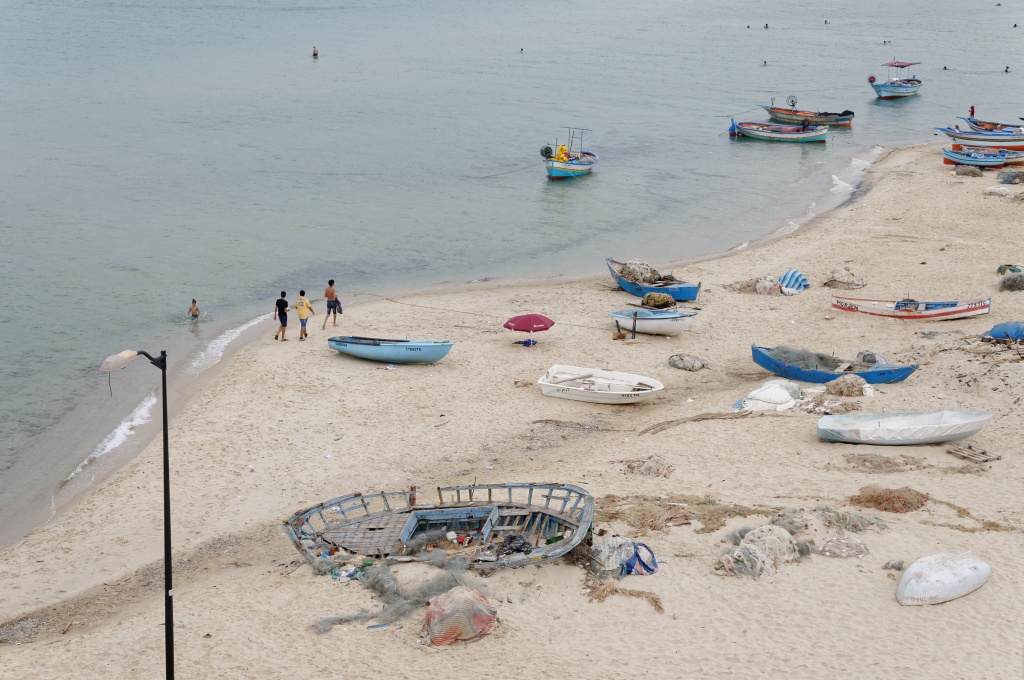
We flew down to Tunisia for a week in September exactly a year ago. I’d planned to write about Hammamet’s lovely laid back tourist vibe, the gorgeous beaches and how much fun it was viewing the Mediterranean from the Africa coast for the first time.
I didn’t want to obsess on the fact that a few weeks later terrorists shot tourists in a museum down the road from the souk we visited. I definitely don’t want to think about the beach where tourists from around the world were murdered in cold blood this summer. It’s less than 30 kilometers (20 miles) from the hotel we stayed in.
Those cowardly acts have nothing to do with what Uwe and I experienced. I took notes as I sat on our sweet balcony, and here is what I wrote:
“The tourists are international. Every body size and shape, every age is represented. We see groups of Italians, French, Egyptians, Algerians, Germans and Brits. Women in black leggings, head scarves, and long sleeved tunics sit by the pool. Two men (young Arab males) hold hands and spring into the pool at a running jump. Kids run and play everywhere I look. Old folks in wheel chairs are pushed by family members.
The French and Italian tourists live up to their reputations with their rule of remaining poolside until 6 p.m. Then they go to change for dinner at 7.
View from our balcony. Taken early evening, when guests had headed to their rooms to change their clothes and think about dinner
Lots of Middle East tourists are traditionally dressed in modest clothing. [1] They swim in the ocean fully dressed! But there are also single Arab women in bikinis, or young couples on holiday.”
I sat and revised Tsunami Cowboys under one of these umbrellas…
“Paragliders are pulled by boats, a yacht and sailboat or two glide by, an endless panorama of ocean spreads from left to right. Without talking about it we head past the pool to go down to the lounge chairs under sun umbrellas on the beach. Uwe reads and I edit the manuscript for my second book Tsunami Cowboys. I’m beyond happy: I’m in an exotic locale with fun stuff to notice all around me and I’m doing good writing work. Each afternoon around 4 I stop and swim in the ocean.”
Our hotel was about twenty minutes from the center of Hammamet.
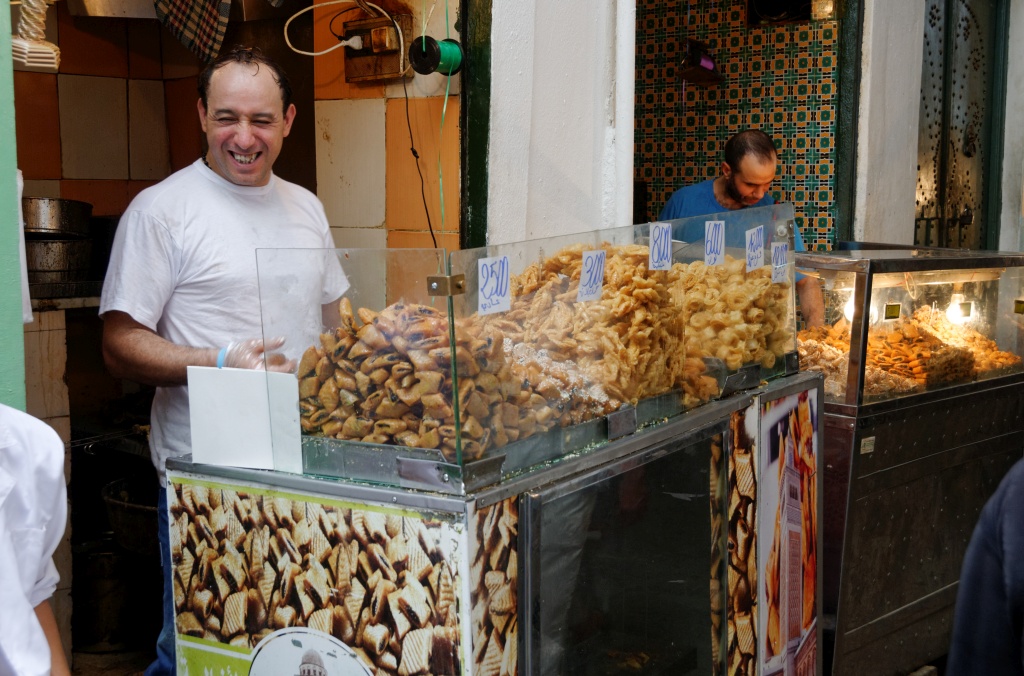
Exploring Hammamet’s souk
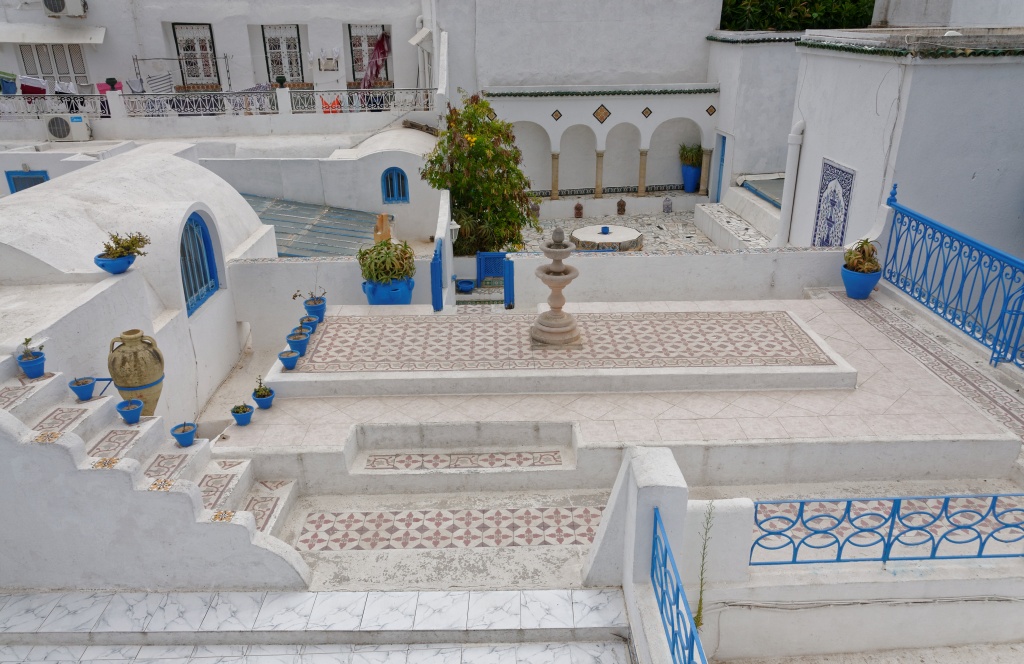
Sometimes we strolled into town for dinner; some nights we had a drink at the hotel and picked one of the restaurants there. We did a couple of tours, to Tunis, Sidi Bou Saïd
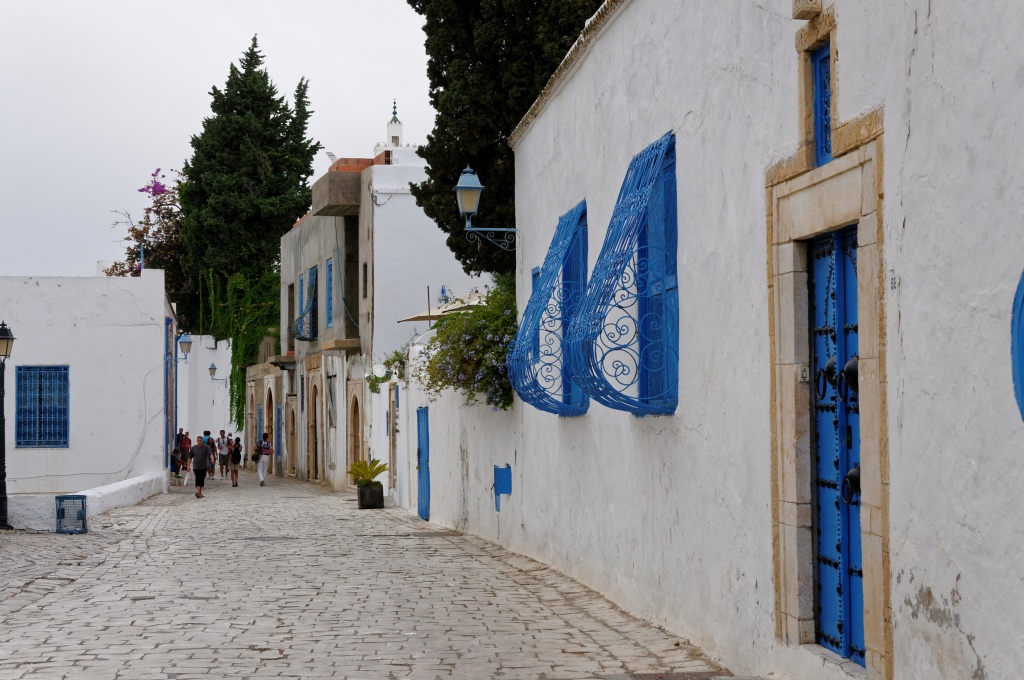
Sidi Bou Saïd is justifiably famous for its vivid blue architecture
Sidi Bou Saïd is popular with artists too
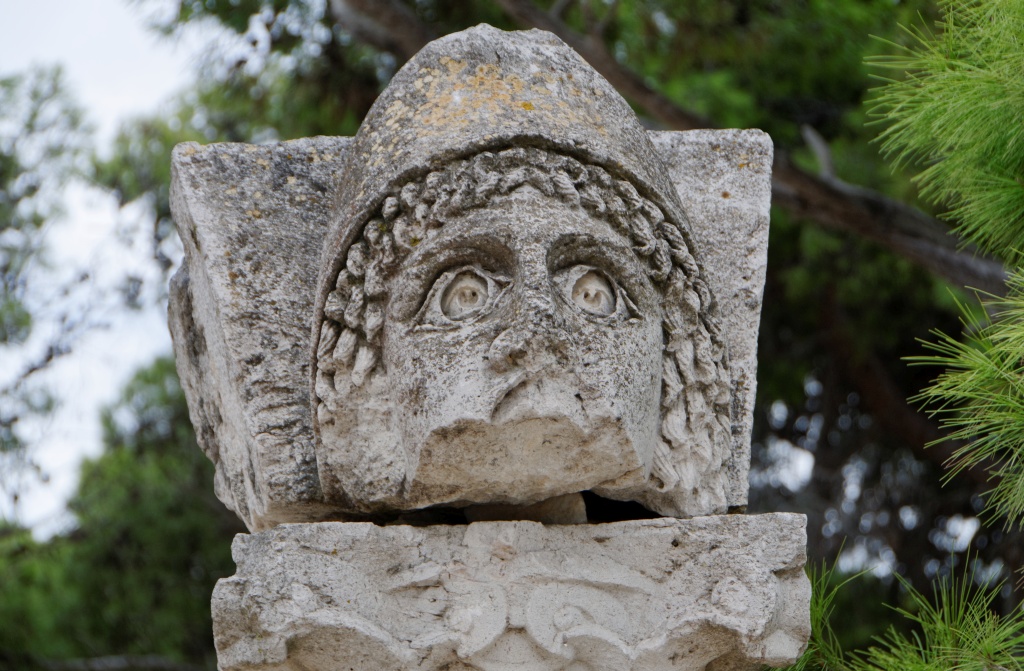
and the ancient city of Carthage. [2]
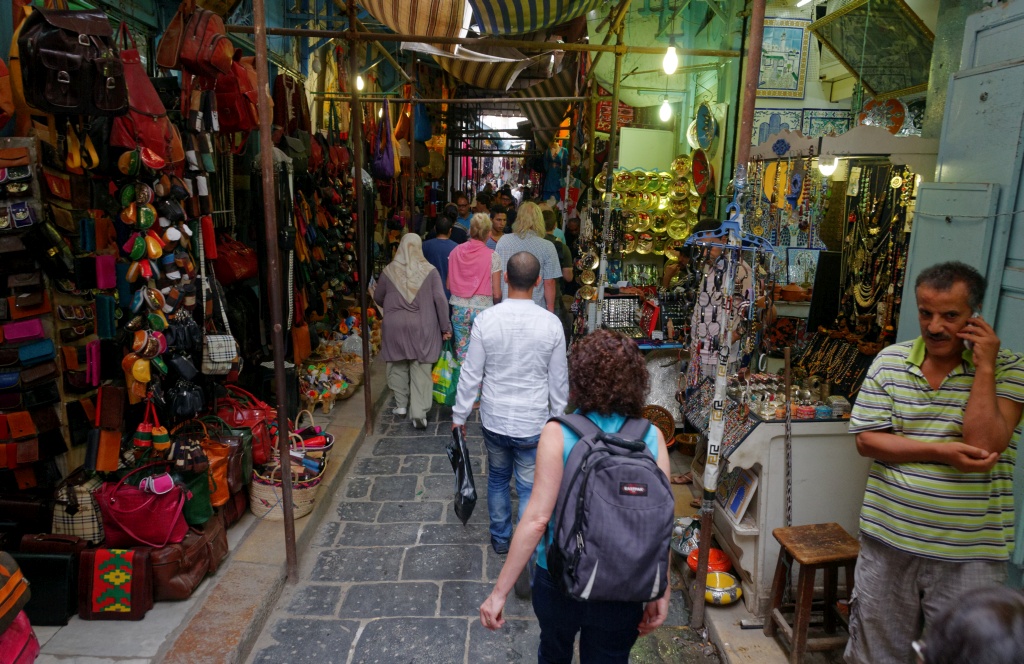
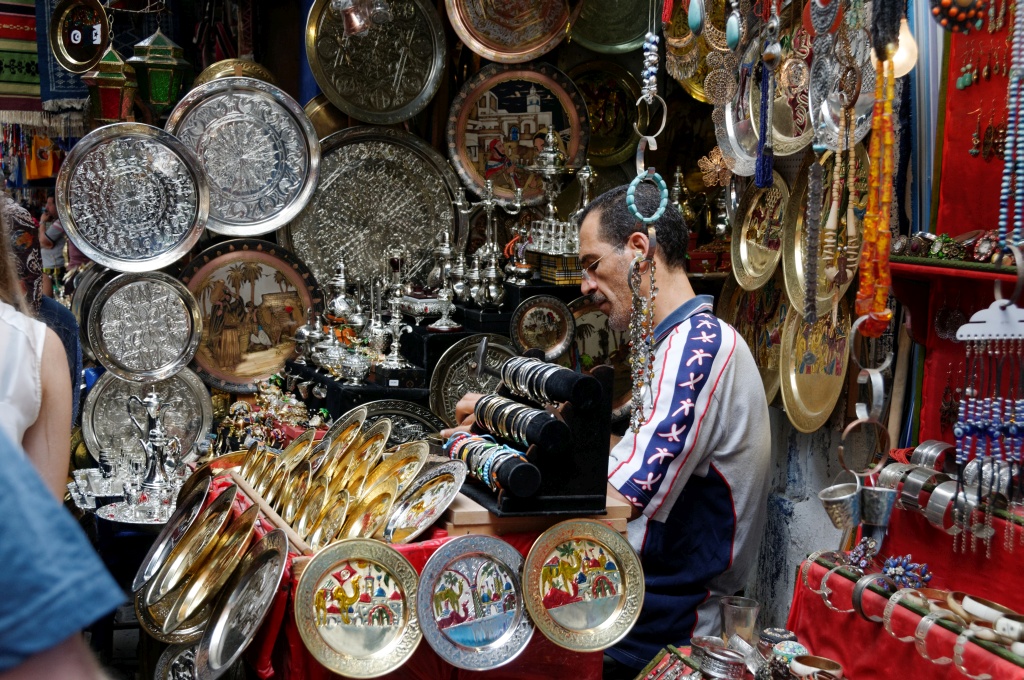
I bargained for sandals at Tunis’ souk [3],
and harissa and couscous spices at an outdoor market.
Touristy? Sure. But here are more of my notes from that week: “Everyone smiles and says hello in the hotel. We’re all here to relax and co-mingle. I have the lovely experience of being welcomed as an American – and when was the last time that’s happened lately – the locals intrigued to learn where I’m from, and even more intrigued to hear that I live in Europe.
I think that’s partly because not many Americans make it to the area, or maybe our hotel books more Europeans and Arabs. Certainly on our charter flight from Germany I’m the only Ami on board! Tunisians are delighted when I assure them that yes, I am enjoying my first visit to their country.”
We learn that Tunisia’s population of 8 million has swelled by an additional 2 million people displaced by wars. Tunisia is a democracy in an unstable part of the world. The Tunisians on the coast are hospitable, curious, worldly. And I want to go back.
I want Tunisia without terrorism.
NOTES: [1] A sign by the pool read “Clothes clog the drains! Bathing suits only, please!”
[2] Carthage made the fatal mistake of challenging Rome. The Romans burned it to the ground, killed all the men and sold the women and children into slavery. Then, to make sure everyone got the message that it was a really bad idea to go against Rome, they sowed the area with salt so that nothing would ever grow again….
[3] The shopkeeper held a lighter to the bottom to prove that they were made of camel and not plastic.
She placed her unbandaged left hand over his on the table top. “Don’t think I’m only a cynic. If I lost my faith in nations, I find huge bravery and kindness in individuals. I kept my faith – and how can that be, after what religion did to my country? But I did. I believe in God. You saved my life so I am saved again. It’s more than a woman could hope for.” She squeezed his hand. “How long do you stay in Stuttgart?”
For the first time his regret about leaving had to do with a person and not with his phobia. “I should take a train tomorrow. Actually, I’m scared to fly,” Guy admitted. “I was in a forced landing once. I’m afraid of being in another.”
“Why fear a statistic chance? Why worry about an abstraction?” Nadia’s shoulders rose and fell in the Eastern European’s shrug, a slow, weary movement that expressed the futility of every question. “Think about the poor people who are in tsunamis. Or a war zone, where real fear is to think, how do you keep walking on the street as a rocket hits somewhere near, or you hear thwack!, and the person in front of you falls down? First you think, this time it isn’t me. It took years for me to stop looking over my shoulder. Stuttgart is civilized, but even here I stumble over Stolpersteine.”
“Over what?”
“Stolpersteine.”
Guy shook his head. “Never heard of it.”
“Them. Come, I will show you. There are some up around the corner.” Nadia refused to explain further.
She insisted on paying the bill and tucked her arm in his as the two of them headed up the Königstrasse. She led him to a stop in front of a store. “What do you see?”
Guy saw Europeans out Christmas shopping, happy people laughing and drinking glühwein, store windows filled with beautifully displayed consumer goods. Was it something special about the storefront? He shifted his weight and his heel came down on an uneven spot in the cement. When he glanced down, Guy saw gold cubes embedded in the sidewalk. He squatted to get a better look. Königstrasse 60, a stone with the name of Clothilde Mannheimer, another beside it for Jakob Mannheimer.
Nadia crouched down next to him. “The Mannheimers lived in this building. They were moved by train to Theresienstadt and died in the concentration camp there,” she translated. “These are their Stolpersteine, their stumbling stones. Wherever we go, we stumble over reminders of the past. The stones make sure we don’t forget the dead, these make sure that people today can’t push the dead from our memories.”
Guy traced the imprint of the names. The little golden cubes were weightier than their size. “Are there more?”
“All over Germany. Other countries, too. The Stolpersteine groups wish to mark the last free place where the persons lived, not where they were sent. Sometimes a family asks for a stumbling block; sometimes a local group did research for victims. And Stolpersteine are for everyone. Especially the Jews, but also the Behinderte, the ones with handicaps,” she corrected herself, “the mentally slow or physically handicapped. And gypsies, Communists. All were killed or did have to leave.”
“Knowing all this it wasn’t hard for you to become a German citizen?”
She gave another slow Eastern European shrug. “I gave up my old passport a decade ago. It was less hard than I expected. My home country is one in the heart.”
A newly laid Stolperstein
– from my chapter “What A Guy” in Tsunami Cowboys. Available online at amazon.com. This link will get you there. I will post more on this extraordinary street art project shortly.
I just spent a few weeks visiting my sister and her family in Hong Kong. I was there in May, ahead of the rainy season. It’s already hot and humid, only a hint of the weather to come….
It can’t be a coincidence that this time of year is also the birthday of Tin Hau. [1, 2]
She’s the Goddess of the Seas, patron saint of sailors and fishermen throughout China and Southeast Asia. Her festival is always held on the twenty-third day of the third lunar month of the lunar calendar. This year her birthday fell on May 11th. My friend Weiyu flew over from Beijing, and we had the good luck to see a dragon parade. [3]
Lin Moniang (don’t forget that Chinese put the family name first) was born during the Song Dynasty on Meizhou Island in Fujian, China. Her dates are 23 March 960 – 4 October 987. She was the seventh daughter, an excellent swimmer, and wore a red dress. No matter how bad the weather was, Lin Moniang stood on the shore in that red dress in order to guide the fishing boats back home.
Wikipedia’s description of her legend is so good that I’ll repeat it verbatim here: “Lin Moniang’s father and brothers were fishermen. One day, a terrible typhoon arose while they were out at sea, and the rest of her family feared that those at sea had perished. In the midst of this storm, depending on the version of the legend, she fell into a trance while praying for the lives of her father and brothers or dreamed of her father and brothers while she was sleeping or sitting at a loom weaving. In both versions of the story, her father and brother were drowning but Moniang’s mother discovered her sleeping and tried to wake her. This diverted Moniang’s attention and caused her to drop her brother who drowned as a result. Consequently, Moniang’s father returned alive and told the other villagers that a miracle had happened.” [4]
She was deified shortly after her death. There are many reports of miraculous sightings of Tin Hau by sailors in distress. Chinese who immigrated often built temples once they arrived overseas to thank her for the safe journey. Each year a major festival is held on her birthday.
One of the most spectacular is in Yuen Long in the New Territories. Weiyu and I headed out early to reach the town (an easy trip on the MTR, the wonderful regional transportation system). We left the metro station and immediately saw bright colors and a crowd of people. As we got closer, firecrackers began to go off! We’d arrived right on time!
The firecrackers exploded and confetti fell out and rained down!
This village had just begun to parade their dragon. They circled the lot a few times accompanied by a loud drum and cymbals. There was another loud bang, more firecrackers popped, and everyone followed the dragon as it headed into town.
We arrived at another square where more dragons waited.
They took turns weaving up and down the main street, curling and snaking, rising and falling in an intricate dance. Sometimes two dragons danced at the same time.
People’s shirts indicated which village and dragon they were with. There were groups of old women waving fans, and children in costume, and lions.
Can you see the dragon on the side in green?
Flags and banners waved around the Fa Paus, ornate towers with paper flowers. Huge elaborate placards wished for luck and prosperity.
One village group’s Fa Pau
Offerings included entire roasted pigs.
I recognized those instantly from the worship of Bà Chúa Xứ in southern Viet Nam. It can’t be a coincidence that her festival starts at the beginning of the rainy season on the twenty-third day of a lunar month too…
NOTES: [1] Tianhou (天后) literally means “Empress of Heaven”. [2] She’s also known as Mazu, Tian Fei or A-Ma. The Buddhists conflated her into a reincarnation of Guan Yin, Goddess of Compassion. [3] She has over 90 temples in Hong Kong alone. [4] http://en.wikipedia.org/wiki/Mazu
Go to my post The Cult of Bà Chúa Xứ to read about south Viet Nam’s most sacred shrine. More pictures from our trips to Vietnam and China and of Uwe’s photography may be viewed at viewpics.de.
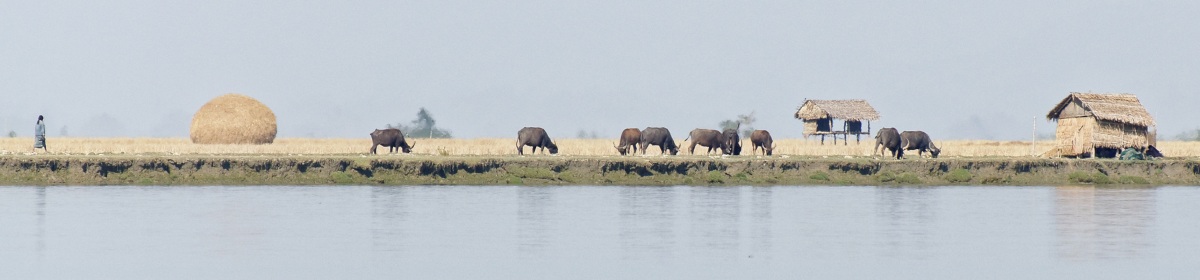

 Goa was Portuguese, she considered writing, and gorgeous ocean views, the rave scene and meals eaten in beach shacks. Every sentence sounded like factoids from a travelogue.