Another installment from my blog thread describing what to call groups of animals … See how many you can guess. Answers listed at the bottom of the page.
The generation generated alarm in the audience.
I was not bowled over by the barrel barreling towards us….
A big congregation congregated on the beach.
The turn turned again towards the sun.
The horde should have hoarded their food.
The fleet fleet ran off.
Answers:
Generation, Snake Farm (Queen Saovabha Memorial Institute), Bangkok Thailand
Generation of vipers [1]
Barrel of monkeys
Congregation of plovers
Turn of turtles [2]
Horde of hamsters
Fleet of mud hens
Barrel, southern ThailandTurn, Wong Tai Sin Medicine Temple, New Territories, China
I’m beyond dismayed – I am furious. The Trump administration is gutting environmental protections. Take action. Speak up! Write letters, make phone calls, donate to organizations like the Environmental Defense Fund and Greenpeace. Volunteer.
I am a Best American Essays-nominated writer. My books are Broken In: A Novel in Stories, Tsunami Cowboys, Grounded, The Trail Back Out, and The Taste of Your Name. Recent awards include Finalist for the 2025 Compass Press Book Award for The Taste of Your Name and Finalist for Greece’s Eyelands 11th International Short Story Contest.
Environmental activist, writer, wilderness traveler, Zen Buddhist student and teacher, Peter Matthiessen was born May 22, 1927 in New York City, New York. He was a CIA officer in his early 20s, one of the few acts of his life that he regretted. He co-founded The Paris Review, one of English language’s most important literary journals. His book Shadow Country won the National Book Award for fiction, and he won again in nonfiction for The Snow Leopard. He remains the only writer to have won in both categories.
A friend gave me The Snow Leopard when it first came out, and I’ve reread it over and over in the decades since then. Matthiessen movingly tells how, after his wife Deborah Love died of cancer, he accompanied the naturalist George Schaller in search of the elusive leopard on the Tibetan Plateau. The book is travelogue, natural world description, and a meditation on life and death.
In his honor I am reprinting a post I wrote after visiting a site with 10,000 Buddhas…. – Jadi
Pam on the path
My sister Pam and her family lived in the New Territories. This part of China is on the mainland north of Hong Kong. While Hong Kong is the most densely and vertically populated city on the planet, the New Territories were still relatively quiet. The landscape consists of steep, lush jungle peaks that end in bays and inlets.
The vertical density of Hong KongThe view from their apartment near Sai Kung
The region is growing, and changing fast. The bus from the apartment passes villages on hillsides or tucked into hamlets and harbors. Floating villages of traditional houseboats are minutes away. And then the high rises suddenly appear, row after row after row.
There are lots more that look just like theseIt’s not far to Man Fat Tsz, the Ten Thousand Buddhas Monastery in Sha Tin. The monastery was founded by the devout layman Venerable Yuexi (the Chinese月溪法師; pinyin: yuè xī). Building began in 1949 as Yuexi and his disciples carried everything up from the foot of the mountain. For eighteen years they constructed the buildings – along with 12,800 Buddha statues.
You head up through a bamboo forest where statues line both sides of the path to the monastery.
There are roughly 500 Arhan [1] statues in plastic, painted gold. Each one is unique.
Their expressions represent the experience of enlightenment. Other statues await once you reach the summit. I felt like I was in a tacky Buddhist Disneyland.
So did you hear the one where the Buddhist monk, the Catholic priest, and the Jewish rabbi enter a temple…
Then I got to the top and entered the main temple. Before the altar is a glass case; it contains Venerable Yuexi’s preserved body! His body (still perfectly intact) was exhumed eight months after his April 24, 1965 death. Yuexi was next embalmed with Chinese lacquer, his head and face covered in gold leaf. [2] The Diamond Indestructible Body of Yuexi’s robed corpse sits in the lotus position. I was oddly moved by his preserved body: with the sight, I had a glimpse of religious truth.
That feeling became surreal as we headed back to the bus stop.
This pagoda appeared on Hong Kong’s $100 banknotes
We climbed down a different set of steps past my least favorite creatures: wild monkeys.
And from the meditative hillside of Ten Thousand Buddhas, we neared and then entered the shopping mall complex at Sha Tin.
Sha Tin shopping mall
As I say, the New Territories has both the traditional and the modern. They all line the same path.
NOTES: [1] To quote Wikipedia, “…in TheravadaBuddhism, an Arhat is a “perfected person” who has attained nirvana. In other Buddhist traditions the term has also been used for people far advanced along the path of Enlightenment.” [2] Taking pictures inside the temple is not allowed.
In memory of Peter Matthiessen, 22 May 1927 – 5 April 2014
My books are Broken In: A Novel in Stories, Tsunami Cowboys, Grounded, and The Trail Back Out.
The Trail Back Out was honored as 2021 IAN Book of the Year Award Short Story Collection Finalist for the Independent Author Network and with a Red Ribbon by the 2021 Wishing Shelf Book Awards of England. In addition, The Trail Back Out was an American Book Fest 2020 Best Book Award Finalist: Fiction Anthologies. The title story The Trail Back Out was longlisted for the 2021 ScreenCraft Cinematic Short Story Award. Broken In: A Novel in Stories was a semifinalist for the international 2020 Hawk Mountain Short Story Collection Award from Hidden River Arts, as well as a Finalist for Greece’s 2021 Eyelands Book Awards. Tsunami Cowboys was longlisted for the 2019 ScreenCraft Cinematic Book Award.
Click here for my author page to learn more about me and purchase my books.
NOTE: The Wonderful Wizard of Oz first appeared in print on 17 May, 1900; the film premiered on 12 August, 1939. Here is one of my very first posts, about author L. Frank Baum, bats, and monkeys…. — Jadi
Both sides of my family hail from the Northeast. We lived for a while in Cazenovia, one of the most beautiful small towns in upstate NY. Caz is just a few miles from Chittenango Falls, and that town was the birthplace of L. Frank Baum, author of The Wizard of Oz.
My sisters and I first saw The Wizard of Oz film on an old black and white television set we called Lucille. Lucille was temperamental (“Dad! Lucille’s on the fritz again!”), but her screen was big.
It was years before I finally saw The Wizard of Oz on a color television. How I gasped when Dorothy opened that door and stepped out into Munchkin Land! But in color or black and white, to this day I don’t much like monkeys.
Balinese Barong
Some years ago my husband and I traveled to Bali. The Balinese fill their temples with statues of the strange half-bird, half-god creature known as Garuda, a lion-like Barong, lots of sinuous snakes, and Hanuman the monkey god. The cultural heart of Bali is Ubud, home to the Monkey Forest which contains the Monkey Temple. I wrapped a sarong around my waist before we entered to show respect, and I know I was curious as to what we’d find.
The temple grounds were filled – no, overrun – with crab-eating macaque (Macaca fascicularis) monkeys. Dozens of them rested on the platforms to the Pura Dalem Agung Padangtegal temple. Many more watched us from up in the canopy of thick jungle trees and vines. But worst of all, a horde of monkeys scampered our way as we drew near. They were used to people and accustomed to visitors who bring them food. We walked slowly, not making any sudden movements, keeping our arms stretched out with our hands opened. I hoped my empty palms signaled: no food here!
Monkey Temple Gang
I breathed a huge sigh of relief when we left the grounds. But I wonder about the sanity (to say nothing of the later health) of tourists who bring bananas and fruit to hand to the macaques. Those critters are feral!
Bali has another disturbing indigenous species: bats.
Bali bats from hell
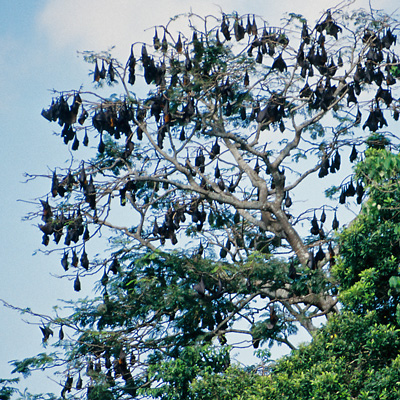
A huge colony of the largest fruit eating bats I have ever seen, all with wingspans of an easy three feet, hung upside down in a very tall tree. I was horrified by their size.
Then they began flying. In the middle of the day. Bright tropical sun highlighted the reddish membranes of their webbed skins. They flew in loops, more and more gigantic bats, circling lower. I began to feel dizzy as a scratchy voice in my head murmured, “I’ll get you, my little pretty …”
Macaques and bats had morphed together into L. Frank Baum’s flying monkeys. Never underestimate the power of imagination in children…or adults. That movie scene still haunts me. Like I said, to this day I don’t much like monkeys.
Here is the 18th (!) installment from my blog thread describing what to call groups of animals … See how many you can guess. Answers listed at the bottom of the page.
This Cambodian army member should have never left the army.
Nigh I saw the nye, they had vanished.
The ambush didn’t ambush anything. [1]
He put the purse in her purse.
The leap leaps down.
The conspiracy conspires to escape.
Answers:
Army deserter captured by member of another army, Angkor Wat, Cambodia
Army of frogs and monkeys
Nye of pheasants (on the ground)
Ambush of tigers
Purse of sand dollars
Leap or leege of leopards
Conspiracy of lemurs
Look closely. Leap member in background, Kanha Tiger Reserve, India
Here is a new installment from my blog thread describing what to call groups of animals … See how many you can guess. Answers listed at the bottom of the page.
The generation generated alarm in the audience.
I was not bowled over by the barrel barreling towards us….
A big congregation congregated on the beach.
The turn turned again towards the sun.
The horde should have hoarded their food.
The fleet fleet ran off.
Answers:
Generation, Snake Farm (Queen Saovabha Memorial Institute), Bangkok Thailand
Generation of vipers [1]
Barrel of monkeys
Congregation of plovers
Turn of turtles [2]
Horde of hamsters
Fleet of mud hens
Barrel, southern ThailandTurn, Wong Tai Sin Medicine Temple, New Territories, China
I always feel a little strange when I recognize it’s time to mark milestones and I have several to announce.
This is my 99th blog post.
I’ve posted in these virtual pages twice a month since I began way back in September of 2012. It all started with my husband’s suggestion that I establish an Internet presence….
My published books are fiction, and this blog serves as a good place to present excerpts. Potential readers of my books might want a sample of my writing and a glimpse of the human being behind the words. It’s also a place for non-fiction essays. I get to explore ideas and topics that don’t need to be transformed for novels. Posting every other week is great writerly discipline. I’ve never missed a bi-monthly posting date!
…. and this all began simply as a way to introduce my two novels Tsunami Cowboys and Broken In: A Novel in Stories. Both are available at amazon.com in book and eBook form.
It’s been a fun journey these last three years! Thanks to all of you for visiting these pages. I wish everyone the happiest of holidays. I’ll be back in the new year with an announcement. Milestone #2 is on the way!!!
My sister Pam is a teacher for international schools. For the last three years she’s been located in the Hong Kong area. It’s a great place to visit: the languages are Cantonese and English, the transportation system is so simple that anyone can feel clever using it, and contrasts between modernity and tradition are everywhere you look.
Pam and her family live in the New Territories. This part of China is on the mainland north of Hong Kong. While Hong Kong is the most densely and vertically populated city on the planet, the New Territories are still relatively quiet. The landscape consists of steep, lush jungle peaks that end in bays and inlets.
The vertical density of Hong KongThe view from their apartment near Sai Kung
The region is growing, and changing fast. On the bus from the apartment we pass villages on hillsides or tucked into hamlets and harbors. Several floating villages of traditional houseboats are minutes away. And then the high rises suddenly appear, row after row after row.
There are lots more that look just like theseSo did you hear the one where the Buddhist monk, the Catholic priest, and the Jewish rabbi enter a temple…
It’s not far to Man Fat Tsz, the Ten Thousand Buddhas Monastery in Sha Tin. It was founded by the devout layman Venerable Yuexi (the Chinese月溪法師; pinyin: yuè xī). Building began in 1949 as Yuexi and his disciples carried everything up from the foot of the mountain. For eighteen years they constructed the buildings – and 12,800 Buddha statues.
You head up through a bamboo forest and statues line both sides of the path to the monastery. There are roughly 500 Arhan [1] statues in plastic, painted gold. Each one is unique.
Their expressions represent the experience of enlightenment. Other statues await once you reach the summit. (Click on any of the thumbnail photos for a closer look.)
I felt like I was in a tacky Buddhist Disneyland until I got to the top and entered the main temple. Before the altar is a glass case, and it contains Venerable Yuexi’s preserved body! His body (still perfectly intact) was exhumed eight months after his April 24, 1965 death. Yuexi was next embalmed with Chinese lacquer, his head and face covered in gold leaf. The Diamond Indestructible Body of Yuexi’s robed corpse sits in the lotus position. I was oddly moved by his preserved body: with the sight, I had a glimpse of religious truth. [2]
That feeling became surreal as we headed back to the bus stop.
This pagoda appeared on Hong Kong’s $100 banknotes
We climbed down a different set of steps past my least favorite creatures: wild monkeys.
And from the meditative hillside of Ten Thousand Buddhas, we neared and then entered the shopping mall complex at Sha Tin.
Sha Tin shopping mall
As I say, the New Territories has both the traditional and the modern. They all line the same path.
NOTES: [1] To quote Wikipedia, “…in TheravadaBuddhism, an Arhat (Sanskrit: अर्हत् arhat; Pali: arahant; “one who is worthy”) is a “perfected person” who has attained nirvana. In other Buddhist traditions the term has also been used for people far advanced along the path of Enlightenment.”
[2] Taking pictures inside the temple is not allowed.