When Kim had told her friends back home about the tour, everyone was excited. “Wow! India! You’ll have incredible adventures! It has the most powerful spiritual energy. They say you go to India and come back changed.”
She’d responded with vague remarks; Kim was a reluctant pilgrim. She didn’t trust people who talked about India as a portal to enlightenment.
But Goa was too Western for her tastes after all. After ten days on the beach, she hungered for the real India… whatever that was. She wouldn’t experience more than a small chunk of the subcontinent. What did she expect, beach parties or yoga in ashrams? Goat curry, or moguls and the Taj Mahal? Ayurveda medicine, or Kashmir shawls? Nonviolent resistance, or gang rape and murder on a public bus? Castes and slums and hovels, or India’s headlong advances as a BRIC nation?
There was surely more than the mutilated saint of Goa’s Catholicism. “There are as many religions as there are people on the planet,” Gandhi had said. India was Hindu and as easily Muslim and Buddhist and Zoroastrian and Christian and Jain and Sikh and Baha’i and….
And, Kim reminded herself, India’s a mirror. Travelers who expect poverty and squalor find both in spades. Visitors seeking enlightenment find that, too. What am I here for? If I stay open minded, what’ll I find? She chewed the tip of her pen.Goa was Portuguese, she considered writing, and gorgeous ocean views, the rave scene and meals eaten in beach shacks. Every sentence sounded like factoids from a travelogue.
We married in Germany and went to Paris for a week. A few months later we threw a party in America. I wanted to show Uwe around the northwest, including a visit to Vancouver. For that part of the trip, the easiest solution would be to rent a car once we got to Canada.
I found a charter bus leaving from Seattle for the right price, leaving at the right hour. When we got to the designated departure spot that morning the others were already waiting to board the bus… all fifty members of the seniors’ tour group.
“Jadi! We’re 40 years younger than anyone else taking this bus,” Uwe whispered.
“Look at the bright side: no crying babies.”
The woman in line behind us tapped my arm. “Excuse me honey, but are you two newlyweds? Are you on your honeymoon?”
I grinned as Uwe began to turn an interesting shade of pink. “We are!” I told her.
“I knew it!” the little senior crowed. She nodded at her friend, totally pleased. “I have a sixth sense for honeymooners. When I meet people I can always tell if they’re newlyweds! What are your names, dear?”
Uwe was hurriedly climbing on the bus away from the conversation.
“Uwe and Jadi Hartmann,” I told her to keep it simple. Our first names are confusing enough without including the information that I’d kept my maiden name.
For a second she looked flustered, but she recovered quickly. “Well, it’s lovely to meet you,” she beamed.
As I boarded the bus and headed down the aisle she was talking with the bus driver. “That young couple that got on the bus ahead of me? They’re on their honeymoon!”
“Gott, Americans ask personal questions,” Uwe chuffed once I’d seated myself next to him.
“They’re friendly. Isn’t it wonderful?” I gave my new husband my sweetest smile.
We settled in for the short trip to Vancouver on a bus filled to capacity with chattering seniors. The bus left promptly, people in their 70s and 80s twittering like happy magpies.
When we reached the highway there was a scratching noise as our driver turned on his microphone. “Welcome on board, on the charter bus for Vancouver, Canada. Our estimated time of arrival is twelve noon. I’m your driver Carl, and I’ll be pointing out sights of interest along the way. But in the meantime, I’ve been informed that we have a pair of newlyweds traveling with us today! Let’s congratulate the new couple! Would Jay – ,“ he faltered suddenly, “Oo – uh, would Mr. and Mrs. Harmon please stand up and take a bow?”
Wild applause.
I was already on my feet. “Stand up!” I encouraged gleefully. Uwe had slumped down in his seat as far as he could get without actually hiding underneath it.
My beet-red husband stood up and sat down in a flash to even louder applause.
As you, dear readers, can surely suspect, any trip that got off to a start like this one had to be good….
I always feel a little strange when I recognize it’s time to mark milestones and I have several to announce.
This is my 99th blog post.
I’ve posted in these virtual pages twice a month since I began way back in September of 2012. It all started with my husband’s suggestion that I establish an Internet presence….
My published books are fiction, and this blog serves as a good place to present excerpts. Potential readers of my books might want a sample of my writing and a glimpse of the human being behind the words. It’s also a place for non-fiction essays. I get to explore ideas and topics that don’t need to be transformed for novels. Posting every other week is great writerly discipline. I’ve never missed a bi-monthly posting date!
…. and this all began simply as a way to introduce my two novels Tsunami Cowboys and Broken In: A Novel in Stories. Both are available at amazon.com in book and eBook form.
It’s been a fun journey these last three years! Thanks to all of you for visiting these pages. I wish everyone the happiest of holidays. I’ll be back in the new year with an announcement. Milestone #2 is on the way!!!
The Germans have a wry saying. “We sent for guest workers, but Menschen came instead.” Meaning that after WWII, the work force of foreigners who came to Germany turned out to be fellow human beings.
I find myself thinking about that saying. The flow of refugees heading this way is huge and overwhelming, and in some ways I am afraid. I love the security and safety of life here, how clean it is. I’m proud to live in a land with universal health care and great mass transit, wonderful street cafés, and (most important of all) the guarantee of personal freedoms and a firm commitment to human rights.
What does this have to do with the hordes of refugees flooding the country? I’m not sure. Maybe nothing at all. But I hear from some of my friends, “What if Europe becomes Muslim? What if the streets are filled next with women in full burkas? What if we lose our freedoms as Germans bend over backwards to accommodate the newcomers?”
They’re nameless, faceless. They’re the others, the ones who constitute a vague but ever-growing threat.
One of my great bonds with the man I married is our desire to explore the world together. We’ve taken vacations in moderate Muslim lands. Every trip was wonderful, filled with people with dreams and hopes like yours and mine. I have a serious disconnect when I try to reconcile the horror of ISIS with the kindness of the friendly people we met in Egypt… Indonesia… Tunisia… Malaysia… Turkey… Singapore. The answer, of course, is they can’t be reconciled. The two have nothing to do with each other.
I’m terrified of the fanaticism that just killed more than 100 people in Paris. The refugees are terrified, too. The people fleeing to Europe want the same things we do: a civilized place to work, live, and raise their children. A stream of humanity is arriving. People with dreams and hopes, like yours and mine.
Each time I go to massage the refugee M. [1], I’m confronted with my own fear of the unknown foreign.
We have no languages in common. I’m not only working without any knowledge of her history; we can’t even talk. One of her children remains in the room the entire time to translate into German for her.
These are the hardest sessions I’ve ever attempted.
As a therapist my hands know their work; I’m capable to treat her PTSD symptoms. But the person-to-person connection…. I have to do this solely through touch. The afternoons of therapy have changed my understanding of the human dimension. It’s become more complicated, and much simpler. It’s changed me as well.
NOTES: [1] To respect the privacy of the persons involved I have changed the names and use initials only.
My father lives on a very cool street. He’s got a little place on a small lake. When I visit, I spend hours watching critters on and in the water.
And then I take a stroll down the road, because Dad has artist neighbors. The Ferros’ artwork decorates the street.
The Ferro home is chock full of art, almost all of it made by Tino and Carole. When Carole kindly gave me and Dad’s partner Judy a tour of the house, I couldn’t stop taking photographs. Every single inch of space contained something interesting and wildly creative.
Carole and Tino. Check out the cicada! The glass lamp! That railing!
The 1920’s home originally belonged to Tino’s parents.
They added on, sourcing materials from old buildings in the area that were being torn down. These ceiling beams came from a church.
They run a gallery, just a few miles away.
Frog Pond Farm Folk Art Gallery North
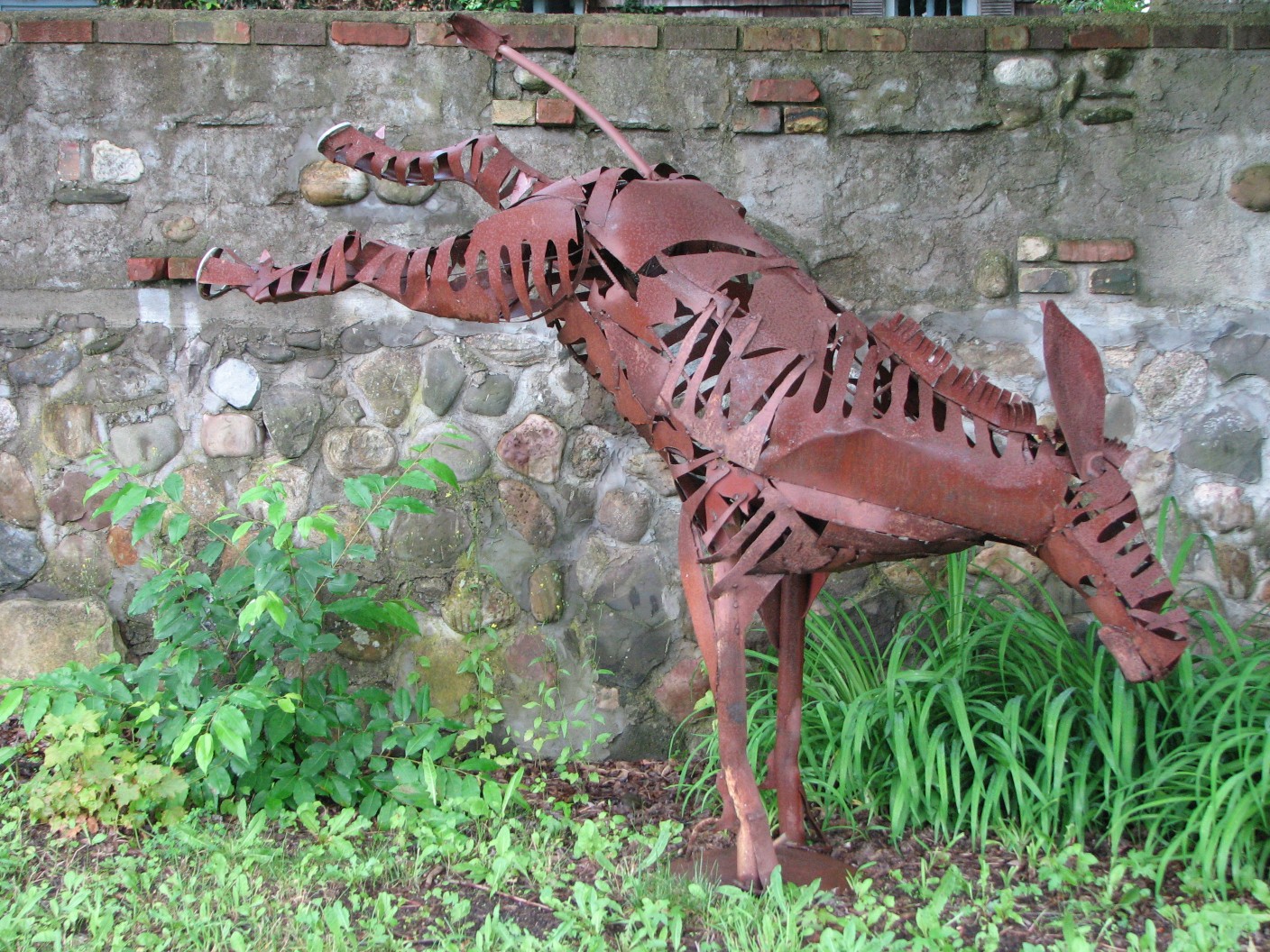
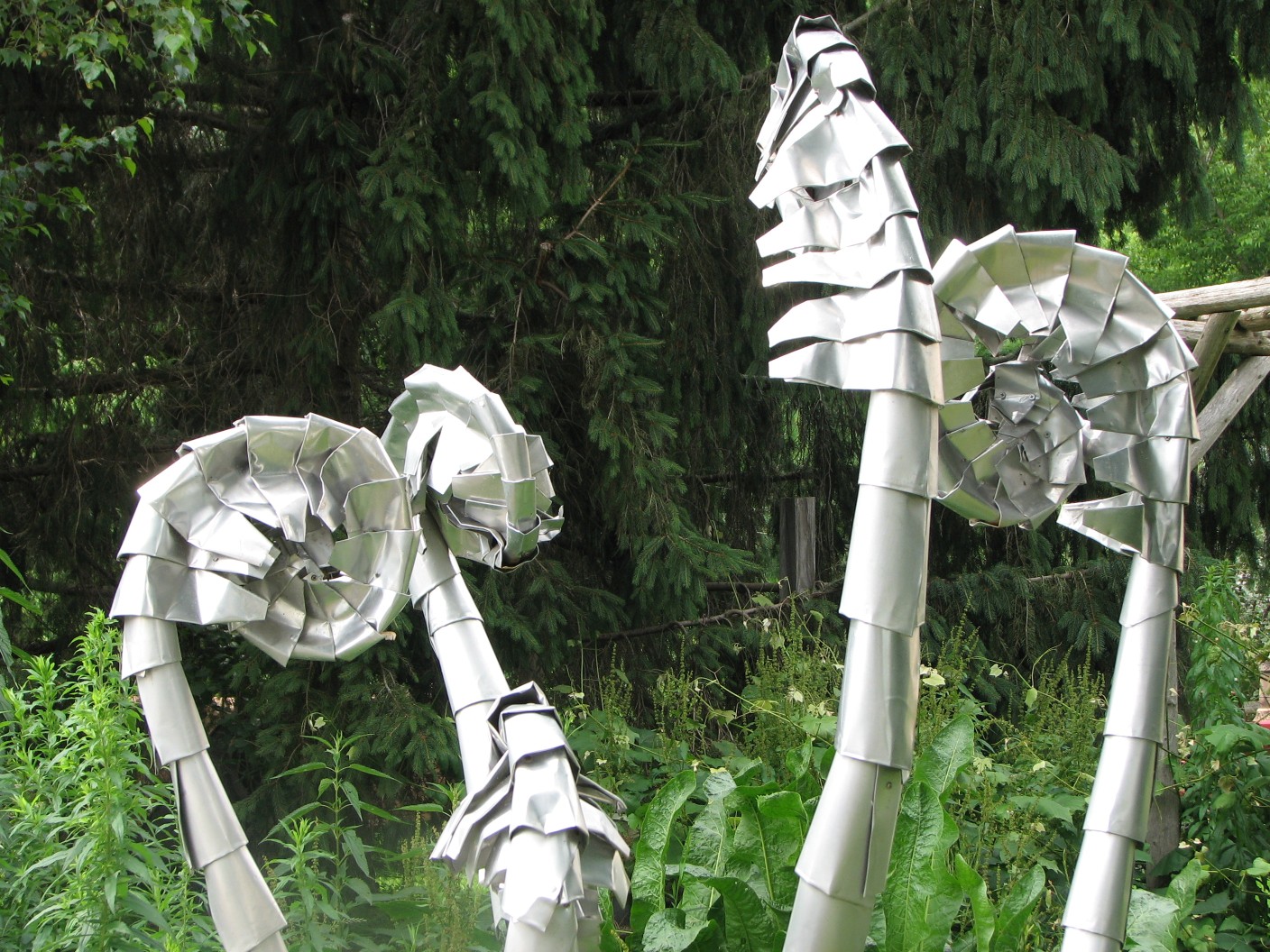
Sculptures adorn the outside lawns; here is only a sample.
Two of the couple’s offspring joined them to create the gallery. Ninety percent of the materials they use are recycled or pre-used. The Ferro family also produces smaller pieces, glass work, and paintings. Click on the thumbnail photos for a closer look.
I loved the female figures made of recycled metal strips from factory punches and stamps.
She crouches over an outdoor fire pit
Tino and Carole worked and raised their family in Portugal from 1988-2008. Tino tells me Europeans still collect their art work.
The Ferros run a second gallery in North Carolina. I can only imagine what’s in that one. But I’m sure those neighbors love having Tino and Carole down the street!
NOTES: [1] For a similar post on sculpture, go to my earlier post Wine and Sculpture. [2] Contact info:
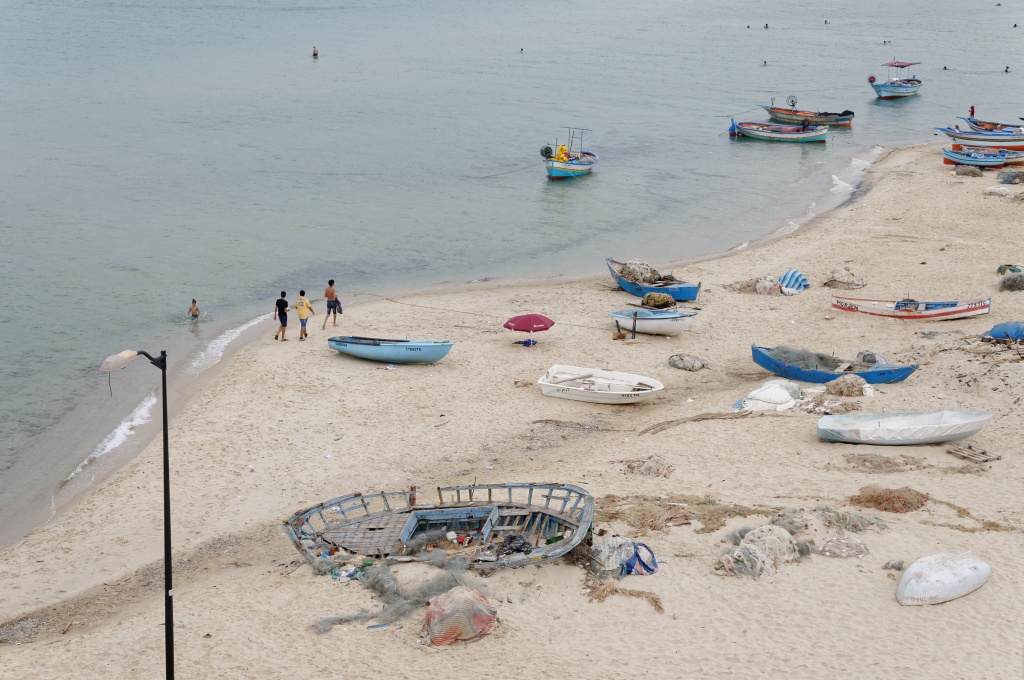
We flew down to Tunisia for a week in September exactly a year ago. I’d planned to write about Hammamet’s lovely laid back tourist vibe, the gorgeous beaches and how much fun it was viewing the Mediterranean from the Africa coast for the first time.
I didn’t want to obsess on the fact that a few weeks later terrorists shot tourists in a museum down the road from the souk we visited. I definitely don’t want to think about the beach where tourists from around the world were murdered in cold blood this summer. It’s less than 30 kilometers (20 miles) from the hotel we stayed in.
Those cowardly acts have nothing to do with what Uwe and I experienced. I took notes as I sat on our sweet balcony, and here is what I wrote:
“The tourists are international. Every body size and shape, every age is represented. We see groups of Italians, French, Egyptians, Algerians, Germans and Brits. Women in black leggings, head scarves, and long sleeved tunics sit by the pool. Two men (young Arab males) hold hands and spring into the pool at a running jump. Kids run and play everywhere I look. Old folks in wheel chairs are pushed by family members.
The French and Italian tourists live up to their reputations with their rule of remaining poolside until 6 p.m. Then they go to change for dinner at 7.
View from our balcony. Taken early evening, when guests had headed to their rooms to change their clothes and think about dinner
Lots of Middle East tourists are traditionally dressed in modest clothing. [1] They swim in the ocean fully dressed! But there are also single Arab women in bikinis, or young couples on holiday.”
I sat and revised Tsunami Cowboys under one of these umbrellas…
“Paragliders are pulled by boats, a yacht and sailboat or two glide by, an endless panorama of ocean spreads from left to right. Without talking about it we head past the pool to go down to the lounge chairs under sun umbrellas on the beach. Uwe reads and I edit the manuscript for my second book Tsunami Cowboys. I’m beyond happy: I’m in an exotic locale with fun stuff to notice all around me and I’m doing good writing work. Each afternoon around 4 I stop and swim in the ocean.”
Our hotel was about twenty minutes from the center of Hammamet.
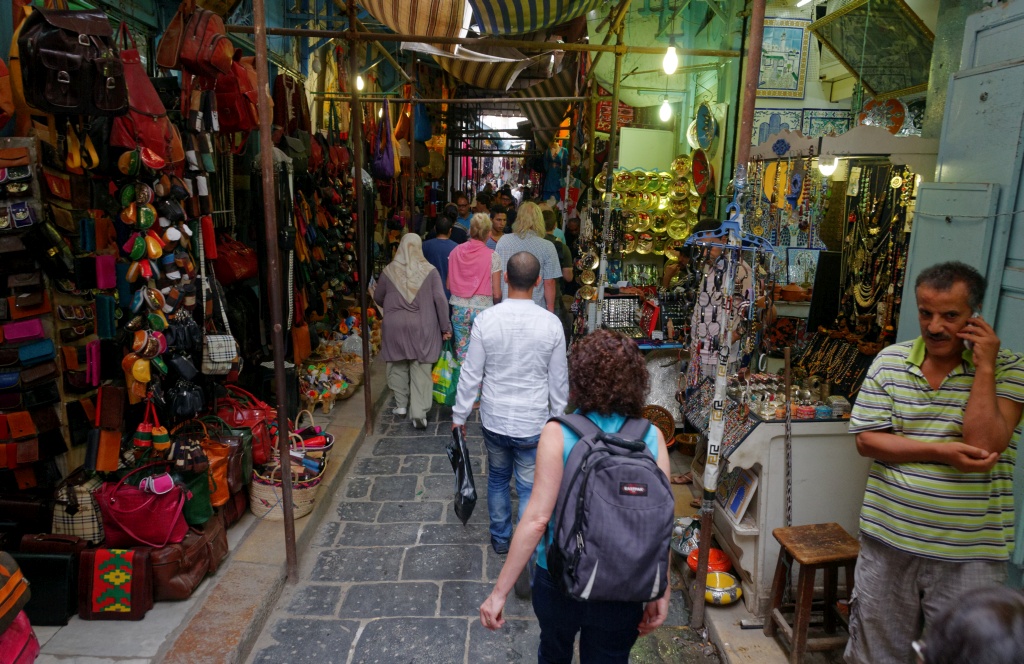
Exploring Hammamet’s souk
Sometimes we strolled into town for dinner; some nights we had a drink at the hotel and picked one of the restaurants there. We did a couple of tours, to Tunis, Sidi Bou Saïd
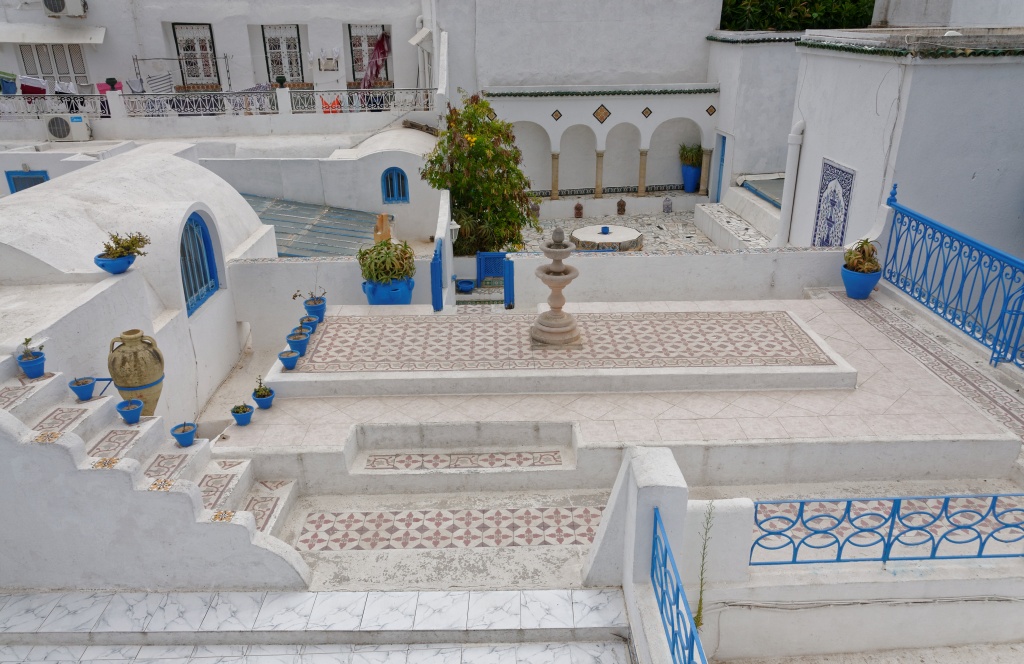
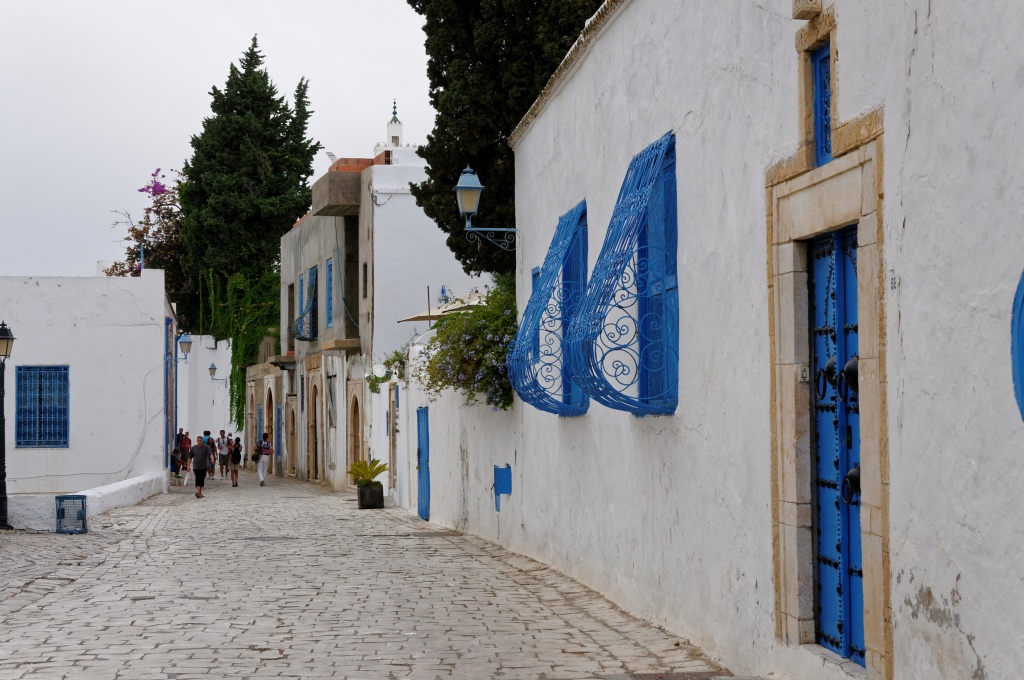
Sidi Bou Saïd is justifiably famous for its vivid blue architecture
Sidi Bou Saïd is popular with artists too
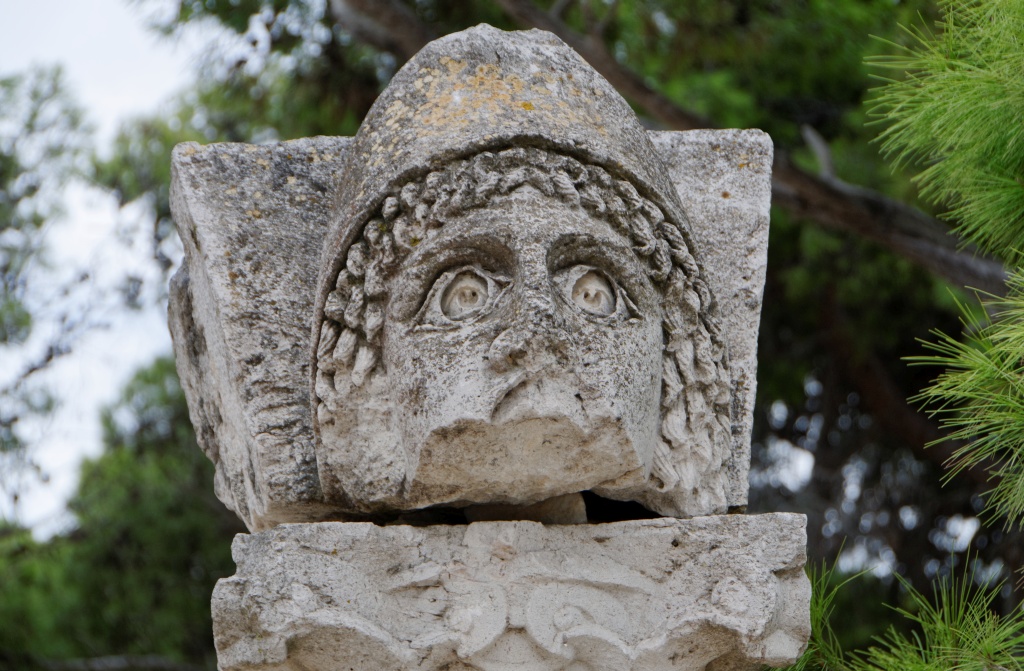
and the ancient city of Carthage. [2]
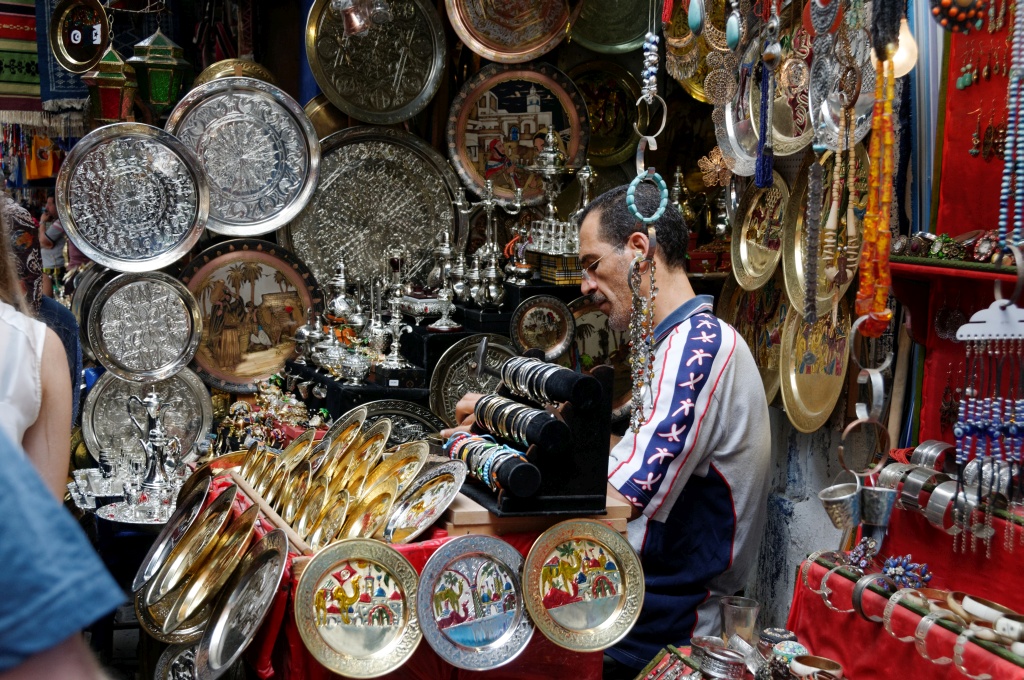
I bargained for sandals at Tunis’ souk [3],
and harissa and couscous spices at an outdoor market.
Touristy? Sure. But here are more of my notes from that week: “Everyone smiles and says hello in the hotel. We’re all here to relax and co-mingle. I have the lovely experience of being welcomed as an American – and when was the last time that’s happened lately – the locals intrigued to learn where I’m from, and even more intrigued to hear that I live in Europe.
I think that’s partly because not many Americans make it to the area, or maybe our hotel books more Europeans and Arabs. Certainly on our charter flight from Germany I’m the only Ami on board! Tunisians are delighted when I assure them that yes, I am enjoying my first visit to their country.”
We learn that Tunisia’s population of 8 million has swelled by an additional 2 million people displaced by wars. Tunisia is a democracy in an unstable part of the world. The Tunisians on the coast are hospitable, curious, worldly. And I want to go back.
I want Tunisia without terrorism.
NOTES: [1] A sign by the pool read “Clothes clog the drains! Bathing suits only, please!”
[2] Carthage made the fatal mistake of challenging Rome. The Romans burned it to the ground, killed all the men and sold the women and children into slavery. Then, to make sure everyone got the message that it was a really bad idea to go against Rome, they sowed the area with salt so that nothing would ever grow again….
[3] The shopkeeper held a lighter to the bottom to prove that they were made of camel and not plastic.
She placed her unbandaged left hand over his on the table top. “Don’t think I’m only a cynic. If I lost my faith in nations, I find huge bravery and kindness in individuals. I kept my faith – and how can that be, after what religion did to my country? But I did. I believe in God. You saved my life so I am saved again. It’s more than a woman could hope for.” She squeezed his hand. “How long do you stay in Stuttgart?”
For the first time his regret about leaving had to do with a person and not with his phobia. “I should take a train tomorrow. Actually, I’m scared to fly,” Guy admitted. “I was in a forced landing once. I’m afraid of being in another.”
“Why fear a statistic chance? Why worry about an abstraction?” Nadia’s shoulders rose and fell in the Eastern European’s shrug, a slow, weary movement that expressed the futility of every question. “Think about the poor people who are in tsunamis. Or a war zone, where real fear is to think, how do you keep walking on the street as a rocket hits somewhere near, or you hear thwack!, and the person in front of you falls down? First you think, this time it isn’t me. It took years for me to stop looking over my shoulder. Stuttgart is civilized, but even here I stumble over Stolpersteine.”
“Over what?”
“Stolpersteine.”
Guy shook his head. “Never heard of it.”
“Them. Come, I will show you. There are some up around the corner.” Nadia refused to explain further.
She insisted on paying the bill and tucked her arm in his as the two of them headed up the Königstrasse. She led him to a stop in front of a store. “What do you see?”
Guy saw Europeans out Christmas shopping, happy people laughing and drinking glühwein, store windows filled with beautifully displayed consumer goods. Was it something special about the storefront? He shifted his weight and his heel came down on an uneven spot in the cement. When he glanced down, Guy saw gold cubes embedded in the sidewalk. He squatted to get a better look. Königstrasse 60, a stone with the name of Clothilde Mannheimer, another beside it for Jakob Mannheimer.
Nadia crouched down next to him. “The Mannheimers lived in this building. They were moved by train to Theresienstadt and died in the concentration camp there,” she translated. “These are their Stolpersteine, their stumbling stones. Wherever we go, we stumble over reminders of the past. The stones make sure we don’t forget the dead, these make sure that people today can’t push the dead from our memories.”
Guy traced the imprint of the names. The little golden cubes were weightier than their size. “Are there more?”
“All over Germany. Other countries, too. The Stolpersteine groups wish to mark the last free place where the persons lived, not where they were sent. Sometimes a family asks for a stumbling block; sometimes a local group did research for victims. And Stolpersteine are for everyone. Especially the Jews, but also the Behinderte, the ones with handicaps,” she corrected herself, “the mentally slow or physically handicapped. And gypsies, Communists. All were killed or did have to leave.”
“Knowing all this it wasn’t hard for you to become a German citizen?”
She gave another slow Eastern European shrug. “I gave up my old passport a decade ago. It was less hard than I expected. My home country is one in the heart.”
A newly laid Stolperstein
– from my chapter “What A Guy” in Tsunami Cowboys. Available online at amazon.com. This link will get you there. I will post more on this extraordinary street art project shortly.
I spent a few weeks north of Hong Kong in the New Territories. The transportation system is easy and each day I went exploring. I’d read up, select yet another fascinating place to discover, and off I’d go.
Entering the temple at Wong Tai Sin
As a massage therapist I went to pay my respects to Sun Si-miao Zhen Ren, Perfected Master and god of Chinese Medicine.
He was a doctor and herbalist who lived from 581 – 682. (Yes. 101 years.) Perfected Master Sun authored some of the most important Traditional Chinese Medicine treatises. Along with medical recipes and information on everything from acupuncture and massage to herbs and diet, he wrote the following: “A Great Physician should not pay attention to status, wealth or age. Neither should he question whether the particular person is attractive or unattractive, whether he is an enemy or a friend, whether he is a Chinese or a foreigner, and finally, whether he is uneducated or educated. He should meet everyone on equal grounds. He should always act as if he were thinking of his close relatives.” [1]
He tried to heal whoever needed his help, regardless of whether his patients were rich or poor. He turned down offers for jobs as physician at the Sui and Tang courts, working instead with ordinary people.
His books are still required reading for all TCM practitioners. Taoists honor him as a god of healing. Even today, the ill and infirm (or people wishing to stay healthy) visit his temple to make offerings.
So I headed to Wong Tai Sin Temple.
I was delighted to discover that at the temple you can worship gods. Goddesses. Protectors and saints. Local deities. Buddha.
The entrance is protected.
I was met by wonderful bronze statues of the twelve animals of the Chinese zodiac.
Then I ascended the stairs and entered the compound.
The temple is just outside a metro stop, smack dab in an urban area. The serenity of the shrines and their religious activity is set against a backdrop of tall buildings.
Click on the photograph and check out all the turtles
Wong Tai Sin Temple includes a meditative garden, and I wandered around to take photographs.
Even more turtles on this side!
As I walked I thought about the gods of medicine. When Uwe and I were in Egypt in 2013 we visited the ruins at Edfu. They contain a room known as the Laboratory. The high walls are covered in hieroglyphics that are some of the world’s oldest formulas for incense and unguents. Our local guide Khairy spoke German and was finishing a degree in Egyptology. Khairy believes that the Egyptian gods were real men and women. He thought they’d once lived and had made discoveries or created things so extraordinary that over time they came to be considered gods. He said, surely whoever wrote the recipes inscribed on these walls must have seemed like a god.
Chamber of medical recipes at Edfu, Temple to Horus
I recalled Khairy’s words as I explored the temple.
When I left Wong Tai Sin I don’t know if I came away a better massage therapist, but I love the idea of a temple to a person who dedicated his life to healing others.
NOTES: [1] On the Absolute Sincerity of Great Physicians (大醫精誠 Dayi Jingcheng). This has been called the Chinese Hippocratic Oath.
On Kowloon Island’s Victoria Harbor you can walk to the Star Ferry pier and the Hong Kong Museum of Art along the Avenue of Stars. Hong Kong’s vibrant film industry and its stars are featured with statues and hand imprints. It’s a great place to take photos of the city, too!
You are seeing correctly. Placards of other cities had been placed along the water front.
In January 2014 I blogged about The United Buddy Bears, a non profit art project that first appeared in Berlin. I saw them when they came to Stuttgart. They’ve gone on to tour around the world and raise money for UNICEF.
When Hong Kong superstar Jackie Chan was in Berlin to film Around the World in 80 Days he discovered Buddy Bears scattered around the city streets.
The project’s message of peace, understanding, love and tolerance among the world’s nations, cultures and religions resonated deeply with Mr. Chan, and he got involved. He created the Jackie Chan Kids Corner where children create their own Buddy Bear designs. Jackie approached the Hong Kong Government, proposing that the project tour to Hong Kong.
He brought the bears to Hong Kong and on May 15, 2004 a “United Buddy Bears Exhibition, the first major event that Hong Kong jointly organised with an overseas organisation to promote public art, opened.” [1]
It’s fitting that the exhibit came to this city. Here East and West meet, and Hong Kong remains a bastion of diversity, tolerance and openness.
The flags of Hong Kong and Germany, side by side
Along with promoting public art, the exhibit raised money for the following charities: the Hong Kong Committee for UNICEF, the Community Chest of Hong Kong, and the Jackie Chan Charitable Foundation.
Jackie Chan was deservedly nominated UNICEF ambassador extraordinary.
Now the postscript: Imagine my surprise (and delight) to find a Buddy Bear on the Avenue of Stars. A plaque states that since the bears appeared more than $4,800,000 HK have been raised!
Everyone walking by wanted to be photographed by the Buddy Bear. I felt ridiculously happy when I spotted it. This bear seemed to connect me to Hong Kong and to my host country Germany and the rest of the world, too.
Some messages just never go out of fashion. As Nick Lowe put it, (What’s So Funny ‘Bout) Peace Love And Understanding?
NOTES: [1] United Buddy Bears Exhibit Opens press release at www.info.gov.hk. Go to my earlier post The United Buddy Bears if you want to read more.
I just spent a few weeks visiting my sister and her family in Hong Kong. I was there in May, ahead of the rainy season. It’s already hot and humid, only a hint of the weather to come….
It can’t be a coincidence that this time of year is also the birthday of Tin Hau. [1, 2]
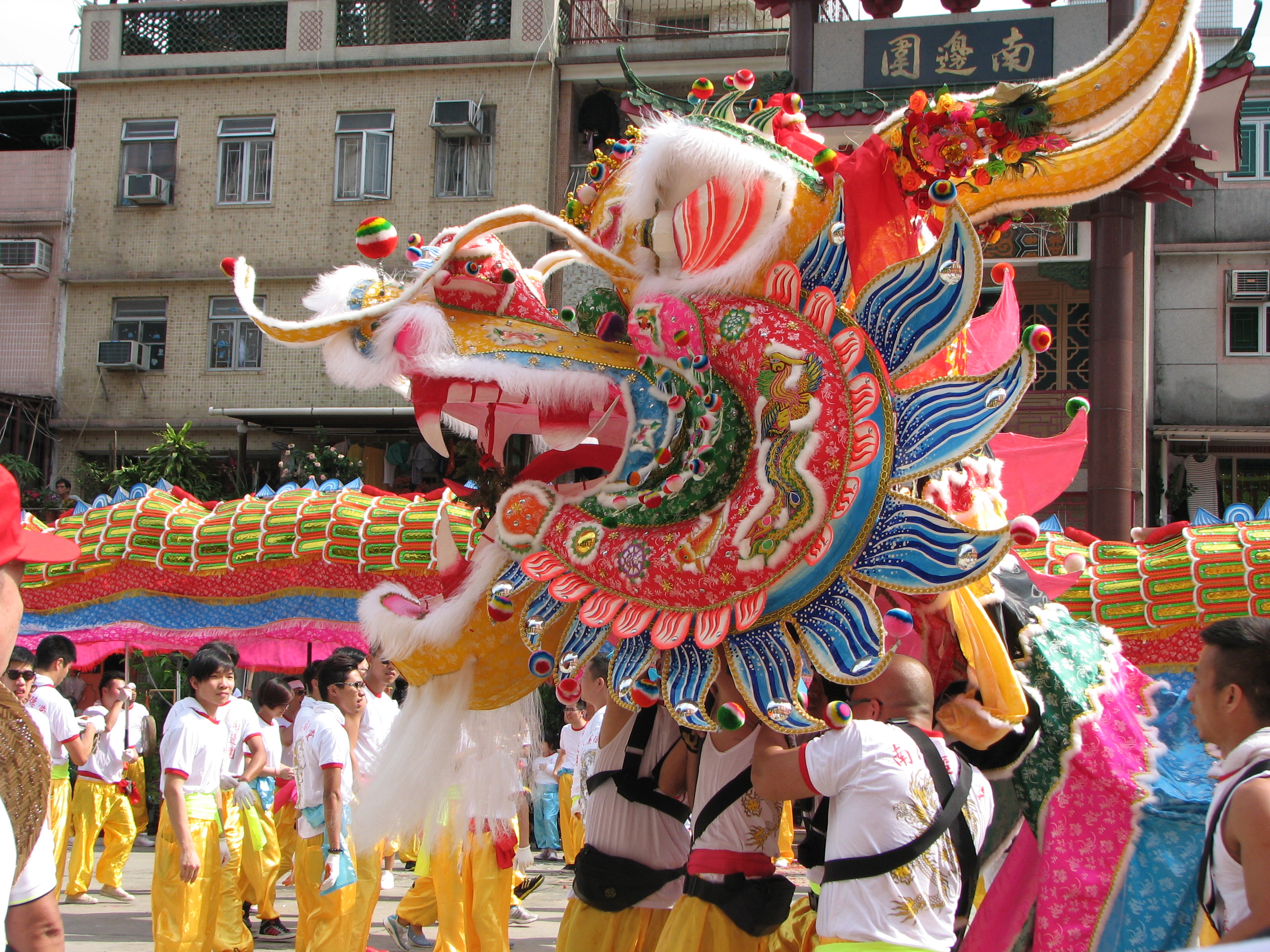
She’s the Goddess of the Seas, patron saint of sailors and fishermen throughout China and Southeast Asia. Her festival is always held on the twenty-third day of the third lunar month of the lunar calendar. This year her birthday fell on May 11th. My friend Weiyu flew over from Beijing, and we had the good luck to see a dragon parade. [3]
Lin Moniang (don’t forget that Chinese put the family name first) was born during the Song Dynasty on Meizhou Island in Fujian, China. Her dates are 23 March 960 – 4 October 987. She was the seventh daughter, an excellent swimmer, and wore a red dress. No matter how bad the weather was, Lin Moniang stood on the shore in that red dress in order to guide the fishing boats back home.
Wikipedia’s description of her legend is so good that I’ll repeat it verbatim here: “Lin Moniang’s father and brothers were fishermen. One day, a terrible typhoon arose while they were out at sea, and the rest of her family feared that those at sea had perished. In the midst of this storm, depending on the version of the legend, she fell into a trance while praying for the lives of her father and brothers or dreamed of her father and brothers while she was sleeping or sitting at a loom weaving. In both versions of the story, her father and brother were drowning but Moniang’s mother discovered her sleeping and tried to wake her. This diverted Moniang’s attention and caused her to drop her brother who drowned as a result. Consequently, Moniang’s father returned alive and told the other villagers that a miracle had happened.” [4]
She was deified shortly after her death. There are many reports of miraculous sightings of Tin Hau by sailors in distress. Chinese who immigrated often built temples once they arrived overseas to thank her for the safe journey. Each year a major festival is held on her birthday.
One of the most spectacular is in Yuen Long in the New Territories. Weiyu and I headed out early to reach the town (an easy trip on the MTR, the wonderful regional transportation system). We left the metro station and immediately saw bright colors and a crowd of people. As we got closer, firecrackers began to go off! We’d arrived right on time!
The firecrackers exploded and confetti fell out and rained down!
This village had just begun to parade their dragon. They circled the lot a few times accompanied by a loud drum and cymbals. There was another loud bang, more firecrackers popped, and everyone followed the dragon as it headed into town.
We arrived at another square where more dragons waited.
They took turns weaving up and down the main street, curling and snaking, rising and falling in an intricate dance. Sometimes two dragons danced at the same time.
People’s shirts indicated which village and dragon they were with. There were groups of old women waving fans, and children in costume, and lions.
Can you see the dragon on the side in green?
Flags and banners waved around the Fa Paus, ornate towers with paper flowers. Huge elaborate placards wished for luck and prosperity.
One village group’s Fa Pau
Offerings included entire roasted pigs.
I recognized those instantly from the worship of Bà Chúa Xứ in southern Viet Nam. It can’t be a coincidence that her festival starts at the beginning of the rainy season on the twenty-third day of a lunar month too…
NOTES: [1] Tianhou (天后) literally means “Empress of Heaven”. [2] She’s also known as Mazu, Tian Fei or A-Ma. The Buddhists conflated her into a reincarnation of Guan Yin, Goddess of Compassion. [3] She has over 90 temples in Hong Kong alone. [4] http://en.wikipedia.org/wiki/Mazu
Go to my post The Cult of Bà Chúa Xứ to read about south Viet Nam’s most sacred shrine. More pictures from our trips to Vietnam and China and of Uwe’s photography may be viewed at viewpics.de.
 Goa was Portuguese, she considered writing, and gorgeous ocean views, the rave scene and meals eaten in beach shacks. Every sentence sounded like factoids from a travelogue.