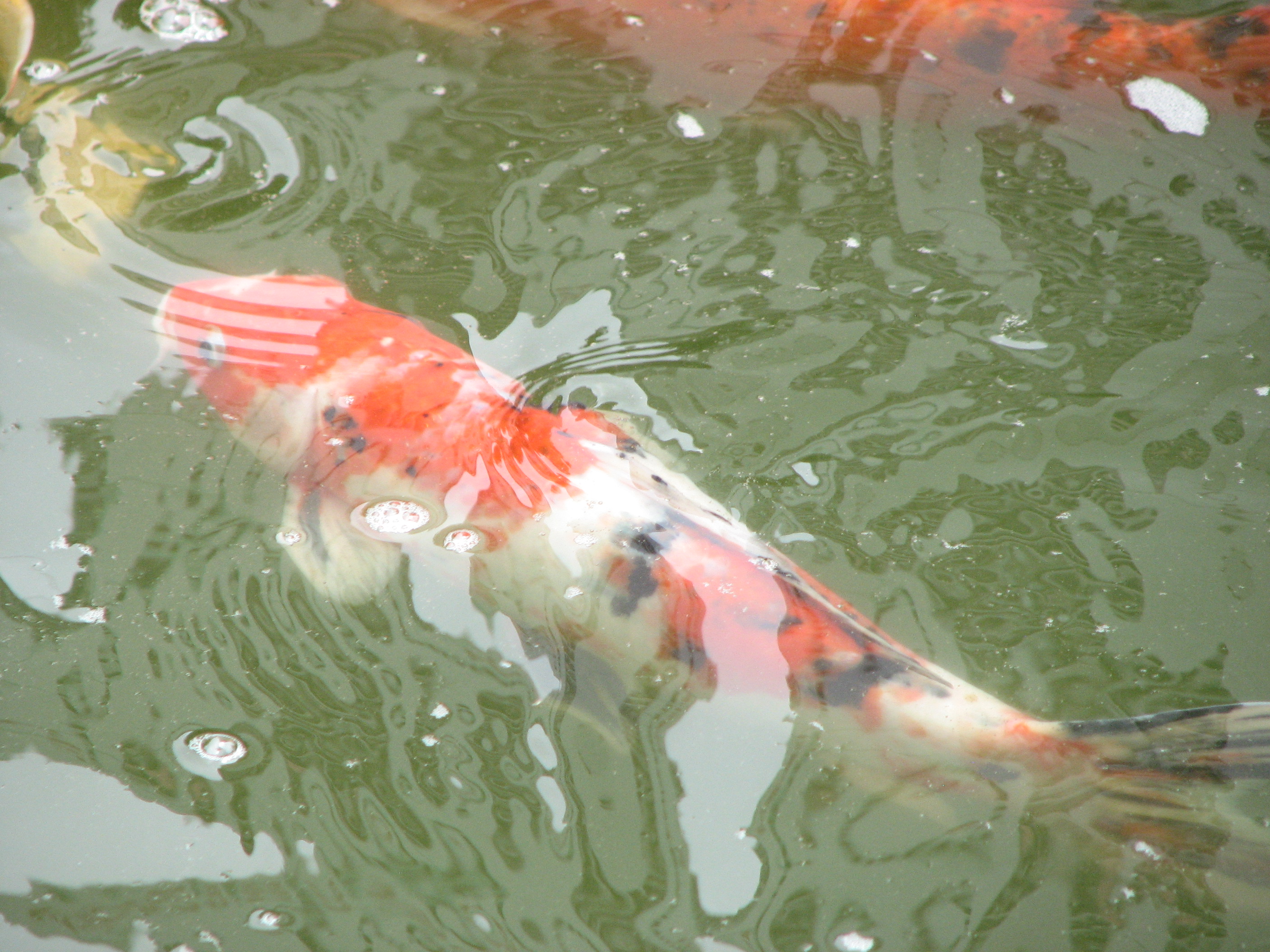
I present to you installment #7 from my blog thread describing what to call groups of animals … See how many you can guess. Answers listed at the bottom of the page. (I’m especially proud of No. 5 on this week’s list!)
Their knot knotted in the mud.
He heard the murmuration’s murmurs.
Unblinking, the stare stared back.
The dole didn’t look doleful.
The earth’s earth was in the earth. ***
Stuffy noses don’t suit a sute.
Stare, Raptor rescue center, AustraliaDole, Wong Tai Sin Medicine Temple, New Territories, China
Answers:
Knot of toads [1]
Murmuration of starlings
Stare of owls [2]
Dole of turtles [3]
Earth of foxes; place the vixen (female fox) searches out to raise her kits; ground she finds the earth in. ***3 uses of the word! [4]
Sute of bloodhounds
Knot member, back trails Cranberry Lake, Adirondacks USA
I’m beyond dismayed – I am furious. The Trump administration is gutting environmental protections. Take action. Speak up! Write letters, make phone calls, donate to organizations like the Environmental Defense Fund and Greenpeace. Volunteer.
I am a Best American Essays-nominated writer. My books are Broken In: A Novel in Stories, Tsunami Cowboys, Grounded, The Trail Back Out, and The Taste of Your Name. Recent awards include Finalist for the 2025 Compass Press Book Award for The Taste of Your Name and Finalist for Greece’s Eyelands 11th International Short Story Contest.
JRR Tolkien was born on January 3, 1892 in Bloemfontein, Orange Free State, South Africa. He is of course reknowned for The Silmarillion, TheHobbit, and The Lord of the Rings trilogy, for which he invented complex alphabets and histories for elvish, dwarvish, and other tongues. Tolkien taught at Oxford, England where he became close friends with fellow scholar and author C.S. Lewis. I once heard a story (I’d love to believe that it’s true), that the two professors were observed in a deep debate that went on for hours. Finally the observer gathered his courage and approached: what, might he ask, were the two men so fiercely arguing about?
“The characteristics of dragons,” they answered, and promptly went back to their discussion.
In Tolkien’s honor I am reprinting the post I wrote after seeing a dragon parade for the goddess Tin Hau in the New Territories of China.
Tin Hau is the Goddess of the Seas, patron saint of sailors and fishermen throughout China and Southeast Asia. [1, 2]
Her festival is always held on the twenty-third day of the third lunar month of the lunar calendar. My friend Weiyu flew over from Beijing, and we had the good luck to see a dragon parade. [3]
Lin Moniang (don’t forget that Chinese put the family name first) was born March 23, 960 in the Song Dynasty, on Meizhou Island in Fujian, China. She was the seventh daughter, an excellent swimmer, and wore a red dress. No matter how bad the weather was, Lin Moniang stood on the shore in that red dress in order to guide the fishing boats back home. She went into a trance during a terrible storm and saved her father’s life.
She was deified not long after she died.
There are many reports of miraculous sightings of Tin Hau by sailors in distress. Chinese who immigrated often built temples once they arrived overseas to thank her for the safe journey.
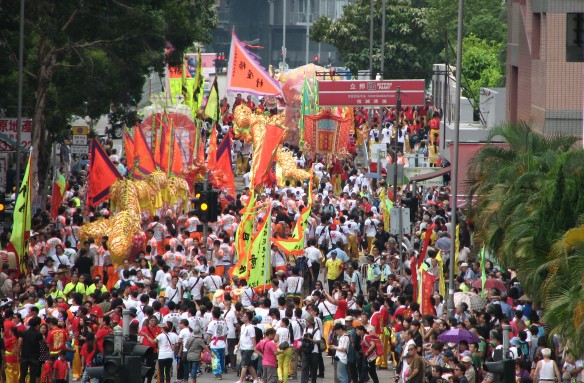
Each year a major festival is held on her birthday. One of the most spectacular is in Yuen Long in the New Territories. Weiyu and I headed out early to reach the town. We left the metro station and immediately spotted bright colors and a crowd of people. As we got closer, firecrackers began to go off! We’d arrived right on time!
The firecrackers exploded and confetti fell out and rained down!
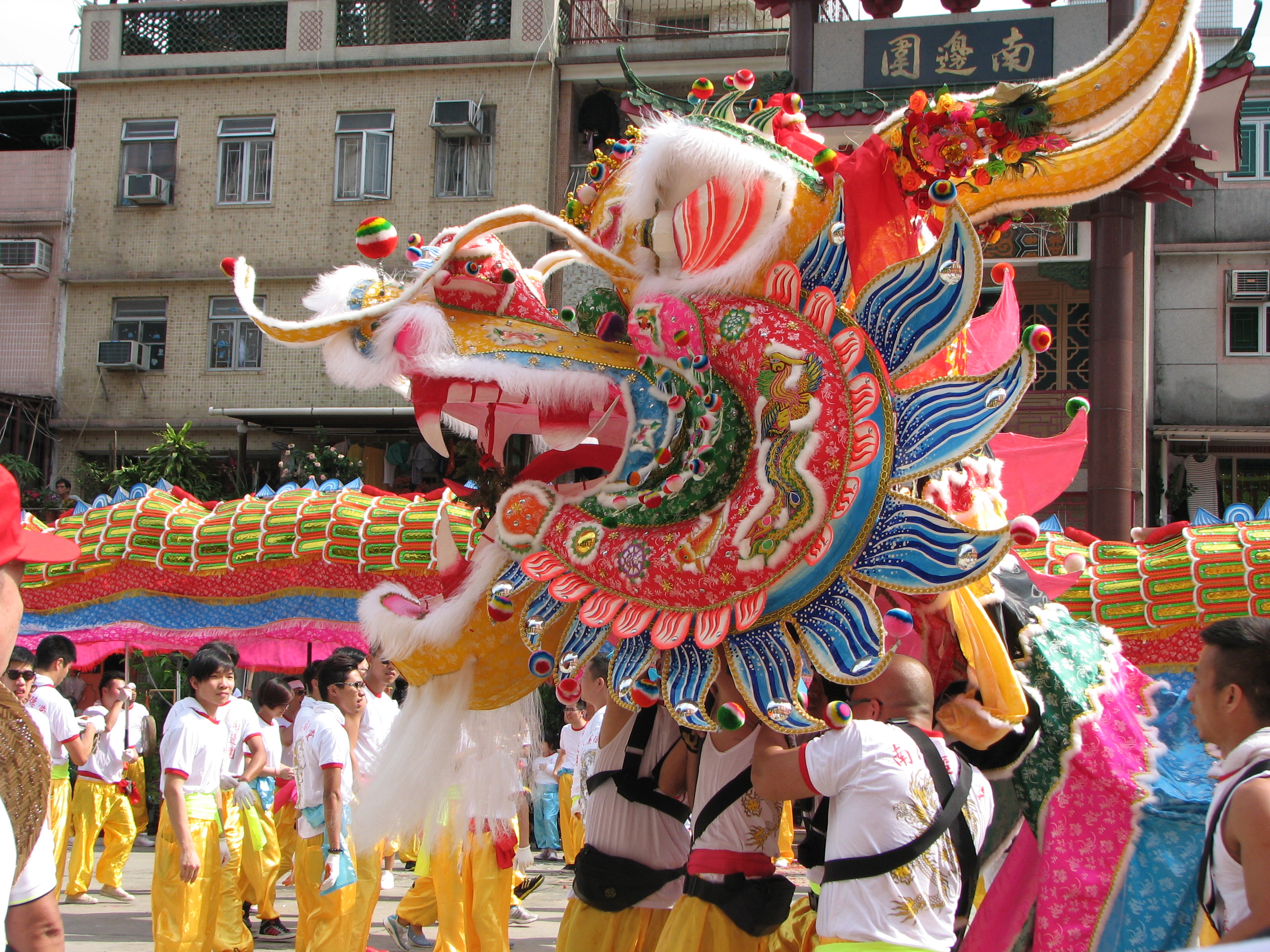
The village had just begun to parade their dragon. They circled the lot a few times accompanied by a loud drum and cymbals. There was another loud bang, more firecrackers popped, and everyone followed the dragon into town.
We arrived at another square where more dragons waited.
The dragons took turns weaving up and down the main street, curling and snaking, rising and falling in an intricate dance. Sometimes two dragons danced at the same time.
People’s shirts indicated which village and dragon they were with. Groups of old women waved fans, children were in costume, and I saw lions.
Can you see the dragon on the side in green?
Flags and banners waved around the Fa Paus: ornate towers with paper flowers. Huge elaborate placards wished for luck and prosperity.
One village group’s Fa Pau
Offerings included entire roasted pigs.
I recognized those roast pigs instantly from the worship of goddess Bà Chúa Xứ in southern Viet Nam. It can’t be a coincidence that her festival starts at the beginning of the rainy season on the twenty-third day of a lunar month too…
In memory of JRR Tolkien, 3 January 1892 – 2 September 1973
My books are Broken In: A Novel in Stories, Tsunami Cowboys, Grounded, and The Trail Back Out.
Tsunami Cowboys was longlisted for the 2019 ScreenCraft Cinematic Book Award. Broken In: A Novel in Stories was semifinalist for the international 2020 Hawk Mountain Short Story Collection Award from Hidden River Arts and Finalist for Greece’s 2021 Eyelands Book of the Year Award (Short Stories). The Trail Back Out was American Book Fest 2020 Best Book Award Finalist: Fiction Anthologies, Runner-Up for the 2021 Top Shelf Award, 2021 IAN Book of the Year Award Short Story Collection Finalist, and awarded a 2021 Wishing Shelf Red Ribbon. The title story The Trail Back Out was longlisted for the 2021 ScreenCraft Cinematic Short Story Award.
Click here for my author page to learn more about me and purchase my books.
Environmental activist, writer, wilderness traveler, Zen Buddhist student and teacher, Peter Matthiessen was born May 22, 1927 in New York City, New York. He was a CIA officer in his early 20s, one of the few acts of his life that he regretted. He co-founded The Paris Review, one of English language’s most important literary journals. His book Shadow Country won the National Book Award for fiction, and he won again in nonfiction for The Snow Leopard. He remains the only writer to have won in both categories.
A friend gave me The Snow Leopard when it first came out, and I’ve reread it over and over in the decades since then. Matthiessen movingly tells how, after his wife Deborah Love died of cancer, he accompanied the naturalist George Schaller in search of the elusive leopard on the Tibetan Plateau. The book is travelogue, natural world description, and a meditation on life and death.
In his honor I am reprinting a post I wrote after visiting a site with 10,000 Buddhas…. – Jadi
Pam on the path
My sister Pam and her family lived in the New Territories. This part of China is on the mainland north of Hong Kong. While Hong Kong is the most densely and vertically populated city on the planet, the New Territories were still relatively quiet. The landscape consists of steep, lush jungle peaks that end in bays and inlets.
The vertical density of Hong KongThe view from their apartment near Sai Kung
The region is growing, and changing fast. The bus from the apartment passes villages on hillsides or tucked into hamlets and harbors. Floating villages of traditional houseboats are minutes away. And then the high rises suddenly appear, row after row after row.
There are lots more that look just like theseIt’s not far to Man Fat Tsz, the Ten Thousand Buddhas Monastery in Sha Tin. The monastery was founded by the devout layman Venerable Yuexi (the Chinese月溪法師; pinyin: yuè xī). Building began in 1949 as Yuexi and his disciples carried everything up from the foot of the mountain. For eighteen years they constructed the buildings – along with 12,800 Buddha statues.
You head up through a bamboo forest where statues line both sides of the path to the monastery.
There are roughly 500 Arhan [1] statues in plastic, painted gold. Each one is unique.
Their expressions represent the experience of enlightenment. Other statues await once you reach the summit. I felt like I was in a tacky Buddhist Disneyland.
So did you hear the one where the Buddhist monk, the Catholic priest, and the Jewish rabbi enter a temple…
Then I got to the top and entered the main temple. Before the altar is a glass case; it contains Venerable Yuexi’s preserved body! His body (still perfectly intact) was exhumed eight months after his April 24, 1965 death. Yuexi was next embalmed with Chinese lacquer, his head and face covered in gold leaf. [2] The Diamond Indestructible Body of Yuexi’s robed corpse sits in the lotus position. I was oddly moved by his preserved body: with the sight, I had a glimpse of religious truth.
That feeling became surreal as we headed back to the bus stop.
This pagoda appeared on Hong Kong’s $100 banknotes
We climbed down a different set of steps past my least favorite creatures: wild monkeys.
And from the meditative hillside of Ten Thousand Buddhas, we neared and then entered the shopping mall complex at Sha Tin.
Sha Tin shopping mall
As I say, the New Territories has both the traditional and the modern. They all line the same path.
NOTES: [1] To quote Wikipedia, “…in TheravadaBuddhism, an Arhat is a “perfected person” who has attained nirvana. In other Buddhist traditions the term has also been used for people far advanced along the path of Enlightenment.” [2] Taking pictures inside the temple is not allowed.
In memory of Peter Matthiessen, 22 May 1927 – 5 April 2014
My books are Broken In: A Novel in Stories, Tsunami Cowboys, Grounded, and The Trail Back Out.
The Trail Back Out was honored as 2021 IAN Book of the Year Award Short Story Collection Finalist for the Independent Author Network and with a Red Ribbon by the 2021 Wishing Shelf Book Awards of England. In addition, The Trail Back Out was an American Book Fest 2020 Best Book Award Finalist: Fiction Anthologies. The title story The Trail Back Out was longlisted for the 2021 ScreenCraft Cinematic Short Story Award. Broken In: A Novel in Stories was a semifinalist for the international 2020 Hawk Mountain Short Story Collection Award from Hidden River Arts, as well as a Finalist for Greece’s 2021 Eyelands Book Awards. Tsunami Cowboys was longlisted for the 2019 ScreenCraft Cinematic Book Award.
Click here for my author page to learn more about me and purchase my books.
To my readers: Welcome to the first post in my new blog thread: A Person + Place/Time/Thing
Robert McKimson was born October 13, 1910 in Denver, Colorado. He worked for Disney for a while, but is best known for animating and directing Looney Tunes and Merrie Melodies for Warner Bros. Cartoons. He was a contemporary of Chuck Jones.
According to his son in the wonderful short documentary Drawn to Life: The Art of Robert McKimson, McKimson suffered a concussion in an accident. When he recovered, the concussion had improved his powers of visualization, and he became an even faster and better animator.
Robert McKimson created and/or directed shorts with a stellar list of cartoon stars: Daffy Duck, Porky Pig, and Bugs Bunny. He also created the Tasmanian Devil. He also created Speedy Gonzales. And, if they weren’t enough, he also created the indomitable Foghorn Leghorn, an oversized rooster with an oversized voice and accent.
As a kid I got such a kick out of Foghorn Leghorn. He was loud, blustering, and incredibly funny (I admit that I still think all these things as an adult, too!).
A few years ago I went to check out the Wong Tai Sin Temple in China’s New Territories. It’s dedicated to the gods of medicine, but upon entering the temple grounds I was met by statues that were oversized animals of the Chinese zodiac including – you guessed it – Foghorn Leghorn’s Asian brother.
In honor of Robert McKimson and his larger-than-life rooster, (“Well I say there, boy! I say!”) I am reprinting the post I wrote describing the statues. – Jadi
I spent a few weeks north of Hong Kong in the New Territories. The transportation system is easy and each day I went exploring. I’d read up, select yet another fascinating place to discover, and off I’d go.
Entering the temple at Wong Tai Sin
As a massage therapist I went to pay my respects to Sun Si-miao Zhen Ren, Perfected Master and god of Chinese Medicine. Taoists honor him as a god of healing. Even today, the ill and infirm (or people wishing to stay healthy) visit his temple to make offerings.
So I headed to Wong Tai Sin Temple. Inside, I was met by wonderful bronze statues of the twelve animals of the Chinese zodiac!
I managed to photograph all but the ox and dog.
HorseRatRabbitSnakeGoatMonkeyTigerPigDragonAnd there he was: Foghorn Leghorn!!
The temple is just outside a metro stop, smack dab in an urban area. Who would have suspected that Foghorn Leghorn resides there?
In memory of Robert McKimson, 13 October 1910 – 29 September 1977
My books are Broken In: A Novel in Stories, Tsunami Cowboys, Grounded, and The Trail Back Out. Books make great gifts!
Tsunami Cowboys was longlisted for the 2019 ScreenCraft Cinematic Book Award. The Trail Back Out was a 2020 Best Book Award Finalist: Fiction Anthologies for American Book Fest. The title story The Trail Back Out was longlisted for the 2021 ScreenCraft Cinematic Short Story Award. Broken In: A Novel in Stories was a semifinalist for the international Hawk Mountain Short Story Collection Award from Hidden River Arts.
Click here for my author page to learn more about me and purchase my books.
I present to you installment #7 from my blog thread describing what to call groups of animals … See how many you can guess. Answers listed at the bottom of the page. (I’m especially proud of No. 5 on this week’s list!)
Their knot knotted in the mud.
He heard the murmuration’s murmurs.
Unblinking, the stare stared back.
The dole didn’t look doleful.
The earth’s earth was in the earth. ***
Stuffy noses don’t suit a sute.
Stare, Raptor rescue center, AustraliaDole, Wong Tai Sin Medicine Temple, New Territories, China
Answers:
Knot of toads [1]
Murmuration of starlings
Stare of owls [2]
Dole of turtles [3]
Earth of foxes; place the vixen (female fox) searches out to raise her kits; ground she finds the earth in. ***3 uses of the word!
Sute of bloodhounds
Knot member, back trails Cranberry Lake, Adirondacks USA
I always feel a little strange when I recognize it’s time to mark milestones and I have several to announce.
This is my 99th blog post.
I’ve posted in these virtual pages twice a month since I began way back in September of 2012. It all started with my husband’s suggestion that I establish an Internet presence….
My published books are fiction, and this blog serves as a good place to present excerpts. Potential readers of my books might want a sample of my writing and a glimpse of the human being behind the words. It’s also a place for non-fiction essays. I get to explore ideas and topics that don’t need to be transformed for novels. Posting every other week is great writerly discipline. I’ve never missed a bi-monthly posting date!
…. and this all began simply as a way to introduce my two novels Tsunami Cowboys and Broken In: A Novel in Stories. Both are available at amazon.com in book and eBook form.
It’s been a fun journey these last three years! Thanks to all of you for visiting these pages. I wish everyone the happiest of holidays. I’ll be back in the new year with an announcement. Milestone #2 is on the way!!!
I spent a few weeks north of Hong Kong in the New Territories. The transportation system is easy and each day I went exploring. I’d read up, select yet another fascinating place to discover, and off I’d go.
Entering the temple at Wong Tai Sin
As a massage therapist I went to pay my respects to Sun Si-miao Zhen Ren, Perfected Master and god of Chinese Medicine.
He was a doctor and herbalist who lived from 581 – 682. (Yes. 101 years.) Perfected Master Sun authored some of the most important Traditional Chinese Medicine treatises. Along with medical recipes and information on everything from acupuncture and massage to herbs and diet, he wrote the following: “A Great Physician should not pay attention to status, wealth or age. Neither should he question whether the particular person is attractive or unattractive, whether he is an enemy or a friend, whether he is a Chinese or a foreigner, and finally, whether he is uneducated or educated. He should meet everyone on equal grounds. He should always act as if he were thinking of his close relatives.” [1]
He tried to heal whoever needed his help, regardless of whether his patients were rich or poor. He turned down offers for jobs as physician at the Sui and Tang courts, working instead with ordinary people.
His books are still required reading for all TCM practitioners. Taoists honor him as a god of healing. Even today, the ill and infirm (or people wishing to stay healthy) visit his temple to make offerings.
So I headed to Wong Tai Sin Temple.
I was delighted to discover that at the temple you can worship gods. Goddesses. Protectors and saints. Local deities. Buddha.
The entrance is protected.
I was met by wonderful bronze statues of the twelve animals of the Chinese zodiac.
Then I ascended the stairs and entered the compound.
The temple is just outside a metro stop, smack dab in an urban area. The serenity of the shrines and their religious activity is set against a backdrop of tall buildings.
Click on the photograph and check out all the turtles
Wong Tai Sin Temple includes a meditative garden, and I wandered around to take photographs.
Even more turtles on this side!
As I walked I thought about the gods of medicine. When Uwe and I were in Egypt in 2013 we visited the ruins at Edfu. They contain a room known as the Laboratory. The high walls are covered in hieroglyphics that are some of the world’s oldest formulas for incense and unguents. Our local guide Khairy spoke German and was finishing a degree in Egyptology. Khairy believes that the Egyptian gods were real men and women. He thought they’d once lived and had made discoveries or created things so extraordinary that over time they came to be considered gods. He said, surely whoever wrote the recipes inscribed on these walls must have seemed like a god.
Chamber of medical recipes at Edfu, Temple to Horus
I recalled Khairy’s words as I explored the temple.
When I left Wong Tai Sin I don’t know if I came away a better massage therapist, but I love the idea of a temple to a person who dedicated his life to healing others.
NOTES: [1] On the Absolute Sincerity of Great Physicians (大醫精誠 Dayi Jingcheng). This has been called the Chinese Hippocratic Oath.
I just spent a few weeks visiting my sister and her family in Hong Kong. I was there in May, ahead of the rainy season. It’s already hot and humid, only a hint of the weather to come….
It can’t be a coincidence that this time of year is also the birthday of Tin Hau. [1, 2]
She’s the Goddess of the Seas, patron saint of sailors and fishermen throughout China and Southeast Asia. Her festival is always held on the twenty-third day of the third lunar month of the lunar calendar. This year her birthday fell on May 11th. My friend Weiyu flew over from Beijing, and we had the good luck to see a dragon parade. [3]
Lin Moniang (don’t forget that Chinese put the family name first) was born during the Song Dynasty on Meizhou Island in Fujian, China. Her dates are 23 March 960 – 4 October 987. She was the seventh daughter, an excellent swimmer, and wore a red dress. No matter how bad the weather was, Lin Moniang stood on the shore in that red dress in order to guide the fishing boats back home.
Wikipedia’s description of her legend is so good that I’ll repeat it verbatim here: “Lin Moniang’s father and brothers were fishermen. One day, a terrible typhoon arose while they were out at sea, and the rest of her family feared that those at sea had perished. In the midst of this storm, depending on the version of the legend, she fell into a trance while praying for the lives of her father and brothers or dreamed of her father and brothers while she was sleeping or sitting at a loom weaving. In both versions of the story, her father and brother were drowning but Moniang’s mother discovered her sleeping and tried to wake her. This diverted Moniang’s attention and caused her to drop her brother who drowned as a result. Consequently, Moniang’s father returned alive and told the other villagers that a miracle had happened.” [4]
She was deified shortly after her death. There are many reports of miraculous sightings of Tin Hau by sailors in distress. Chinese who immigrated often built temples once they arrived overseas to thank her for the safe journey. Each year a major festival is held on her birthday.
One of the most spectacular is in Yuen Long in the New Territories. Weiyu and I headed out early to reach the town (an easy trip on the MTR, the wonderful regional transportation system). We left the metro station and immediately saw bright colors and a crowd of people. As we got closer, firecrackers began to go off! We’d arrived right on time!
The firecrackers exploded and confetti fell out and rained down!
This village had just begun to parade their dragon. They circled the lot a few times accompanied by a loud drum and cymbals. There was another loud bang, more firecrackers popped, and everyone followed the dragon as it headed into town.
We arrived at another square where more dragons waited.
They took turns weaving up and down the main street, curling and snaking, rising and falling in an intricate dance. Sometimes two dragons danced at the same time.
People’s shirts indicated which village and dragon they were with. There were groups of old women waving fans, and children in costume, and lions.
Can you see the dragon on the side in green?
Flags and banners waved around the Fa Paus, ornate towers with paper flowers. Huge elaborate placards wished for luck and prosperity.
One village group’s Fa Pau
Offerings included entire roasted pigs.
I recognized those instantly from the worship of Bà Chúa Xứ in southern Viet Nam. It can’t be a coincidence that her festival starts at the beginning of the rainy season on the twenty-third day of a lunar month too…
NOTES: [1] Tianhou (天后) literally means “Empress of Heaven”. [2] She’s also known as Mazu, Tian Fei or A-Ma. The Buddhists conflated her into a reincarnation of Guan Yin, Goddess of Compassion. [3] She has over 90 temples in Hong Kong alone. [4] http://en.wikipedia.org/wiki/Mazu
Go to my post The Cult of Bà Chúa Xứ to read about south Viet Nam’s most sacred shrine. More pictures from our trips to Vietnam and China and of Uwe’s photography may be viewed at viewpics.de.
My sister Pam is a teacher for international schools. For the last three years she’s been located in the Hong Kong area. It’s a great place to visit: the languages are Cantonese and English, the transportation system is so simple that anyone can feel clever using it, and contrasts between modernity and tradition are everywhere you look.
Pam and her family live in the New Territories. This part of China is on the mainland north of Hong Kong. While Hong Kong is the most densely and vertically populated city on the planet, the New Territories are still relatively quiet. The landscape consists of steep, lush jungle peaks that end in bays and inlets.
The vertical density of Hong KongThe view from their apartment near Sai Kung
The region is growing, and changing fast. On the bus from the apartment we pass villages on hillsides or tucked into hamlets and harbors. Several floating villages of traditional houseboats are minutes away. And then the high rises suddenly appear, row after row after row.
There are lots more that look just like theseSo did you hear the one where the Buddhist monk, the Catholic priest, and the Jewish rabbi enter a temple…
It’s not far to Man Fat Tsz, the Ten Thousand Buddhas Monastery in Sha Tin. It was founded by the devout layman Venerable Yuexi (the Chinese月溪法師; pinyin: yuè xī). Building began in 1949 as Yuexi and his disciples carried everything up from the foot of the mountain. For eighteen years they constructed the buildings – and 12,800 Buddha statues.
You head up through a bamboo forest and statues line both sides of the path to the monastery. There are roughly 500 Arhan [1] statues in plastic, painted gold. Each one is unique.
Their expressions represent the experience of enlightenment. Other statues await once you reach the summit. (Click on any of the thumbnail photos for a closer look.)
I felt like I was in a tacky Buddhist Disneyland until I got to the top and entered the main temple. Before the altar is a glass case, and it contains Venerable Yuexi’s preserved body! His body (still perfectly intact) was exhumed eight months after his April 24, 1965 death. Yuexi was next embalmed with Chinese lacquer, his head and face covered in gold leaf. The Diamond Indestructible Body of Yuexi’s robed corpse sits in the lotus position. I was oddly moved by his preserved body: with the sight, I had a glimpse of religious truth. [2]
That feeling became surreal as we headed back to the bus stop.
This pagoda appeared on Hong Kong’s $100 banknotes
We climbed down a different set of steps past my least favorite creatures: wild monkeys.
And from the meditative hillside of Ten Thousand Buddhas, we neared and then entered the shopping mall complex at Sha Tin.
Sha Tin shopping mall
As I say, the New Territories has both the traditional and the modern. They all line the same path.
NOTES: [1] To quote Wikipedia, “…in TheravadaBuddhism, an Arhat (Sanskrit: अर्हत् arhat; Pali: arahant; “one who is worthy”) is a “perfected person” who has attained nirvana. In other Buddhist traditions the term has also been used for people far advanced along the path of Enlightenment.”
[2] Taking pictures inside the temple is not allowed.






 Environmental activist, writer, wilderness traveler, Zen Buddhist student and teacher, Peter Matthiessen was born May 22, 1927 in New York City, New York. He was a CIA officer in his early 20s, one of the few acts of his life that he regretted. He co-founded The Paris Review, one of English language’s most important literary journals. His book Shadow Country won the National Book Award for fiction, and he won again in nonfiction for The Snow Leopard. He remains the only writer to have won in both categories.