 Author and journalist Mark Kurlansky was born December 7, 1948 in Hartford, Connecticut. He has written about oysters, cod, salt, salmon, milk and paper – among other topics. His writing is engaging and informative. I have copies of Cod: A Biography of the Fish That Changed the World (an international bestseller translated into more than 15 languages) and Salt: A World History. His book Nonviolence: Twenty-five Lessons From the History of a Dangerous Idea was awarded the 2007 Dayton Literary Peace Prize. In his honor I am reprinting the post I wrote after we visited a saltworks in Laos. – Jadi
When we talk about salt, we talk most often of sodium chloride. This is NaCl, consisting of the elements sodium and chlorine.
There is a charming tradition in Germany of bringing a loaf of bread and salt to friends when they move into a new home. The saying is that if you have those two items in your house you’ll always survive. Bread and salt are still ceremoniously served to guests in parts of northern and eastern Europe.
Mark Kurlansky writes, “Loyalty and friendship are sealed with salt because its essence does not change. In both Islam and Judaism, salt seals a bargain because it is immutable… In Christianity, salt is associated not only with longevity and permanence but, by extension, with truth and wisdom. The Catholic Church dispenses not only holy water but holy salt, Sal Sapientia, the salt of wisdom.” [1]
Seeing the hard way salt is won from pits changed forever the way I think about this simple condiment.
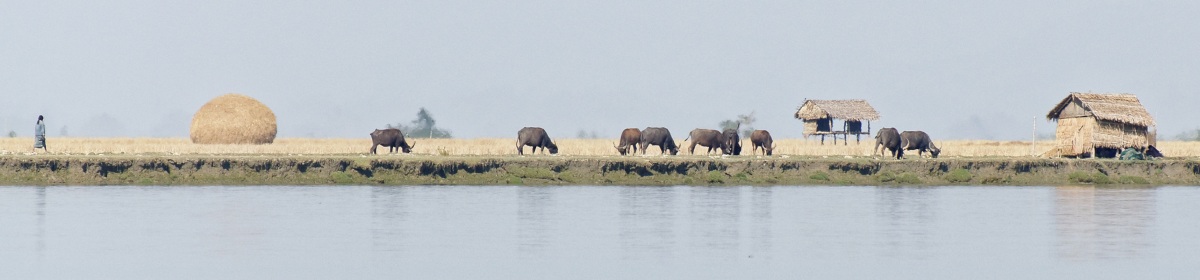
We were staying for only a few days in Vientiane, the capitol of Laos, and spent a day with a guide and a driver to see a bit of the area. One of the spots we toured was a traditional salt harvesting town. A little settlement lives at and from the pits – and has burned down numerous times. Each time, they rebuild right next to the pits.


Salty waters are brought up from deep underground

and then boiled in open metal pans. Their burning fires glowed and sent off intense heat. The briny steam that rose felt like being in some strange circle of Dante’s Purgatory.


Once the water has boiled away the salt is gathered in baskets, weighed, and stored in a barn.


Workers then bag and tag the salt, preparing it for market.

Salt is a serious business. The salt from this mine is sent to the north where people still suffer endemic goiters.
I thought of the pits of hell, of work so demanding and hot that it left scars. Just being tied to a spot like this must bake you and make you hard. Or so I thought. Instead, I met workers doing their jobs in neatly ironed clothing. The women all had on jewelry. A group of little children trailed us everywhere, laughing and mugging as children do.

Since that day salt has tasted both sweeter and bitterer, or herber as the Germans say. And in that small word I hear the echo of the coming season, Herbst, Autumn. The summer is burning away and fall is coming. May your harvest tables everywhere include bread and salt.
NOTES: [1] Mark Kurlansky, Salt: A World History (Vintage Books, 2002), p. 7. ©2014 & 2021 Jadi Campbell. Previously published as The Salt Pits. More of Uwe’s pictures from Laos and his photography may be viewed at viewpics.de.
The Trail Back Out was honored as 2021 IAN Book of the Year Award Short Story Collection Finalist for the Independent Author Network. In addition, The Trail Back Out was an American Book Fest 2020 Best Book Award Finalist: Fiction Anthologies. The title story The Trail Back Out was longlisted for the 2021 ScreenCraft Cinematic Short Story Award. Broken In: A Novel in Stories was a semifinalist for the international 2020 Hawk Mountain Short Story Collection Award from Hidden River Arts, and is currently a Finalist for Greece’s international 2021 Eyelands Book of the Year Award (Short Stories).
Click here for my author page to learn more about me and purchase my books.





 I am honored, awed, and humbled that my short story anthology just received its third distinction. I was notified that The Trail Back Out was selected as a Finalist for the 2021 IAN Book of the Year Award (Short Story Collection) by the Independent Author Network. Go to this link for the finalists and winners:

 I’ve been going for long walks on the trails in the woods and orchards here, trying to absorb the news. The Trail Back Out is available for purchase and download.
 Annie Edson Taylor was born on October 24, 1838 in Auburn, New York. On October 24, 1901, her 63rd birthday, she became the first person in history to go over Niagara Falls in a barrel and survive. Ms. Taylor hoped to secure her financial future with the stunt, but aside from some initial speaking engagements and a memoir she didn’t make much money. Her manager stole the barrel, and she had to use up her savings to hire private detectives to track him and the barrel down again. Annie died in Niagara County and her body is interred in the ‘Stunter’s Rest’ section of the Oakwood Cemetery in Niagara Falls on the New York side of the waters. In her honor I am reprinting a post I wrote after visiting the waterfalls of southern Laos. – Jadi
 On our last trip to Laos we headed south to the quiet little city of Pakse in the Chapasak province. We wanted to see old ruins – and really spectacular waterfalls!


 When the French colonized Laos they came up with a bold (and ultimately quixotic) plan to build a railway through the region. They wanted to go around the waterfalls and create a faster, easier way to travel and ship goods either to the north, or to the southern Vietnam port of Saigon. The result is what a CNN article wryly refered to as “Laos’ first railway: 14 km of rust” [2].
 But oh, those waterfalls on the Bolaven Plateau: we hiked in to as many as our young guide was willing to take us to. And we didn’t even need a barrel.




 Our first stop was the UNESCO World Heritage city of Würzburg. [1]
 Würzburg’s Residential Palace was built from 1720-1744 by Balthasar Neumann and is the most important building from the Southern German Baroque era. Definitely worth a visit! But I want to talk about a little statue I found in the Court Gardens in the back.

 NOTES: [1] My readers know that Uwe and I make a beeline for World Heritage sites. They’ve always, always been worth the effort! [2]