In You’ll Be Sorry! I gave you Schifferstadt’s Walk of Shame for medieval and Renaissance miscreants. And shame on you for enjoying my Tale of Schadenfreude.
Today I give you the city of Speyer…. Speyer is a mere 5 miles /8 kilometers from Schifferstadt. Coincidentally (?) both cities are known for their Walks of Shame.

Speyer was the heart of the Holy Roman Empire. Five German kings and eight Holy Roman Emperors are buried here, and the Speyer Cathedral is a UNESCO World Heritage site.
The city is beautiful. Speyer is on the River Rhine, and cool beer gardens and restaurants decorate the shore. The streets are filled with bicycles of students from the German University of Administrative Sciences Speyer. From 1084 to 1349 an important Jewish community flourished in the region. You can still visit the medieval mikveh, the Jewish ritual bath house, first mentioned in 1126. [1]


Speyer’s main street is lined with gorgeous old buildings like the Unicorn Apothecary from 1703.
As you leave the Speyer Cathedral, you walk past a huge basin known as the Cathedral Bowl. In a custom that began in the Middle Ages, the bowl is filled with wine on special religious occasions! Everyone gets to partake, citizens and visitors alike. [2, 3]

One last fact matters most to this post. According to the website Speyer.de, “[s]ince its construction in the 14th century, it played a significant role in the execution of a prison sentence: whoever had broken a state law and fled to the cathedral bowl was protected from prosecution.” Reread this sentence, because it takes on ominous importance with the next factoid….
At the other end of the main street stands the Altpoertal, the Old City Gate. Building began in 1230 and the Old City Gate marked the terminus of a road pompously called Via Triumphalis, extending from the Cathedral to the city walls. The Holy Roman Emperor and his retinue paraded from the Gate to the Cathedral on major religious days. However, the Altpoertal tower also served as the town prison, and the road in the opposite direction, leading from Cathedral to prison, was the scene of Walks of Shame.


Some guilty women were forced to parade down the street naked, with a stone tied around the neck. Males were allowed to keep their clothes on. If he had enough money, a man could pay a hefty sum and avoid the Walk of Shame. [4] Reaching the gate to begin a prison sentence might have been a relief. It would have been a looong walk from the Cathedral to the Altpoertal.
The top of the Altpoertal tower provides a great view of the route taken by the humiliated. But I want to know more about that Cathedral Bowl and how it provided sanctuary!
NOTES: [1] While Crusaders busily slaughtered Jews in the Rhineland, a Speyer law stated that anyone who harmed a Jew would have his hands cut off. Wikipedia/Speyer But then the Black Death struck Speyer in 1349 and Jews were blamed for the plague, proving that stupidity has a long history. [2] The bowl was filled in 2011 for the Cathedral’s 950th dedication anniversary. It holds more than 1500 liters of wine! [3] The Church knows how to throw a party [4] Sexism and the ogling of female bodies, along with wealthy men buying their way out of trouble have long histories too. Go to these sites for more on Speyer: Speyer Tourism; Speyer.de
Text and Photos © Jadi Campbell 2018. Uwe’s photos of our trips and his photography may be viewed at viewpics.de.
Click here for my author page to learn more about my books and me.


 A bold boast, but true. For starters, it contains the world’s largest Romanesque crypt. The crypt has been described as ‘the most sublime monument on German ground.” [1] Speyer is the last resting place of both kings and emperors. The Pope had to crown a king (always men, natch) for him to be officially titled Holy Roman Emperor. Depending on political conditions, the Pope might – or might not – name the ruler “Imperator Romanum”.


 But I recall with glee the Peking duck Uwe and I ate in Beijing. The restaurant specialized in only Peking duck, along with all the pomp and circumstance such a dish demands.
 Our Chinese friend Weiyu orders for us, but every single table wants the same meal. Waiters are formally dressed, complete with chefs’ toques, mouth masks and protective gloves. By the end of the evening they carve hundreds of plates of duck.


 May November 11th bring you flights of fancy and a visit from the Bluebird of Happiness. By now the ducks and geese, indeed, all migrating birds have already left for warmer climates. Despite the record-breaking warm days here in Germany, winter is coming (yes, we hear you John Snow).


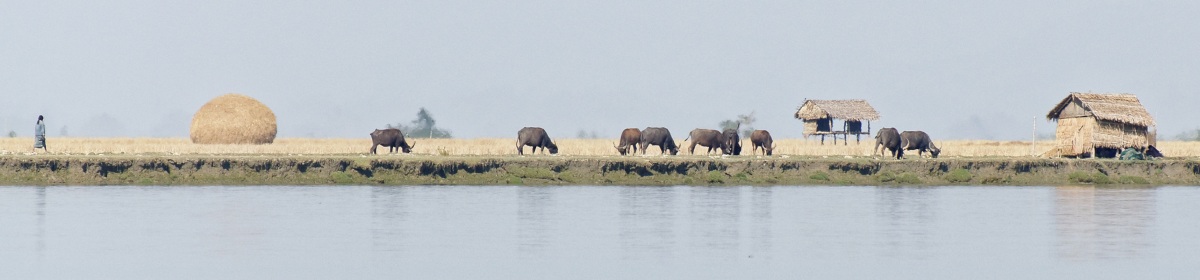
 Locals still go fishing in what looked like awkward and probably highly dangerous but effective fashion.

 The chance to get into areas that are still relatively untouched by mass tourism.

 Plus you never know when you’ll sail into the middle of a local festival. We literally did just that as we headed down river from Pakse to reach 4,000 Islands. A long boat race was going on, and Uwe and I didn’t need to be asked twice if we wanted to stay for a while and watch.


 We booked our trip with a gentle young guide and a variety of boats. The infrastructure is simple compared to Germany or Hong Kong, but with cell phones and patience it all went smoothly. When you’re in a place as lovely as Laos is, it’s all good.
 On our last trip to Laos we headed south to the quiet little city of Pakse in the Chapasak province. We wanted to see old ruins – and really spectacular waterfalls!


 When the French colonized Laos they came up with a bold (and ultimately quixotic) plan to build a railway through the region. They wanted to go around the waterfalls and create a faster, easier way to travel and ship goods either to the north, or to the southern Vietnam port of Saigon. The result is what a CNN article wryly refered to as “Laos’ first railway: 14 km of rust” [2].
 NOTES: [1] I turned 16 the year that Pink Floyd’s Dark Side of the Moon was released. If you know me, you know this fact explains everything, including what makes me laugh. [2]

 I can guarantee you we’ve already scoped out all the good places to eat! Gran Canaria was no exception, and Uwe found a highly praised locale kitty-corner to our hotel. Hungry, on Thursday we headed over to Restaurante de Cuchara and entered a small family restaurant, probably 12 tables max. The owners greeted guests like old friends (most of them were) and only the owners’ handsome son Guillermo spoke English. He took it upon himself to serve us each course – which he was also cooking – and explained each dish with pride. The meal was great. I’ve retained a little of my high school and college Spanish (moving to Germany and having to learn Deutsch highjacked most of the foreign language area of my brain). But I could read the flier on our table that said Restaurante de Cuchara was serving a special six-course menu on Saturday.


 I was dying to ask him a question. When he came with our desserts I said, “We’ve been wondering if we might ask you, where did you train as a chef?” He smiled. “NOMA, in Copenhagen. I worked for a while in Bangkok, too.” NOMA! We knew NOMA has been repeatedly rated the best restaurant in the world. [2]


