My sister Pam is a teacher for international schools. For the last three years she’s been located in the Hong Kong area. It’s a great place to visit: the languages are Cantonese and English, the transportation system is so simple that anyone can feel clever using it, and contrasts between modernity and tradition are everywhere you look.
Pam and her family live in the New Territories. This part of China is on the mainland north of Hong Kong. While Hong Kong is the most densely and vertically populated city on the planet, the New Territories are still relatively quiet. The landscape consists of steep, lush jungle peaks that end in bays and inlets.
The vertical density of Hong KongThe view from their apartment near Sai Kung
The region is growing, and changing fast. On the bus from the apartment we pass villages on hillsides or tucked into hamlets and harbors. Several floating villages of traditional houseboats are minutes away. And then the high rises suddenly appear, row after row after row.
There are lots more that look just like theseSo did you hear the one where the Buddhist monk, the Catholic priest, and the Jewish rabbi enter a temple…
It’s not far to Man Fat Tsz, the Ten Thousand Buddhas Monastery in Sha Tin. It was founded by the devout layman Venerable Yuexi (the Chinese月溪法師; pinyin: yuè xī). Building began in 1949 as Yuexi and his disciples carried everything up from the foot of the mountain. For eighteen years they constructed the buildings – and 12,800 Buddha statues.
You head up through a bamboo forest and statues line both sides of the path to the monastery. There are roughly 500 Arhan [1] statues in plastic, painted gold. Each one is unique.
Their expressions represent the experience of enlightenment. Other statues await once you reach the summit. (Click on any of the thumbnail photos for a closer look.)
I felt like I was in a tacky Buddhist Disneyland until I got to the top and entered the main temple. Before the altar is a glass case, and it contains Venerable Yuexi’s preserved body! His body (still perfectly intact) was exhumed eight months after his April 24, 1965 death. Yuexi was next embalmed with Chinese lacquer, his head and face covered in gold leaf. The Diamond Indestructible Body of Yuexi’s robed corpse sits in the lotus position. I was oddly moved by his preserved body: with the sight, I had a glimpse of religious truth. [2]
That feeling became surreal as we headed back to the bus stop.
This pagoda appeared on Hong Kong’s $100 banknotes
We climbed down a different set of steps past my least favorite creatures: wild monkeys.
And from the meditative hillside of Ten Thousand Buddhas, we neared and then entered the shopping mall complex at Sha Tin.
Sha Tin shopping mall
As I say, the New Territories has both the traditional and the modern. They all line the same path.
NOTES: [1] To quote Wikipedia, “…in TheravadaBuddhism, an Arhat (Sanskrit: अर्हत् arhat; Pali: arahant; “one who is worthy”) is a “perfected person” who has attained nirvana. In other Buddhist traditions the term has also been used for people far advanced along the path of Enlightenment.”
[2] Taking pictures inside the temple is not allowed.
Cleopatra: He’s speaking now, Or murmuring ‘Where’s my serpent of old Nile?’ — Shakespeare Antony and Cleopatra, Act I, Scene 4
This is Part 2 to my post about our brief trip to Luxor, Egypt. As I look through Uwe’s photographs from that week I’m struck by his images of the Nile.
There is something sensuous about this river… One of my very favorite Shakespeare plays is Antony and Cleopatra. Here is the description of Cleopatra floating down the Nile:
Enobarbus: The barge she sat in, like a burnished throne,
Burned on the water; the poop was beaten gold,
Purple the sails, and so perfumed, that
The winds were love-sick with them, the oars were silver,
Which to the tune of flutes kept stroke, and made
The water which they beat to follow faster,
As amorous of their strokes.
…From the barge A strange invisible perfume hits the sense
Of the adjacent wharfs. The city cast
Her people out upon her, and Antony,
Enthroned i’ the market-place, did sit alone,
Whistling to the air; which, but for vacancy,
Had gone to gaze on Cleopatra too
And made a gap in nature.
Agrippa: Rare Egyptian! (Act II, Scene 2)
The Nile is iconic. It’s the longest river in the world, around 4,160 miles or 6,670 kilometers The Nile originates at Lake Victoria and Lake Tana, and ends at the Mediterranean. It flows northward through Tanzania, Rwanda, Kenya, Uganda, Burundi, Ethiopia, Democratic Republic of the Congo, Sudan, South Sudan, and Egypt.
It is the largest oasis on the planet. When we visited in May 2013 tourism had declined so far that there were no longer any direct flights to Luxor. Instead, we flew to Hurghada on the Red Sea and a van met us. We drove for four hours across the barest desert landscape imaginable. No nomads, no towns, no vegetation or animal life to be seen. When we reached the Nile, visible signs of life appeared again.
All of the great ancient cities we visited are on the river’s banks. Karnak, Luxor/Thebes. Dendera, Edfu. From our hotel balcony we gazed directly across the river to the Valley of the Kings. The Valleys of the Kings, the Queens and the Nobles are on the west bank of the Nile River as you must be buried on that side in order to enter the afterlife.
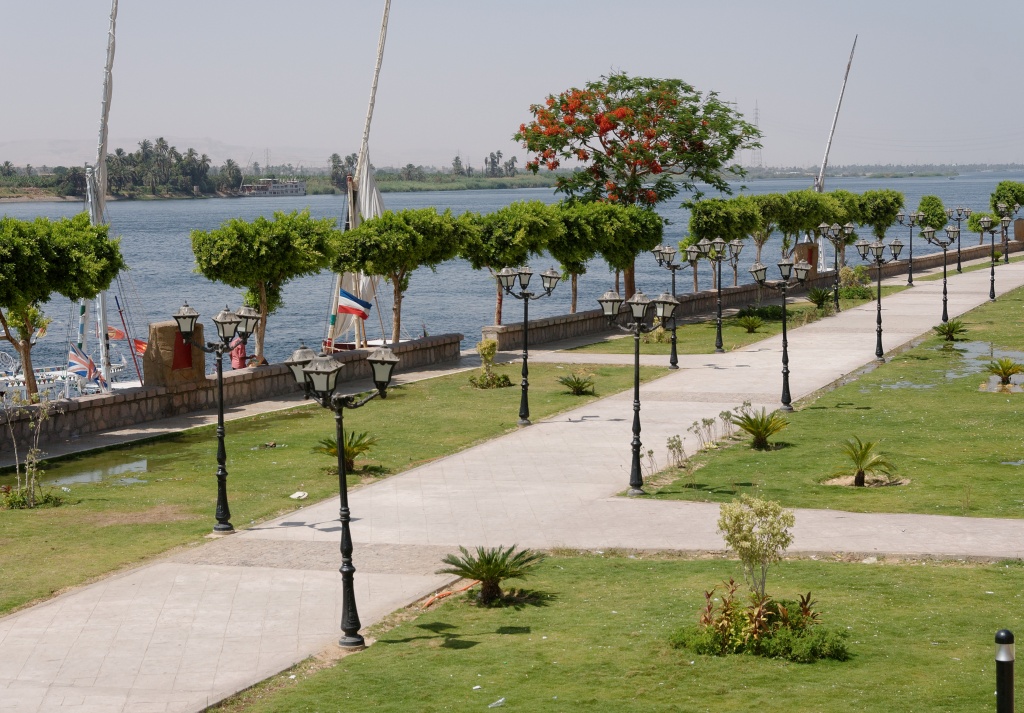
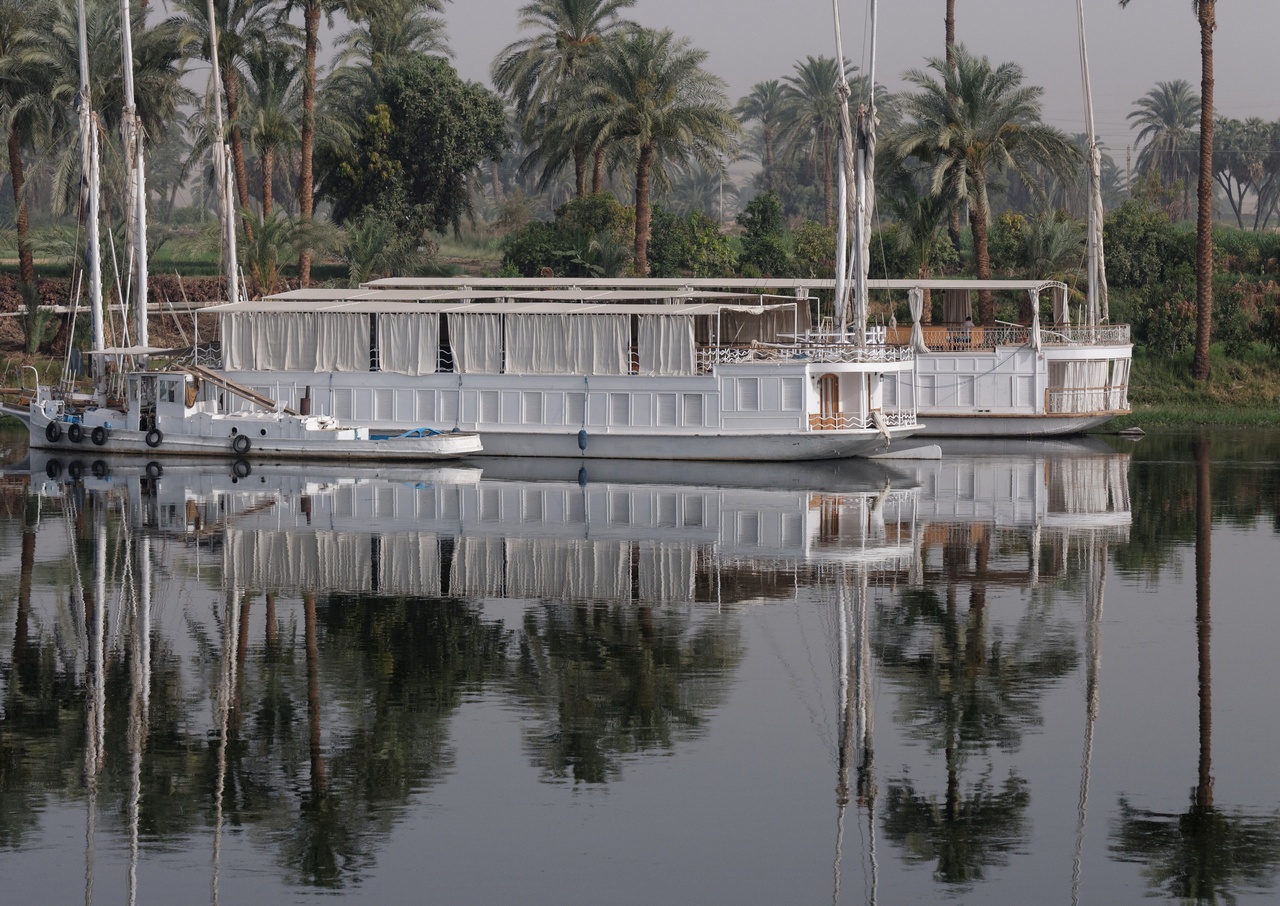
We sailed downriver to Dendera, enjoying the scenery that flowed slowly past.
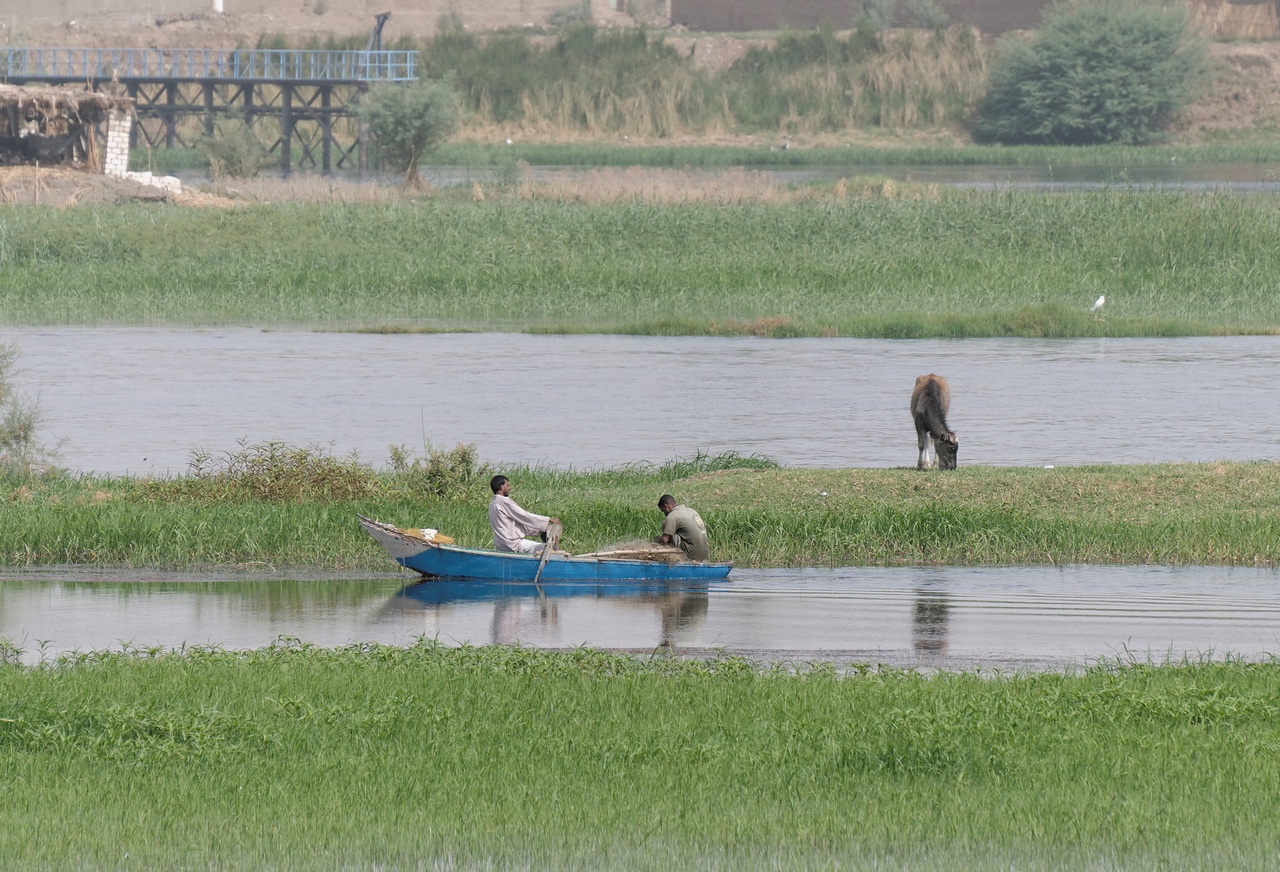
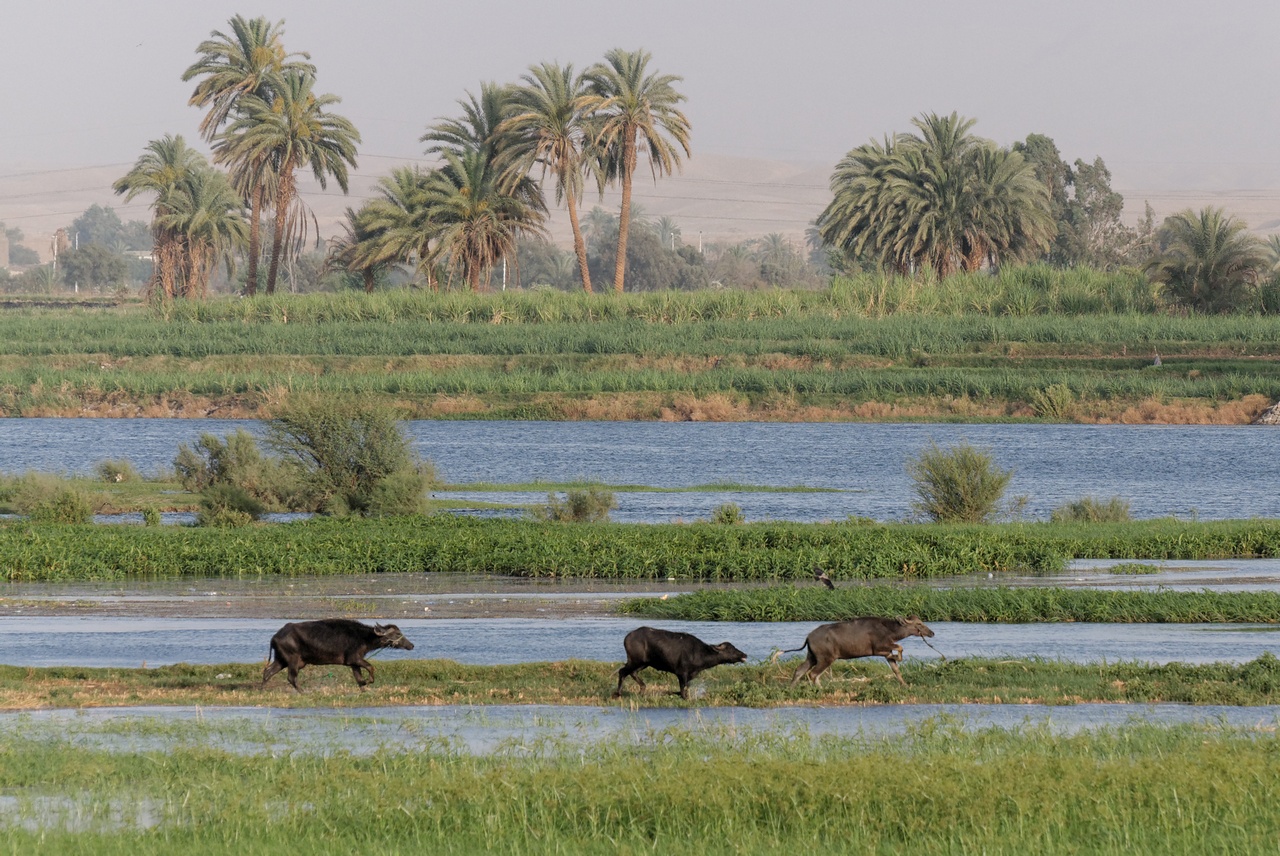
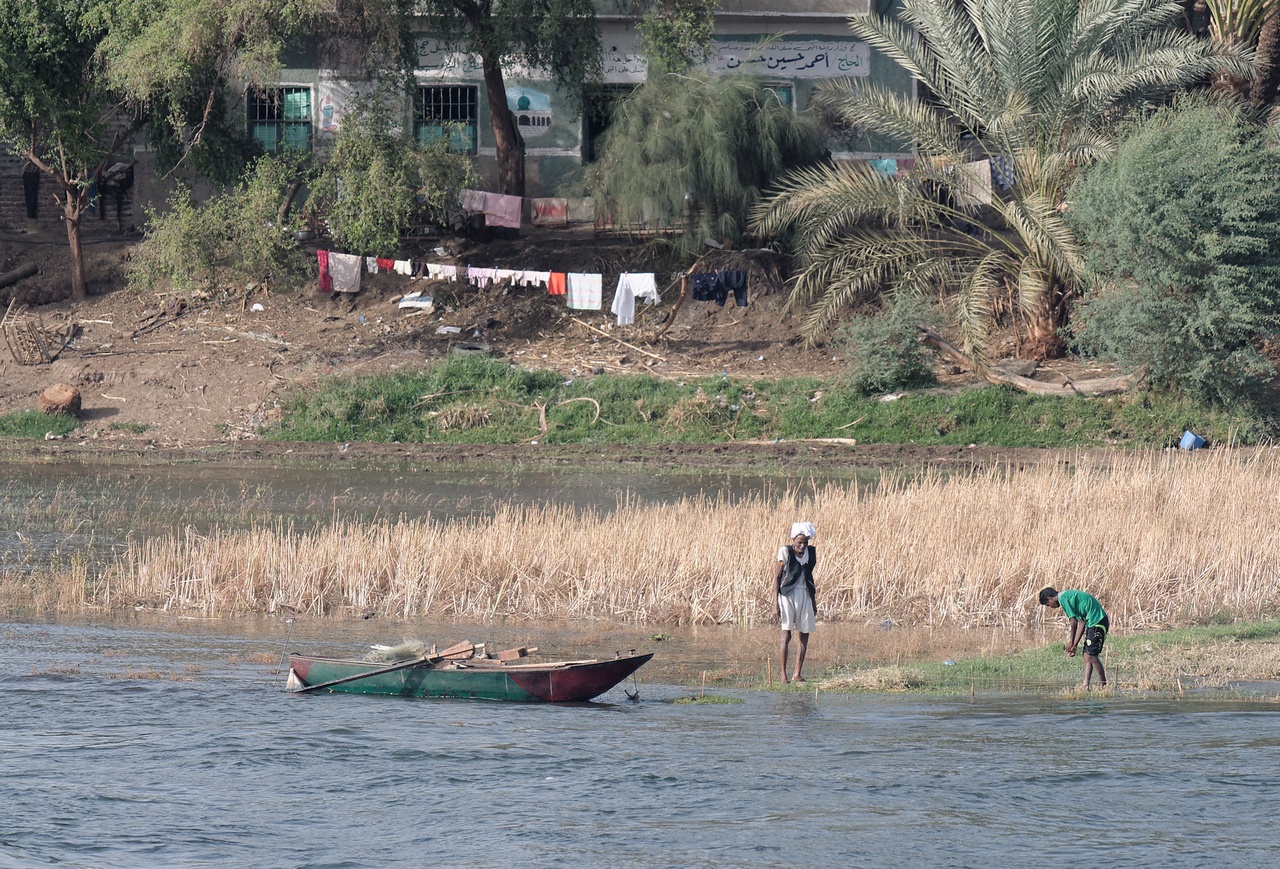
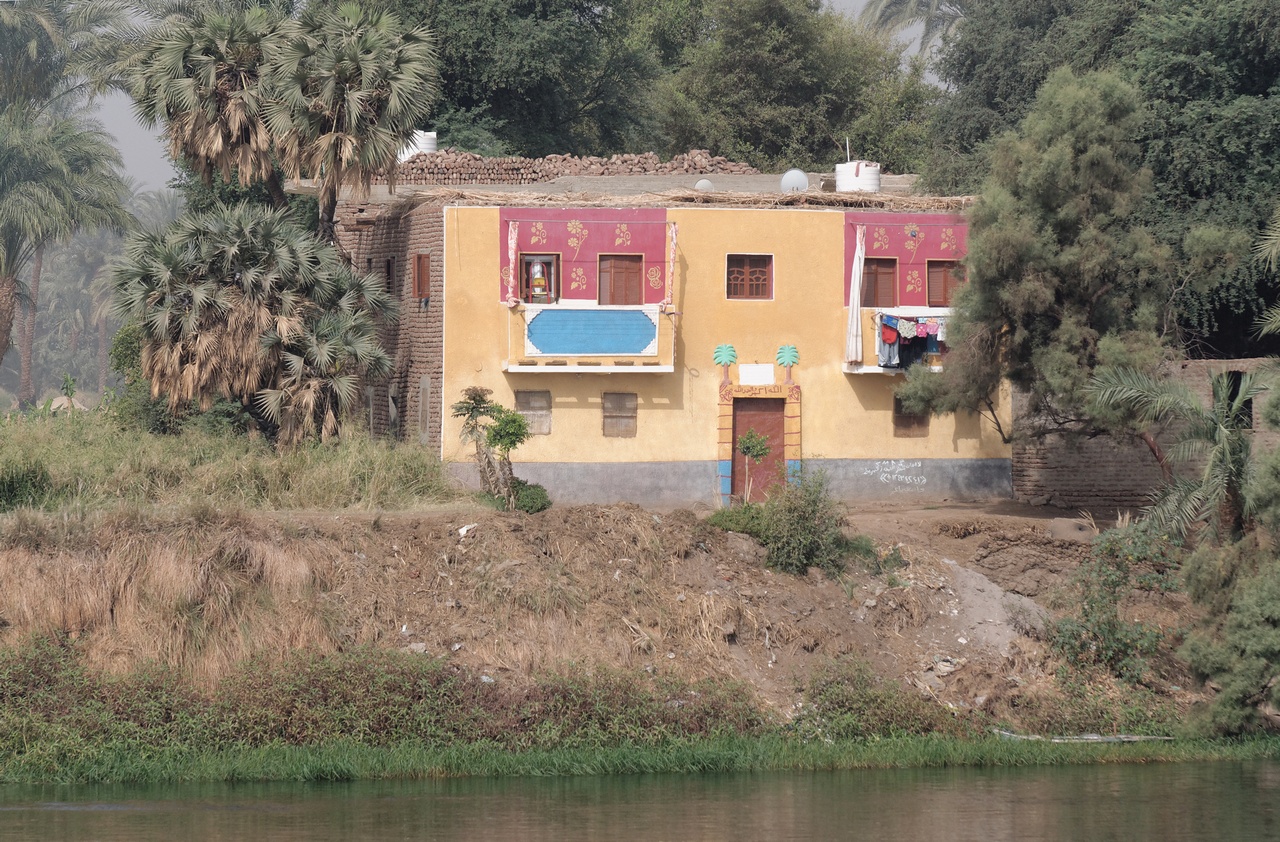
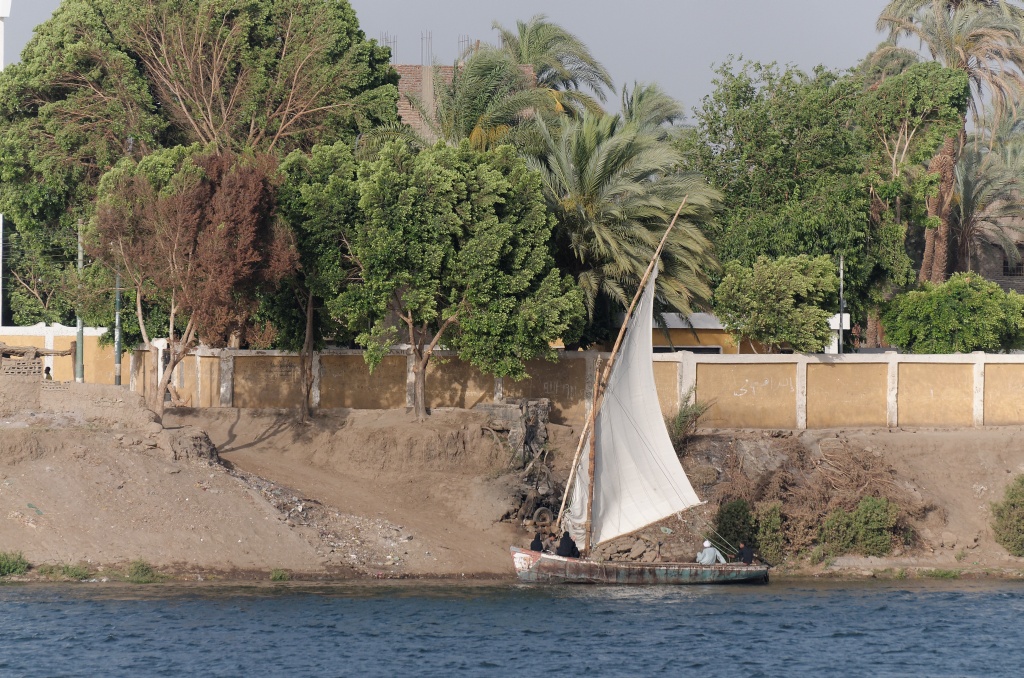
The fertile Nile was the original source of Egypt’s wealth and today 40 million Egyptians (50% of the population) live near its banks. There was life on the shores and in the water everywhere we looked.
Cleopatra: …we’ll to th’ river: there, My music playing far off, I will betray Tawny-finned fishes. (Act II, Scene 5)
Antony: The higher Nilus swells, The more it promises; as it ebbs, the seedsman Upon the slime and ooze scatters his grain, And shortly comes to harvest. (Act II, Scene 7)
The Egyptian calendar was based on the Nile’s three flood cycles. According to Wikipedia, “[t]hese seasons, each consisting of four months of thirty days each, were called Akhet, Peret, and Shemu. Akhet, which means inundation, was the time of the year when the Nile flooded, leaving several layers of fertile soil behind, aiding in agricultural growth. Peret was the growing season, and Shemu, the last season, was the harvest season when there were no rains.” [1]
As I looked out at the river and thought about my mother, I sensed the rhythms of life and death more clearly than ever before.
To the ancients, the Nile was the River Ar meaning “black” because of the rich, fertile sediment left on the banks from the Nile’s flooding. When the Aswan Dam was built in 1970, the annual flooding ended. But by the time we left I knew why Shakespeare’s hero confessed,
Antony: Egypt, thou knew’st too well My heart was to thy rudder tied by th’ strings, And thou shouldst tow me after. (Act III, Scene 9)
Medinet Habu, the Mortuary Temple of Ramses III, with none
Let’s get one thing clear right away: Uwe and I are NOT danger chasers. We don’t pick areas to visit that are experiencing unrest or natural disasters. When we went to Luxor for a week in May 2013, tourism in the area was wa-a-y down. But it’s so far from Cairo that we never felt threatened.
Edfu – Temple of Horus
A week after we were there Egypt imploded, and we would not have made that trip. As it was we had Luxor, the Valley of the Kings, and the ruins up and down the Nile banks to ourselves. What an experience, like getting a private tour of the world’s greatest antiquities!
Dendera Temple
Egypt was a special wish of mine for decades. My mom was a teacher, and when she died the last unit she was teaching was on ancient Egypt. At her funeral my family was touched to receive drawings from the children she’d taught. They’d drawn mummies, and Mom’s spirit as a bird. There was even a drawing of a mummified feline with a caption: Mrs. Campbell’s cat.
Luxor TemplePillars like lotus
Some of the world’s most spectacular ruins, and there were almost no other tourists. Occasionally a lone bus pulled in with a group from a cruise ship or daytrippers from Hurghada on the coast, but most of the week we wandered in amazement all by ourselves.
Deir el-Bahari, Temple of Queen Hathsephut
I can’t even begin to understand Egyptian iconography. Gods with the heads of cows?
The goddess Hathor
or an ibis? how about an alligator? A giant scarab as an object of worship — huhhh? It’s so foreign to me that Luxor was a glorious dip into an age that I didn’t even bother trying to grasp.
The scale of what we were looking at was also beyond my imagination, both in age and in sheer height! At each site we admired impossibly high ceilings. We could see the original paint, thousands of years later.
Original blue paint
Even the air feels like it contains the dusty molecules of ancient dynasties…. We sat each evening on the hotel balcony and enjoyed the view and the heat. On the day that I became older than my mother was when she passed away, I sat looking out over the Nile.
The ageless Nile River
Aside from dishonest horse carriage drivers, the Egyptians were all kind, helpful, and incredibly friendly. I look forward to returning!
Waiting.
NOTES: All photogaphs can be enlarged by simply clicking on the image. More of Uwe’s images from Egypt and his photography may be viewed at viewpics.de.
Uwe and I put an exclamation point at the end whenever we talk about Khajuraho! We visited last January, and we’re still talking about it.
In the interests of proper grammar I’m leaving out the exclamation point from now on. You may add it in for yourselves if you like.…
When we visited, Khajuraho could only be reached via a long trek on bad roads. Since we’re talking about India, this means the roads are bad indeed.
Where’d the road go?Down here maybe?
The driver we’d hired was there to meet us at our hotel in Agra, and off we went. Five bone-jolting hours later we reached our destination.
Along with its inaccessibility, Khajuraho is notorious for 1,000 year old, perfectly preserved, UNESCO World Heritage erotic carvings.
Somehow this site survived a millennia (millennia, people!), in a spot that had no fortresses or fortifications to speak of. The temple complex existed simply for the purpose of worship.
And what worship. Every single inch of the temple buildings are carved in high relief, depicting gods, tender lovers, voluptuous attendants, monkeys, elephants, assistants for the sexual act….
Hundreds of skilled stonemasons were hired to build the site. The Khajuraho region has excellent sandstone, and the sandstone temples were built with granite foundations. All were constructed without mortar! Instead, gravity holds the stones together with mortise and tenon joints. Some of these stones are megaliths weighing up to 20 tons.
The glory of sandstone is that it loans itself to delicate carving. Even viewing the temple walls from the ground we could see the wrinkles in Ganesh’s trunk; the fingernails of the apsaras and the beads in their strands of jewelry; the sheer layers of veils over their thighs and buttocks.
Uwe vanished almost immediately with his camera, leaving me alone with the young male guide. I could feel my face go red, and it wasn’t a hot flash or sunburn. I was terribly afraid of how embarrassed I was going to be. But the guide pointed out the various depictions of the act of love and spoke in a clear calm voice, explaining the significance (pull your minds of out the gutter, dear readers) in terms of energy, religion, and esoteric philosophy.
It was mid-January, past the usual Christmas tourist season. It was also a two-week period when northern and central India get swathed in fogs – something smarter tourists than we knew. As a result we had the pleasure of being two of the few Westerners at the site.
Most of the others were Indians on holiday, and I was touched to see that at Khajuraho, this meant young married couples. They walked around the compound, standing in front of particularly erotic carved panels, heads together in discussion.
How about the next panel?Is that a new yoga position?
While only 10% of the carvings depict sexual acts, you can guess which panels elicited the most commentary. These were the love-making couples known as maithunas. Other carvings depict everyday activities: playing musicians, potters, farmers, soldiers on horseback, etc.
Musicians
The temples were probably built in the one hundred year period between 950 and 1050 AD, during the Rajput Chandella dynasty. According to historical records, by 1100 Khajuraho contained 85 temples covering 20 square kilometers. Roughly 20 temples still stand. They were located 60 kilometers from Mahoba, the medieval capital of the Chandela kingdom.
Khajuraho was mentioned by the Arabic historian Abu Rihan-al-Biruni, in 1022 AD, and by Ibn Battuta, the Moroccan traveler, in 1335 AD.
When Muslim rulers took control, heathen places of worship were systematically destroyed. Ironically, even centuries ago the remoteness of these temples helped secure their survival. Nature did the rest as vegetation and forest reclaimed the site. For years the temples were covered by dense date palm trees which gave the city its name: in Hindi, Khajur = date. (The more ancient name was Vatsa.)
The scenes explain Hinduism’s four goals for life: dharma (right way of living), kama (aesthetic enjoyment), artha (prosperity) and moksha (liberation). The complexity of the geometric layout and the grid pattern of the temples with their circles, squares and triangles, the importance of geographic orientation and bodies of water and the carvings’ iconography is beyond my very weak grasp. Instead, here is an excerpt from the UNESCO website:
Greatly influenced by the Tantric school of thought, the Chandela kings promoted various Tantric doctrines through royal monuments, including temples. Sculptors of Khajuraho depicted all aspects of life. The society of the time believed in dealing frankly and openly with all aspects of life, including sex. Sex is important because Tantric cosmos is divided into the male and female principle. Male principle has the form and potential, female has the energy. According to Hindu and Tantric philosophy, one cannot achieve anything without the other, as they manifest themselves in all aspects of the universe. Nothing can exist without their cooperation and coexistence. In accordance with ancient treaties on architecture, erotic depictions were reserved for specific parts of the temples only. The rest of the temple was profusely covered with other aspects of life, secular and spiritual. Source: UNESCO/CLT/WHC
Khajuraho remained forgotten by the outside world until 1838 when a British army engineer, Captain T.S. Burt, was carried in via palanquin. I laughed so hard when I read that the Victorian officer was shocked by what he found….
Go to my earlier posts Travel Karma & Remind Me Again: What Are We Doing Here? to read about our visits to India. All photogaphs can be enlarged by simply clicking on the image. More of Uwe’s pictures from India and his photography may be viewed at viewpics.de.
We’ve come to Paris for a quick getaway, and Stuttgart is less than 4 hours by direct fast train. As we think about what we want to do and see, we realize neither of us have ever visited Chartres.
Uwe and I go out of our way to see sacred places around the globe. (See my posts The Cult of Bà Chúa Xứ or The Music of the Heavenly Spheres for some photos and tales from other sacred spots.) Energies gather in some unlikely places. Sometimes I stand in famous spots and am disappointed, while a place less known for religion makes me feel the presence of the divine.
Chartres. I’ve been trying for days – weeks, actually – to summarize the “facts” about this site. It was built 1140-1260 and the labyrinth was laid in the first decade of the 13th century. I wonder what to mention about Chartres’ 1,000 years as a pilgrimage destination, or the female energies of the cathedral and their tenderness. Mary’s tunic, the Sancta Camisia worn at the birth of Jesus Christ, was brought here by Charlemagne. The king in turn had been given the relic as a gift during a trip to Jerusalem.
When the earlier church building burned on June 10, 1194, the Sancta Camisia miraculously survived. Chartres remains an important Marian pilgrimage center, and the faithful still come from around the world over to honor it.
Chartres is one of the most impressive Gothic cathedrals on Earth. Back in my college days at the University of Oregon, Professor James Boren in his Chaucer and Medieval Literature classes explained Chartres as literally turning the architectural form inside out. For the first time the ribs holding up the entire structure had been placed outside, allowing the inside heart of the structure to soar up into the Heavens, seemingly without limits. The support of flying buttresses was necessary because of the unprecedented size and heights of the stained glass windows and the nave. Professor Boren’s face glowed; this stern and learned man radiated as he lectured about a place that he said changed him when he saw it. That lecture and the look on his face stayed with me. Chartres: someday I would see it.
***
Chartres Cathedral contains one of the few remaining medieval labyrinths. It’s large with a circumference of 131 feet, almost exactly the same size as the West Rose window.
Rose Window
In the Middle Ages, French church labyrinths were the sites of Easter dances involving clergy and the tossing of a leather ball. Sadly, the labyrinths were destroyed, covered over, or hidden by Church authorities suspicious of their powers and pagan beginnings. (Labyrinths, including Chartres’, traditionally had an disk or placque of Theseus and Ariadne and the Minotaur at their centers. In fact, another name for a cathedral that contained a labyrinth was the “Domus Daedali” [House of Daedalus], a nod to antiquity’s Daedalus, designer of the labyrinth that held the Minotaur in Knossos.) *
But, Chartres’ labyrinth survived. I learn that while it’s covered by chairs most of the time, the labyrinth is made free for visitors to enter on Fridays. My one request to Uwe for our trip becomes, “Please let’s go to Chartres on Friday!”
So here we are, entering one of the holy pilgrimage destinations in Christianity.
Chartres. Once inside, the cathedral’s beauty immediately takes my breath away. I am so deeply moved that in the next moment I’m close to tears. Whatever I expected, this sacred soaring space is beyond all imagination. Light streams in through the windows and illuminates the visitors, pilgrims, and the simply curious. All of us are suffused in colors.
For a while I just walk around. Uwe’s already moved off with his camera, ready as always to use his art with photography to capture in images what my brain grapples with in words.
As the minutes pass I grow more and more stunned. And I remain dangerously, or is that gorgeously, close to breaking into tears. There is an energy to this place, a sense of the holy and the really, really blessed, that I have seldom felt anywhere.
The Schwedagon Pagoda in Burma comes to mind. It is the most important pagoda in the country, and I felt the top of my head buzz like it was going to blow off from the concentration of religious energies. Or a back pond in the Adirondacks with only my family as fellow witnesses: loons with a pair of chicks calling in low cries to one another as they eyed us but didn’t swim away. Or a tiny Greek Orthodox church in Thessaloniki, supposedly built on the site where Apostle Paul preached. I attended on Sunday with my friend Cynthia and our Greek host Fotis, who led us up to an altar surrounded by burning, hand-dipped wax tapers. Fotis insisted we take bread from the common basket. Tears streamed on both our faces; I finally felt the deeper meaning of breaking bread in fellowship.
All of these places’ sacred energies are present in Chartres. It is so much more than I deserve or had awaited. I take a deep breath to center myself, and move forward to stand poised at the entry to the labyrinth.
***
“A labyrinth is an ancient symbol that relates to wholeness. It combines the imagery of the circle and the spiral into a meandering but purposeful path. …
“A labyrinth is an archetype with which we can have a direct experience. … It is a metaphor for life’s journey. It is a symbol that creates a sacred space and place and takes us out of our ego to “That Which Is Within.” At its most basic level the labyrinth is a metaphor for the journey to the center of your deepest self and back out into the world with a broadened understanding of who you are. …
“A labyrinth is not a maze. A maze is like a puzzle to be solved. It has twists, turns, and blind alleys. It is a left brain task that requires logical, sequential, analytical activity to find the correct path into the maze and out. A labyrinth has only one path. It is unicursal. The way in is the way out. There are no blind alleys. The path leads you on a circuitous path to the center and out again.
“A labyrinth is a right brain task. It involves intuition, creativity, and imagery. With a maze many choices must be made and an active mind is needed to solve the problem of finding the center. With a labyrinth there is only one choice to be made. The choice is to enter or not. A more passive, receptive mindset is needed. The choice is whether or not to walk a spiritual path.” – Dan Johnston, Ph.D. at www.lessons4living.com
Exterior Chartres Cathedral
While I walk the labyrinth and contemplate the mystery of the sacred**, Uwe photographs me. When I see his photos later I’m surprised, and glad.
***
NOTES: * Another name for the eleven-circuit labyrinth is the “Chemin de Jerusalem” or Road of Jerusalem. Walking the labyrinth in Chartres or other places could be made instead of making the pilgrimage to Jerusalem.
** I haven’t even tried to talk about the lunations of the labyrinth. Their meaning is still debated. A celestial calendar? Esoteric design of the deeper mysteries?
Walking a Sacred Path. Rediscovering the Labyrinth as a Spiritual Tool. Dr. Lauren Artress, Riverhead Books, 1995.
Classes of children, schooled in knowledge of what
unthinkable tragedy
took
place
here
stand for photos before the fountain with the flame
in the center burning
until the last nuclear weapon is dismantled;
Before the cenotaph shielding
names of the dead, reopened, names
added on August 6th.
The Peace Park, the terrible
hypocenter.
And the tourists with cameras?
We bear witness. We come to
ask, Why?
How many
angels danced on the head of a pin?
We come to see The Truth or
as much truth as we can bear.
Seeing demands the clearest sight
possible when your eyes are filled
with the pin pricks of tears
Water,
like the water the burned begged for as they died
The peace fountains spouting outside the museum
the river that flows
calmly, becalmingly
near the A-Bomb Dome,
where the cranes have taken up residence.
(17 October 2010 21:27 p.m.)
NOTES: I wrote the first version of this poem while we visited Japan in 2010. The atomic bomb was dropped on Hiroshima at 8:15 a.m.on August 6, 1945. Sadako Sasaki lived 2 kilometers from the epicenter. She was 2 years old at the time, and died of the radiation exposure 10 years later. Sadako is famous for folding origami cranes. According to the Japanese legend, anyone who folds 1,000 cranes will be granted a wish: Sadako hoped to be healed. Today classrooms of children all around the world send strings of paper cranes to be displayed at Sadako Sasaki’s memorial in the Peace Park. Her statue and story are a powerful reminder of the innocent lives lost.
The cenotaph is opened each August 6th and the newest names of the dead are added. Its arched form provides a shelter to the souls of the victims.
The Peace Park contains statues dedicated by countries around the world; a museum; and monuments. We visited at night and the Dome (the only building left standing after the blast) was occupied by cranes. The image of this World Heritage Monument and the symbolic birds took a powerful hold on my imagination. When we returned at daylight to visit the park it overflowed with classes of laughing children, stunned tourists, and an atmosphere that is impossible to describe. It is a place of shared tragedy, and humanity.
The cranes were still there, perching in the Dome.
(All photographs can be enlarged by simply clicking on the image.)
More pictures from our trip to Japan and of Uwe’s photography may be viewed at viewpics.de.
We love travel. I refer to traveling to new cultures and places as connecting the dots. With each trip I feel a little more connected to the world at large and to the various dots that make up my picture of this planet and we who inhabit it.
While in Burma, we took a boat up the Irrawaddy River from Mandalay to Mingun for the day. Yet another fallen kingdom, Mingun is reknowned for the largest functioning bell in the world. It weighs in at 55,555 viss (90,718 kilograms or 199,999 pounds). The sound is a deep claaangg, rung by thumping the bell hard on the lip with a mallet. Mingun is also famous for the king who bankrupted his people with an attempt to outdo every shrine-builder who’d ever lived: King Bodawpaya wanted to build the huge stupa known as Mingun Pahtodawgyi.
It would be the highest in the world, a magnificent 150 meters tall, dwarfing everything built
How the stupa would have appeared finished
prior to it.
Work began in 1790.
King Bodawpaya never finished his religious edifice. He ran out of funds; or, halted construction due to a prophesy that his realm would end when the building was completed; or, that completing the stupa would signal his death. An earthquake on March 23, 1839 dislodged the huge bell and damaged the structure beyond saving. The Mingun Pahtodawgyi became the world’s largest pile of bricks…
Mingun Pahtodawgyi. Can you spot the teeny tiny humans in the photograph? (Click on the photograph)
The structure stands, all semi-finished 50 meters (150 feet) of it, roughly a third of the original planned height.
It’s a holy place and the faithful still come to worship. And the curious come to climb it [enter Jadi and Uwe, stage right]. Now, at any sacred Buddhist site, you remove your shoes at the base of the structure.
Going up, sir?
And you climb the stairs, barefoot, and then clambor on the ruins, barefoot, for one truly awe-inspiring view of the Irrawaddy River and the surrounding countryside.
View of the Irrawaddy River and several of Mingun’s gorgeous temples
Shan pilgrims in traditional outfits had also climbed the stupa and gave us the gift of their smiles and waves.
Shan pilgrims
It was a magnificent afternoon and yet another highlight of our 4 weeks in Burma.
Picnicking on the Edge
It wasn’t until we were safely home again that I got a good look at Uwe’s photographs.
Go on, I dare youJust a few small jumps and you’re there
There was a photo I had taken, too.
Hope those bricks are stable!
All photogaphs can be enlarged by simply clicking on the image. And click on the final image to enlarge it for an even better idea of how damaged the site is.
More pictures from our trip to Burma, and of Uwe’s photography, may be viewed at viewpics.de.
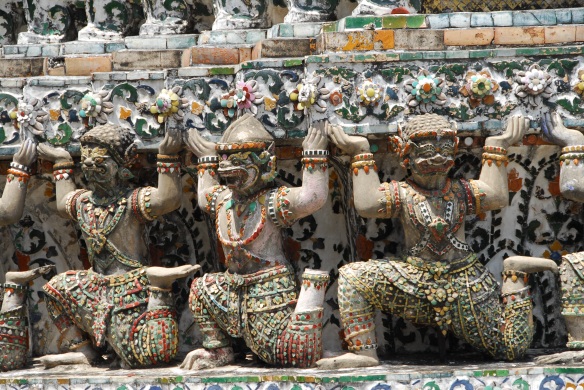
Pieter was right: the temple massages at Wat Pho really were awesome. Lisa wasn’t surprised by how crowded the site was, because it was dazzlingly, exotically beautiful. All of the palace buildings had golden roofs that gracefully swooped down and curled back up towards the heavens. Guardian demons held up columns or stood with watchful eyes. All of the surfaces were covered with encrusted diamond shapes of colored glass, or tiny mirrors. Throngs of tourists wandered with cameras and guidebooks, admiring the buildings that glittered in the bright Thai sun. “It’s almost as if this entire site is winking at us!” Lisa exclaimed.
Lisa and Babs wandered with their own cameras until they found the traditional massage school. An attendant asked them what kind of session they wanted (how long? what style massage? rather from a male or female therapist, or no preference?) and assigned them numbers. Babs’s number was called first and she looked nervous as she vanished out of sight with a therapist. A few minutes later Lisa heard 32 announced. She stood up and a young Thai woman led her to a different building.
The slats of the rattan walls in the low open structure let in both light and air. Lisa was led to the back of the long room, filled with low mats to the left and right. All around her fully clothed people lay on backs or stomachs as Thai therapists pulled at their limbs. Her therapist pointed for Lisa to lie down, and Lisa watched intently as the Thai girl put her palms together in front of her chest and whispered a prayer. She took one of Lisa’s legs in her hands, and Lisa forgot everything around her as the therapist smoothed away the knots of travel.
###
In the tropical climate Babs’s own long blond hair had gone completely limp. Babs was miserable. She was pretending she wasn’t shocked and frightened of the foreign megalopolis. Thailand’s capitol city might be a short plane ride away from Singapore. In reality, Bangkok was light years distant from any sanitized, orderly place. Babs knew Lisa admired her for what she perceived to be Babs’s sophistication and worldliness, her previous international travel experience. But just a few days in Bangkok quickly forced Babs to admit how terribly narrow the contours of her worldly knowledge were.
She was terrified of the jostling throngs and afraid of the foreign faces hurrying down the streets. The Bay Area consisted of lots of ethnic groups, of Americans. The jumble of nationalities here was far too authentic. If one more sticky brown body brushed against hers, she would have to scream.
At the temple Babs had been unable to relax despite the massage therapist’s coaxing, dexterous fingers. She had lain fearful and stiff, horribly awkward as a stranger touched her. Babs left the temple with an uncomfortable awareness of how uptight she was and no idea of how to release it.
Her sinuses were clogged with humidity and the aromas of overripe fruits and other odors she couldn’t identify. The stench from open food grills just made her want to gag, while the sly, half closed eyes of the Buddhas in their strange rich temples frightened her. They watched Babs, and on all accounts they found her wanting. The glittering Thai world was simultaneously far too blinding, and contained far too much clarity.
Lisa noticed nothing of how scared Babs was. Instead, Lisa charged head first into the contradictory experience of the crowded streets and serene, glittering temples. Babs was dismayed first by her friend Lisa’s surprising lack of fear, and next by her startling physical transformation. For the first time in their friendship she was discerning a little stab of jealousy against plain Lisa.
– from my short story “Banged Cock” in Broken In: A Novel in Stories. Available online at amazon.com,amazon.de, and amazon in countries everywhere.
(All photogaphs can be enlarged by simply clicking on the image.)
More pictures from our trips to Thailand, and of Uwe’s photography, may be viewed at viewpics.de.
In 2009 we spent 4 weeks in Burma, the maximum time permitted on a visa. For years we’d debated back and forth about whether to go. Does one travel to a repressive regime? Just the year before, monks were shot for demonstrating peacefully in the streets. In the end we decided to go and bear witness. A country closed tight and ruled with iron fists, the poverty and corruption are unbelievable… as are the loving kindness of the Burmese and the beauty and magic of their land. I have been pondering what to post about our trip to Burma and how to write it, because Burma is unlike anyplace on earth.
But these are only words.
Let me begin again, this time with a story:
Sacred Pali script
On our very last day in-country, in Yangon we stopped at a café on a busy street with outdoor tables. All of the tables were filled with other tourists. The locals did not have the money for anything so extravagant. A beer, a pineapple juice, and hot green tea arrived; I wrote out some last post cards. Hovering in the street were the post card seller, a hawker for newspapers (used and days old), and a skinny boy with an endless “Hello? hello! Hello? hello!” When a tourist looked his way he said “Eat,” and mimed someone putting food in his mouth. He hovered looking over the wall dividing the café from the street, persistent with hunger.
I became aware of an ethereal music swimming its way up from the background of my consciousness. I thought someone down the street a ways with access to a power generator was playing a recording of a beautiful, haunting voice. Then the sound came nearer, and it was a young Burmese person. At first I thought it was a man slowly making his way down the road. It was a woman: she had her hair up under a cap and thanaka paste on her cheeks to protect her skin from the sun.
A voice from the Heavenly Spheres
She halted and stood very still as she sang, or chanted verses, or recited a Buddhist prayer. It wasn’t clear if she was singing or speaking and didn’t matter. The purity of that voice pierced all barriers and reached all hearts. Every so often the little metal cymbals in her fingers went ching! in a perfect counterpoint.
When she stopped, the entire café burst into spontaneous applause. People kept getting out of their seats to put bills in the can on a string around her neck. I checked my wallet. I knew my last offering in Burma was going to this young woman with the voice that sang with the music of the spheres. This music usually can’t be heard. The Greek mathematician Pythagoras of Samos believed the movement of planets (heavenly spheres) creates ethereal and earthly harmonies; Shakespeare wrote often about how these harmonies affect events. All I know for sure is that on that afternoon, in a dusty street in Burma, a young woman was channeling that music for us to hear.
I walked out with a 1,000 kyat note, stepped around the restaurant’s retaining wall to donate – and saw my singer had just one leg. She was propping herself up with a rough plank of wood.
This is my final image of the country sometimes called Myanmar. This is my avatar for Burma: a transcendent voice beyond language, standing with only one leg, singing gloriously, regardless.
I will post more about Burma in the coming months.
(All photogaphs can be enlarged by simply clicking on the image.)


 You head up through a bamboo forest and statues line both sides of the path to the monastery.
  There are roughly 500 Arhan [1] statues in plastic, painted gold. Each one is unique.


 That feeling became surreal as we headed back to the bus stop.

 We climbed down a different set of steps past my least favorite creatures: wild monkeys.
 And from the meditative hillside of Ten Thousand Buddhas, we neared and then entered the shopping mall complex at Sha Tin.