NOTE: Illustrator/author Maurice Sendak was born on 10 June, 1928 in England. In his honor I am reprinting the post I wrote upon hearing that he had died. —Jadi
Our first experiences learning to speak seem to involve rhymes. [Twinkle twinkle and Dr. Suess, anyone?] We recite as children, loving language’s sing-song chants.
One of the very first pieces I memorized as a child (to this day I can recite it) was ‘The Cow’ from A Child’s Garden of Verses and Underwoods by Robert Louis Stevenson, printed in 1913.
| The Cow |
| The friendly cow all red and white | |
| I love with all my heart: | |
| She gives me cream with all her might, | |
| To eat with apple-tart. | |
| She wanders lowing here and there, |
5 |
| And yet she cannot stray, | |
| All in the pleasant open air, | |
| The pleasant light of day; | |
| And blown by all the winds that pass | |
| And wet with all the showers, |
10 |
| She walks among the meadow grass | |
| And eats the meadow flowers. |
Can’t you see her?? In my child’s brain she was white and a funny shade of red (who ever heard of a red cow? I mean, really.) And she was named Flossie, or Maisie, or Bessie. Placid Maisie meanders in a huge field, chewing her cud and surrounded by fairy rings of little flowers.
I have to be in the right mood for poetry, but I still have the used copy of The Norton Anthology of Modern Poetry from my college days of long ago. (How long ago? Decades. A couple of ’em.) My edition of Robert Frost’s complete works came to me when my mother died. When I read Frost, his poems of New England keep me linked to her, too.
Emily Dickinson still knocks me out, and every word Shakespeare penned is poetry in exalted form.
Poetry is emotion and experience expressed in crystalline shapes, no matter whether it’s metered or free verse. Prose works by poets betray themselves through the beauty of the writing. Think of The English Patient. I read that book slower and slower, and found myself rereading pages over and over, savoring Ondaatje’s mastery with language. Or anything by Ray Bradbury: each of his strange magical visions contains a goodly dose of poetry.
Hmm. I just went back and read what I’ve got here so far… Scratch the comment about needing to be in a certain mood to read poetry.
The Muses pay a very special visit on those they gift with the ability to speak through poems. For me it’s the hardest of all forms of writing. Sadly, the poetic Muses Erato (love poetry), Calliope (epic poetry), Euterpe (songs and elegiac poetry), and their sister Polyhymnia (hymns and sacred poetry) just don’t knock on my door more than once a decade or so. An impulse to even attempt a poem is the sighting and citing of a rare bird. The last time, and it came over me in a total rush of surprise and inspiration, was the death of Maurice Sendak.
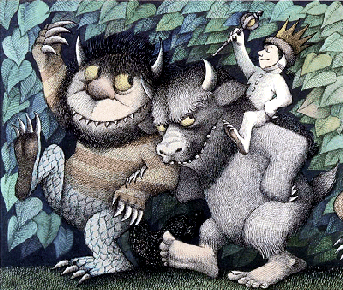
(Photo from Wikipedia)
Mr. Sendak accompanied my childhood and probably yours too, and he was particularly part of my sister Pam’s early years. I remember his Nutshell Library books, extra small to fit the hands of children. There were 4 of them: Alligators All Around, Chicken Soup With Rice, One Was Johnny, and Pierre (A Cautionary Tale). Pammy read them repeatedly, relating especially to the contrary Pierre. A few years ago I spotted an interview with Sendak in The New York Times (click here for the interview).
The article brought back those little books and how much my sister loved Maurice Sendak. I promptly sent the link to Pam and we spent several weeks emailing back and forth about his wonderful art and our childhood memories.
In May last year, Maurice passed away. My sister was teaching in Japan; had she heard yet? For some reason I wanted to be the person to break the news to her. I debated how to contact Pam and gently let her know.
The next morning I awoke preoccupied with way too much to do. I began my tasks with the radio on. NPR mentioned that Terry Gross was doing a special Fresh Air show in honor of Maurice Sendak’s passing (a much older interview with Sendak and a more recent one recorded not long before his death). Despite really having no time to spare, I sat down to give 5 minutes to Sendak.
An hour later I still sat. By now tears were streaming down my face. Sendak’s wise, sweet old voice came over the airways, speaking of the secret fears of children, of his inability to believe in God after the horrors of the Holocaust (he lost his entire extended family), his more than half a century with the man he loved, Dr. Eugene Glynn, a NYC psychoanalyst his parents never knew about… Sendak told his story as the tears continued to pour.
I forgot everything, the chores that had seemed so important that morning, the things I had wanted to cross off my to-do list that day. The interview ended, I got shakily out of my chair, found some tissues and blew my nose, wiped my eyes, and sat down to write my sister. “Pam,” I said, “I just heard an incredibly moving interview with Maurice Sendak. He’s died, and I wanted you to get the news from me…. but really you need to hear this interview and listen to his voice.”
And as I sat, a Muse spoke. I wrote the first version of the following poem in one take.
Maurice
Maurice Sendak
Your words and drawings,
depictions transcribe
the soul&depths
of my sister, Pammy.
You died yesterday,
83 years old and not a day
older than the children now grown
adults weeping, mourning
your passing theirs passing
something of childhood gone beyond
retrieving.
Maurice.
I listen to recordings of your voice
You speak, the New Yorker
in you so obvious
I love your sense of place
your first generation voice
of Polish immigrants
of your humanity
your humility
your atheism
your embrasure of
a definition of the world
in which God is
everywhere
in the Wild Things
where they are
My Wild Things salute you.
My Wild Things weep.
Gnash our teeth.
Our King has left us.
Our island, and not just New York
is so much smaller with your passing.
We will cook a meal
Eat a supper and
wish
You were still with us.
(In loving memory of Maurice Sendak, June 10, 1928 to May 8, 2012.)
Copyright © 2013 Jadi Campbell.
Click here for my author page to learn more about my books and me.
 They will all be taking their vacations. Spots that are usually crowded anyway are going to be jam-packed. This is not an experience for visitors with weak hearts or fear of crowds.




 For twenty-five years (minus a day) I had a memory of rose-colored glass. Uwe and I got married a quarter of a century ago. Aside from thinking Yikes, how did that happen?!, I have sighed Awwww. Not many things last this long, especially when we’re talking about human beans….
 Our wedding anniversary recently took place, and we wanted to return to the little town in Alsace where it all began. We booked the same hotel and both think we may even have been given the same room. We drove over a day before our anniversary and checked in as it began to rain. The sight of the rain on the windows was get outta here romantic.
 I took some pictures. But later, checking to make sure my photos turned out, I was puzzled. The views of the village outside the windows had stayed pretty. But, wait a second: where were the colored panes of glass both of us are sure we remember?
 The mystery was solved by a friend who reminded me that hotels – especially old ones – spend money on renovations. So, along with the elevator that was not there when we checked in 25 years ago, the windows were probably recent too. The glass in the windows is now textured, ‘pebbled’ maybe is the word I want. The view is still ever so slightly wavy and distorted…
 This 3-day festival celebrates the start of the rainy season by shooting rockets off into the heavens. [1] Teams compete for awards with home made rockets. HOME MADE.


 But what a terrific way to mark the change of seasons: throw a village party, give out some prizes (and these were significant: our guide told us a new house and a water buffalo were among the prizes to be awarded), and shoot off some fireworks. Just make sure that they’re home made, by a team of you and your friends.


 We were in Laos and Vientiane for the first time, and only had a couple of days there. So we booked a car and driver and a guide, and left the city for a day. On the way back, we drove down a road filled with stands selling food and drinks. “It’s a rocket festival,” our guide exclaimed. “Would you like to stop and see it?”

 What really drew our interest were the large numbers of men in dresses and skirts, wearing make-up. It was still the afternoon, and most of them were already hammered.
