
Allow me to introduce an amazing woman! One of my writing buddies and best friends here is Pia Newman, aka the Planelope. [1] She spent a weekend here recently, to visit with me and the others from a group of friends who used to write together on a regular basis. And drink while talking about writing. And laugh. And laugh. And laugh.
Pia’s been off on a grand adventure. Make that: Grand Adventure. She’s seeing the world with an entity known as the WiFi Tribe. We as her friends are living vicariously, following along as Pia resided and worked first in Bali, then in Chiang Mai, Thailand, and now in South Africa.
Pia first discovered the WiFi Tribe last year on FB. She was looking for a way to travel more while working, and not necessarily by herself. She’s gained a community of like-minded digital nomads who travel and grow together. Pia gets new motivation from shared creative energy, just like what she used to have with her local writing group (us). But with the WiFi Tribe, she gets to see the world….
A maximum of 25 (usually 20) people in any spot at any given time makes the experience intimate and truly tribal. At the moment there are 3 tribes for 2018: Africa/Asia, Europe, and South America.
Working at home has lots of distractions (don’t I know!). What excites her most about the WiFi Tribe is that it’s a work group that really, truly works. As Pia says, “If you work around other people typing away 40, 50, or 60 hours a week, it will motivate and inspire you too…”
But I’ll let Pia speak for herself. She writes an awesome blog about her experiences. You can get information on her book projects, too. So, everyone, without further ado, here’s Pia!
Pia Newman: Writer & Digital Nomad/
NOTES: [1] We call her the Planelope because no one plans like Pia. No one. She used to get up to write at 6:00-7:00 before going to a full-time job. If her dedication isn’t bad enough, her productivity puts the rest of us to shame too: she’s already written 8 first drafts of novels and polished 3 of them. And in 2012-13 she did a one-year course online to get credentialed as a screenwriter. If she wasn’t so wonderful we’d seriously hate her. ©Jadi Campbell 2018. Photo by Julia Kallweit.
Click here for my author page to learn more about my books and me.


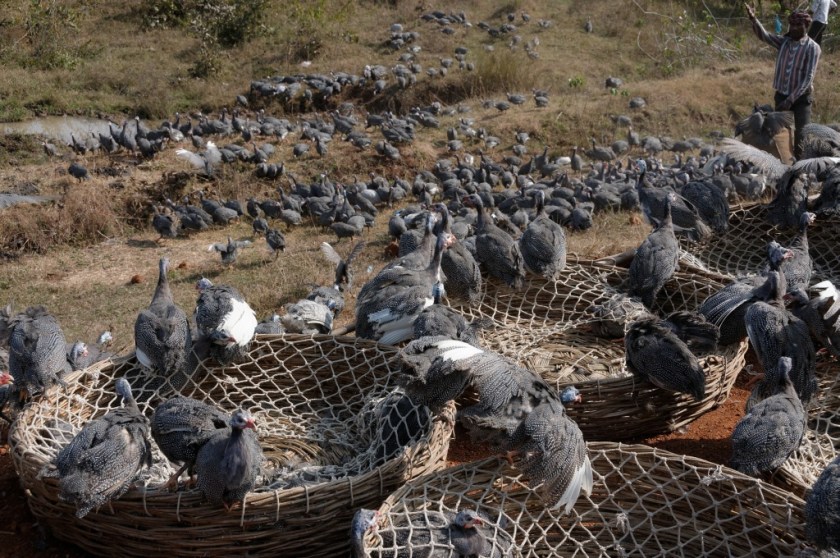 Chickens can’t fly (although they will get a running start and stay airborne for a second or two). There are more chickens than any other bird. According to Wikipedia, “[t]he domestic chicken is descended primarily from the
 We didn’t witness any of the usual pecking order. Maybe these hens were too hungry.


 The market attracts more than 3,000,000 visitors each year! Tour busses pull up and unload shoppers from all over Europe. The Weihnachtsmarkt takes over several piazzas downtown; the 3x weekly Wochenmarkt for fresh produce and flowers moves to the Königstraße, the main pedestrian street.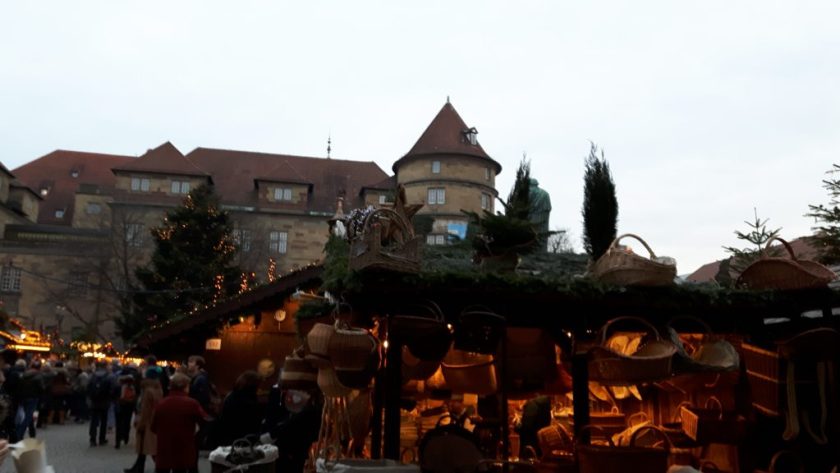


 We began our trip to southern Spain in Granada. When I stood inside Granada’s Cathedral, I suddenly – and very vividly – remembered what and how I’d seen it 40 years earlier. At the Alhambra, my memories were blurry remembrances of running water.


 This hypostyle hall (meaning that the roof rests on pillars) contains a grand 856 columns of finest jasper, marble, onyx and granite. These columns are topped with the arches, which are futher topped with more arches.


 What would I say if you were to ask me to select one thing I remember most after my first visit to the Mezquita as a teenager, all those years ago? I’d say: A sense of wonder.


 Artwork both secular and sacred is woven into every stroke of calligraphy that embellishes gorgeous walls and doorways and niches at both the Alhambra and in Córdoba. The effect is one of standing in a house of mirrors or an echo chamber with lights and patterns extending on and out into Forever.
 No single detail stayed. Just… a fleeting glimpse of the Divine.

 NOTES:
  I just made a second trip to southern Spain. It had been over forty years between visits, and I had no idea what – if anything – I might remember. My first trip was with my high school Spanish Club. We were all young, and boy were we excited to be able to drink legally for a change!
 I can remember loving the symmetry. I sure don’t remember any specific part of it. As I say, my memories are a blurry recollection of warm stone walls with ingenious decorations. Just… an impression of a harmony that contains a hundred thousand details you will get lost in once you begin examining the space more closely.


 Water, water, everywhere…. The former Islamic rulers built a sophisticated system of fountains and pools. Those fountains were designed to include the sound of flowing waters, and flowers and fruit trees were planted to delight the senses with their perfumes.

