I’m beyond dismayed – I am furious. The Trump administration is gutting environmental protections. As The Los Angeles Times reported, “Repealing key protections could erase $254 billion in annual benefits for public health and the environment, compared with $39 billion in savings for regulated industries.” [1]
To quote blogger Curtis Mahon: “To my many friends who thought it wouldn’t happen, guess what, it has happened! Donald Trump has dropped the environmental destruction nuke of an EO, planning to sunset ALL environmental regulations made in the last 100 years. And I mean ALL. https://www.whitehouse.gov/…/zero-based-regulatory…/
The Endangered Species Act. Gone. The Migratory Bird Treaty Act. Gone. The Marine Mammal Protection Act. Gone. The Anadromous Fish Conservation Act. Gone. The Bald Eagle Protection Act. Gone! You name it, it’s gone.
To remind those friends why we have these laws, I’m going to try to put them into terms which anyone can understand, money. The Endangered Species Act is literally the founding, central pillar of modern conservation globally. It’s hard to list the accomplishments of this act as it is so vast. It directly protects and calls for plans to raise the populations of rare species. It’s directly responsible for the comeback of many iconic species, such as the Bald Eagle, the Peregrine Falcon, the California Condor, and a host of others. Talk about return on investment, the amount of money spent vs the amount gained from people wishing to just see iconic rare species is in the billions of dollars. For what would a visit to the grand canyon be without seeing a condor soar over or a visit to Yellowstone without seeing wolves and bison. People do whole drives across the country just for these experiences and that’s what the ESA is about. Lots of revenue there. The Migratory Bird Treaty Act was one of the first environmental laws every made, and bans the harm or collection of all non-game birds in America. It was implemented in a time when hunters we shooting everything to turn them into hats, from songbirds to puffins to herons to albatross. The banning of this and subsequent restoration efforts lead to dramatic increases in bird populations and continue to protect them from harm. In just one example, consider a puffin. In Maine, every tourist I talk to wants to see two things, lobster and puffins. They were once hunted to near extinction in the US and are now a central pillar to the economy of an ENTIRE STATE. Thousands of people a DAY take expensive boat trips for puffins and that’s at risk without these regulations, not to mention cuts to NOAA. The Marine Mammal Protection Act protects whales from being killed or harmed and lead to the global war on whaling. Now because of it, America watches whales! You can go on a whale watch in nearly every coastal city in America and it generates HUNDREDS of millions of dollars in tourism and employs thousands of people. We hurt whales, we hurt our pockets and jobs.
The Anadromous Fish Conservation Act allows the government to enter agreements with states and plan and fund ways to increase the populations of migratory fish. It has direct benefits to anglers across the country, funding 50% of initiatives for things like stocking and habitat restoration in major fisheries such as both Atlantic and Pacific Salmon, Trout, Striped Bass, American Shad, and Sturgeon. And removing the Bald Eagle Protection Act! I thought we loved eagle guys? What’s more American than a Bald Eagle, and they want to remove protections for them? Many older Americans can probably remember a time when they never saw Bald Eagles. Now you can see them commonly in nearly every state! That’s a direct result of the Endangered Species Act and Bald Eagle Protection Act. These are just a few of the laws the Republican party wishes to remove. All have proven track records of benefiting Americans, both monetarily through supporting major American industries worth billions of dollars and employing hundreds of thousands of Americans and spiritually as corner stones of the country’s wilderness. The removal of these protections is peak short term gains over long term profits.”
I’m going to repost a blog thread I wrote ten years ago. I wrote it to honor my entomologist father Bobbo and inform readers in a humorous way about animals that are on the Endangered Species List.
Now it’s going to be all of them. We won’t take long to end up on that list too. For these posts I updated my information on endangered species. Most of the news is grim. Take action. Volunteer. Speak up! Write letters, make phone calls, donate to organizations like the Environmental Defense Fund and Greenpeace.
I am a Best American Essays-nominated writer. My books are Broken In: A Novel in Stories, Tsunami Cowboys, Grounded, The Trail Back Out, and The Taste of Your Name. My most recent book The Taste of Your Name was a finalist for the 2025 Compass Press Book Award.
Elvis Aaron Presley was born on January 8, 1935 in Tupelo, Mississippi. He recorded when rhythm and blues was moving into the more mainstream rock & roll, and ‘Elvis the Pelvis’ brought rock & roll into scandalized living rooms across America. His long string of hits began with Heartbreak Hotel and include the exquisite Love Me Tender, his final hit Burning Love, and of course, Return to Sender. (I don’t have room to list all his hits and the influence he had!) Elvis sold 146.5 million certified album sales in the U.S. alone. He is among the best-selling singers of all time. In his honor I am reprinting the post I titled Return to Sender. – Jadi
One year in the middle of the month of April, not one but two Christmas cards I mailed off (both on the 17th of December) came back to me.
They carry yellow stickers. Return to Sender. Not Deliverable as Addressed. Unable to Forward.
One is a card for a friend I worked with in San Francisco in the early 1980s. We were secretaries in the Marketing Department of what at that time was a national-wide not-for-profit insurance company. Those were heady days, of alcoholic lunches when the bosses took you out at noon and you returned to the office several hours and many rounds later. After work, life meant meeting friends for drinks or beers at the neighborhood bars, and more restaurants and cultural events than you could count. I was in my twenties and living in ‘the big city’ for the first time.
San Francisco was a candy store, and I was a wide-eyed child with a big appetite.
The second returned Christmas card is addressed to the retired librarian from the University of Washington Health Services. I worked at UW in the late 1980s. I was going to massage school in my spare time, and my friend was keenly interested in what I was doing, as she was in anything to do with the world of healing. Traditional or alternative medicine: she always wanted to know more. She suggested we do a trade. I gave her massages right there in her office at lunch time. [1] She did document searches for me, tracking down peer-reviewed medical journal articles about massage in the days when massage was still a dicey career choice. (I was asked more times than I care to count what the name of the massage parlor was where I planned to ‘work’.) (Hah. Hah. Hah.)
My friend the librarian ran a working farm. We also traded those massage sessions in her office for packages amounting to half a lamb each spring. Once she snuck in a package of goat meat. “But how do I cook goat meat?” I protested.
“Really? Congratulations, Jadi. This is what people eat in a lot of places in the world. Figure it out!” I passed THAT package along to friends when I went to visit them. The husband is one of the best cooks I know, and Jim would have a solution. [2]
So here I am, firmly settled in Germany with my Swabian husband. I send out yearly Christmas cards along with a letter and a current photo taken by Uwe [3]. It’s my annual production, each letter hand stamped with glittery snowflakes. Because my mom made the most wonderful Christmas cards in the world. She had a husband and three very active little girls, and her cards were magic.
Mom would recruit us to help her color in the cards. I don’t know if this hand-painted card smeared then or later
My own, less clever Christmas cards are a way to remain connected to my mom’s tradition. And the cards are my way to remain connected, if I can, even if just one day out of the year, with the people who were in my life in various places at various times. Each of them helped me with their friendships more than they’ll ever know. Each year a few cards come back, and another friend has dropped from my life.
I still miss and love them all. [4]
In memory of Elvis Aaron Presley, January 8, 1935 – August 16, 1977
I am a Best American Essays-nominated writer. My books are Broken In: A Novel in Stories, Tsunami Cowboys, Grounded, The Trail Back Out, and The Taste of Your Name. My most recent book The Taste of Your Name was a finalist for the 2025 Compass Press Book Award.
I’m excited to announce that my fifth book is now available!
The Taste of Your Name is the story of an erotic triangle, reclaimed memories, the fates of refugees, and the importance of bread. The story also delves into the history of qurt, koliva, witch cakes, and sin foods. Once you finish reading, nothing will ever taste the same again.
Mustafa is a Syrian refugee who runs a bakery in Stuttgart with an American woman named Neela. Her German stepsister Jo provides trauma massage for a war refugee who refuses to talk about what happened. Neela and Jo both have a relationship with Brian, who is trying to retrieve their grandmother’s memories.
How do we resolve memories, the ones we can’t remember or desperately want to forget? How do food traditions unite us? What happens when reality, bad or good, overtakes your life? Read this book and get ready to forget the outside world for a while!
The Taste of Your Name was a finalist for the 2025 Compass Press Book Award. Available at Amazon or Barnes and Noble, as eBook and Kindle, paperback, and hardcover. Follow these links for Amazon.com or Amazon.de.
I am a Best American Essays-nominated writer. My previous books are Broken In: A Novel in Stories, Tsunami Cowboys, Grounded and The Trail Back Out.
Tsunami Cowboys was longlisted for the 2019 ScreenCraft Cinematic Book Award. Broken In: A Novel in Stories was semifinalist for the international 2020 Hawk Mountain Short Story Collection Award from Hidden River Arts and Finalist for Greece’s 2021 Eyelands Book of the Year Award (Short Stories).
The Trail Back Out was the 2023 San Francisco Book Festival Winner for General Fiction, American Book Fest 2020 Best Book Award Finalist: Fiction Anthologies, Runner-Up for the 2021 Top Shelf Award, 2021 IAN Book of the Year Award Short Story Collection Finalist, and awarded a 2021 Wishing Shelf Red Ribbon. The title story The Trail Back Out was longlisted for the 2021 ScreenCraft Cinematic Short Story Award.
I’ve posted steadily about our trip to southern Africa. It’s fun to write about! The region is a bottomless wellspring of inspiration.
That trip gave me something I don’t feel very often: hope.
We’ve spent months in Asia in natural habitats that are now being dammed, or mined, or paved in the name of progress. It’s all happening so quickly. We know we won’t recognize those places when we go back.
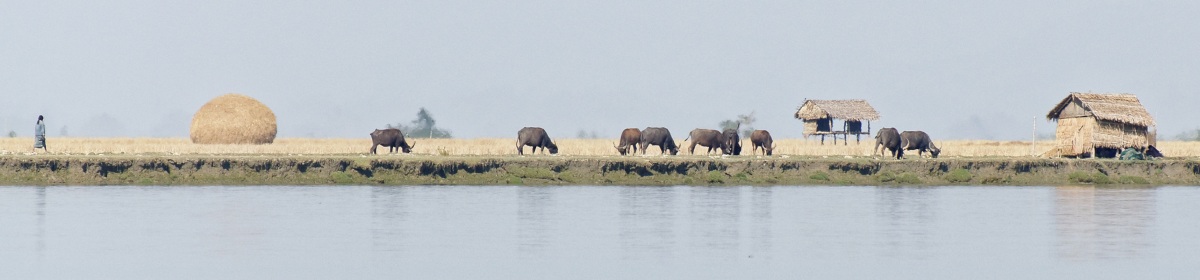
Laos. China is damming the Mekong River and neighbors to the south will be impacted (ie, all of them)Borneo. Indonesia has moved the capitol city Jakarta from Java to Borneo, reducing the orangutan’s habitat even furtherSittwe, Burma. The junta is crushing all resistance; Uwe and I won’t be allowed to visit this region if we go backnorthern Cambodia/Laos border. The rare Irrawaddy dolphin will go extinct if the water in the Mekong River is further reduced
But in southern Africa, in Botswana and Namibia, we were thrilled by the wildlife and the inhabitants. These countries spoke in growls and whistles and birdsong and hippo songs and human voices.
The Kavango-Zambezi Transfrontier Conservation Area (KAZA TFCA) is the largest transnational conservation area in the world at 444.000 km2. It is enormous, larger than Germany and Austria combined and nearly twice as large as the United Kingdom. The KAZA TFCA lies in the Kavango and Zambezi river basins where Angola, Botswana, Namibia, Zambia and Zimbabwe converge. [1]
There are issues to deal with – the loss of domestic animals to predators. The way elephants eat or trample crops. The complicated cross-country agreements. But, as their website states, “Local communities participate with enthusiasm in management of the TFCA through the Transboundary Natural Resources Managment Forum. The aim of this forum is to maximize skills and resources to promote sustainable land use, conservation of wildlife and landscapes, and rural development.”
I urge everyone to learn about this multinational effort to preserve the environment for the benefit of ALL inhabitants, whether winged, hooved, legged, or finned. FINALLY! A region of the world that’s getting it right!
My books are Broken In: A Novel in Stories, Tsunami Cowboys, Grounded and The Trail Back Out.
Tsunami Cowboys was longlisted for the 2019 ScreenCraft Cinematic Book Award. Broken In: A Novel in Stories was semifinalist for the international 2020 Hawk Mountain Short Story Collection Award from Hidden River Arts and Finalist for Greece’s 2021 Eyelands Book of the Year Award (Short Stories).
The Trail Back Out was the 2023 San Francisco Book Festival Winner for General Fiction, American Book Fest 2020 Best Book Award Finalist: Fiction Anthologies, Runner-Up for the 2021 Top Shelf Award, 2021 IAN Book of the Year Award Short Story Collection Finalist, and awarded a 2021 Wishing Shelf Red Ribbon. The title story The Trail Back Out was longlisted for the 2021 ScreenCraft Cinematic Short Story Award.
Click here for my author page to learn more about me and purchase my books.
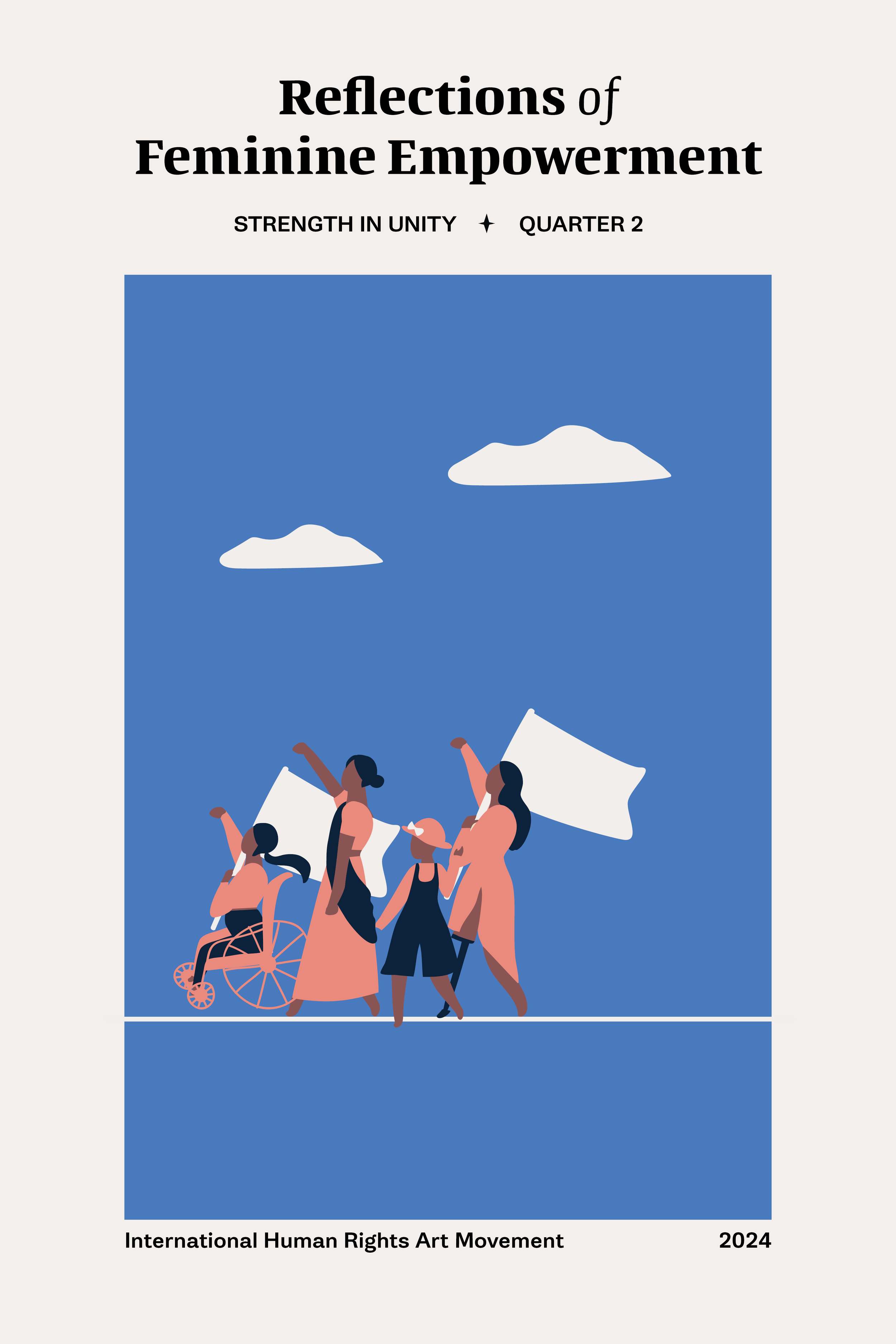
The International Human Rights Art Movement has published my short autobiographical essay “Red, Red Roses” in their most recent quarterly.
Here is The International Human Rights Art Movement mission statement:
“The IHRAM uses our platforms to give voice to artists and issues around the world. We protect freedom of expression by highlighting those who might be suppressed or oppressed in their home countries.
We bring together all members of society through our programming, from artists-in-exile and at risk; to activists on the front lines of the struggle for rights and justice in their own country; to creators working in all media; to national and international politicians, government agencies, social leaders and celebrities.
We believe that creative engagement with all members of the society is the surest path toward social justice and positive change.
The IHRAM magazine was created with a simple goal: to celebrate and uplift up-and-coming authors from all over the world; each of the authors in this anthology contend with their identities in the context of their environments, providing readers with their unique perspectives on issues of human rights.”
“The pieces featured in this quarter’s magazine explore themes of economic parity, workplace equity, and the ongoing pursuit of gender equality. IHRAM Magazine proudly advocates for peaceful feminism through creativity that sparks dialogue and promotes unity. Through poetry, prose, and visual art, we delve into not only the challenges but also the triumphs of women worldwide, amplifying voices often marginalized and celebrating the resilience found in shared stories.
I wrote this essay several years ago to read at a fundraiser during VDays, hosted by New English American Theater. All profits were donated to two Stuttgart organizations that assist women and children in need.
Tsunami Cowboys was longlisted for the 2019 ScreenCraft Cinematic Book Award. Broken In: A Novel in Stories was semifinalist for the international 2020 Hawk Mountain Short Story Collection Award from Hidden River Arts and Finalist for Greece’s 2021 Eyelands Book of the Year Award (Short Stories). The Trail Back Out was the 2023 San Francisco Book Festival Winner for General Fiction, American Book Fest 2020 Best Book Award Finalist: Fiction Anthologies, Runner-Up for the 2021 Top Shelf Award, 2021 IAN Book of the Year Award Short Story Collection Finalist, and awarded a 2021 Wishing Shelf Red Ribbon. The title story The Trail Back Out was longlisted for the 2021 ScreenCraft Cinematic Short Story Award.
Click here for my author page to learn more about me and purchase my books.
Johnny Hartman was born July 3, 1923 in Houma, Louisiana. As a jazz singer Johnny Hartman is most famous for his 1963 collaboration with saxophonist John Coltrane on the sublime album John Coltrane and Johnny Hartman. Also playing on the album are McCoy Tyner, Jimmy Garrison, and Elvin Jones. (This was John Coltranes’s only album with a singer!)
Hartman was a crooner par excellence. Frank Sinatra’s name might be more famous, but from the first time I heard Hartman singing a song I knew who I’ll forever prefer. I discovered him late in life, the soundtrack to a film perhaps, or playing on a jazz radio station. In any case, I promptly bought three of his CDs. When I’m in a mood for love or my spirit needs soothing, I listen to his voice. In his honor here is a post I wrote about romance. How can I not honor him? Hartman’s kind of music will never go stale. – Jadi
For twenty-five years (minus a day) I had a memory of rose-colored glass. Uwe and I got married over a quarter of a century ago. Aside from thinking Yikes, how did that happen?!, I have sighed Awwww. Not many things last this long, especially when we’re talking about human beans….
You know how some couples seem to glide through life without ever having a disagreement?
We aren’t that couple.
walking around a town with even more history than we have
But I distinctly recall that the hotel room where we spent our first night as husband and wife had old-fashioned windows with glass panels in various colors. I can remember looking at those little panes and thinking, How wonderful to begin married life looking at the world through rose-colored glasses. That first image has comforted me countless times. It’s provided me with endless inspiration, and I love telling friends the story of those old windows that shimmered and glowed like gemstones.
We wanted to return to the little town in Alsace where it all began. We booked the same hotel and both of us think we may even have been given the same room. We drove over a day before our anniversary and checked in as it began to rain. The sight of the rain on the windows was get outta here romantic.
I took some pictures. But later, checking to make sure my photos turned out, I was puzzled. The views of the village outside the windows had stayed pretty. But, wait a second: where were the colored panes of glass both of us are sure we remember?
Had my mind and emotions played tricks all these years, keeping me roped in with a faulty metaphor? Or is my eye sight seriously that bad?
The mystery was solved by a friend who reminded me that hotels – especially old ones – spend money on renovations. So, along with the elevator that was not there when we checked in 25 years ago, the windows were probably recent too. The glass in the windows is now textured, maybe ‘pebbled’ is the word I want. The view is still ever so slightly wavy and distorted…
We had three gorgeous days in one of our favorite regions in Europe. Yes, it remained romantic. As you can see from the photos, with rain or without, the views from the windows are lovely.
And, in the right light, my world as a married woman still looks rose-colored.
no my vision wasn’t impaired by the wine we bought at this winery, founded in 1728…
In memory of Johnny Hartman, 3 July, 1923 – 15 September, 1983
My books are Broken In: A Novel in Stories, Tsunami Cowboys, Grounded, and The Trail Back Out.
Tsunami Cowboys was longlisted for the 2019 ScreenCraft Cinematic Book Award. Broken In: A Novel in Stories was semifinalist for the international 2020 Hawk Mountain Short Story Collection Award from Hidden River Arts and Finalist for Greece’s 2021 Eyelands Book of the Year Award (Short Stories). The Trail Back Out was the 2023 San Francisco Book Festival Winner for General Fiction, American Book Fest 2020 Best Book Award Finalist: Fiction Anthologies, Runner-Up for the 2021 Top Shelf Award, 2021 IAN Book of the Year Award Short Story Collection Finalist, and awarded a 2021 Wishing Shelf Red Ribbon. The title story The Trail Back Out was longlisted for the 2021 ScreenCraft Cinematic Short Story Award.
Click here for my author page to learn more about me and purchase my books.
I keep posting about the trip to southern Africa that Uwe and I made in November 2023. I’m doing it to share Uwe’s breathtaking photographs, and to share with you what we experienced.
The act of blogging reinforces my memories. Writing these posts helps me recall where we went and what we did.
But there’s something else going on here. In the months since we returned home I’ve created post after post after post after post after post, as if nothing can shut me up….
They aren’t just for the followers who stay with me as I tell tales. I write to keep reminding myself of how great I felt about the world during that entire trip.
The feeling came to me as a revelation. When I climbed shakily out of what I considered a toy tin helicopter after our ride over the Okavango Delta, I was startled to realize I was feeling something unfamiliar:
Optimistic.
I don’t know about you or everyone else, but it looks to me like ongoing world events are grim. Wars, climate change, mass extinctions, corrupt and greedy politicians destroying democratic governments to hang onto power…. It’s a long, depressing list. So to feel unequivocally GREAT about a spot was wonderful.
Thanks to all of you for reading, liking, and commenting on my endless flow of stories about southern Africa. I want to spread my sense of optimism. Let’s share some hope for a change!
My books are Broken In: A Novel in Stories, Tsunami Cowboys, Grounded and The Trail Back Out.
Tsunami Cowboys was longlisted for the 2019 ScreenCraft Cinematic Book Award. Broken In: A Novel in Stories was semifinalist for the international 2020 Hawk Mountain Short Story Collection Award from Hidden River Arts and Finalist for Greece’s 2021 Eyelands Book of the Year Award (Short Stories).
The Trail Back Out was the 2023 San Francisco Book Festival Winner for General Fiction, American Book Fest 2020 Best Book Award Finalist: Fiction Anthologies, Runner-Up for the 2021 Top Shelf Award, 2021 IAN Book of the Year Award Short Story Collection Finalist, and awarded a 2021 Wishing Shelf Red Ribbon. The title story The Trail Back Out was longlisted for the 2021 ScreenCraft Cinematic Short Story Award.
Click here for my author page to learn more about me and purchase my books.
I wrote Family Myths after my father died. It’s the true story of one of the worst conversations in my life. Almost fifty years passed and neither of us ever mentioned that conversation again.
The University of Colorado Boulder’s Program for Writing and Rhetoric did me the incredible honor of accepting Family Myths for publication in Hindsight Journal, their annual publication.
Hindsight Journal has just come out. Click on this link to read the magazine on line for free. Hindsight Journal 4
For any readers out there who have words etched in your brains, this story is for you.
My books are Broken In: A Novel in Stories, Tsunami Cowboys, Grounded and The Trail Back Out.
Tsunami Cowboys was longlisted for the 2019 ScreenCraft Cinematic Book Award. Broken In: A Novel in Stories was semifinalist for the international 2020 Hawk Mountain Short Story Collection Award from Hidden River Arts and Finalist for Greece’s 2021 Eyelands Book of the Year Award (Short Stories).
The Trail Back Out was the 2023 San Francisco Book Festival Winner for General Fiction, American Book Fest 2020 Best Book Award Finalist: Fiction Anthologies, Runner-Up for the 2021 Top Shelf Award, 2021 IAN Book of the Year Award Short Story Collection Finalist, and awarded a 2021 Wishing Shelf Red Ribbon. The title story The Trail Back Out was longlisted for the 2021 ScreenCraft Cinematic Short Story Award.
Click here for my author page to learn more about me and purchase my books.
Dr. Jane Goodall was born on April 3, 1934 in Hamstead, London, England. She is a anthropologist and primatologist, acknowledged as the world’s expert on chimpanzees. In 1960 she went to the Gombe Stream National Park of Tanzania to study the Kasakela chimpanzee community. That study is still going, making it the the longest continuous study of animals in their natural habitat [1]. In her honor I give you the post I wrote after we visited the orangutan rehabilitation center on Borneo. – Jadi
In 2019 we saw our first free roaming orangutan.
We were at Semenggoh Nature Reserve, just south of Kuching in the Sarawak state on Borneo. Semenggoh is also a Wildlife Centre, established in 1975 as a rehabilitation sanctuary. They take in injured, orphaned, or rescued orangutans. The sole goal of the centre is the rehabilitation and gradual return of animals to fend for themselves in the wild.
Orangutans are endangered, rare, marvelous. They’re native to only two places on the entire planet: Borneo or Sumatra. Our chances of running across them in the wild were pretty much zero, but at Semenggoh maybe we could watch them feeding.
Our individually booked, guided visit conjoined with the larger international tourist groups. The centre gives educational lectures. We learned the rarity and habits of these giant primates. Orangutans spend at least 60% of their waking time looking for food. “Their diet consists of 300 different kinds of fruit such as barks, honey, young shoots, insects and occasional bird egg and small vertebrae. Fruits make up 60% of the orangutan’s diet.” Also (this fact surprised me), “a 1-mile square radius of rainforest can only support a low population density of about 2.5 orangutans.” [2]
The centre maintains a feeding platform. Orangutans are called back for lunch if they want it. But the jungle vegetation fruited a second time last winter, and we were informed that if the orangutans didn’t show, this was a sign that they were fending successfully for themselves in the thick woods. And indeed, none of the creatures responded to the rangers’ calls. [3]
We waited patiently for the tardy luncheon guests. Then suddenly walkie talkies crackled. The seemingly relaxed park guides sprang into action, urging everyone back towards the entrance. A ranger had spotted an orangutan!
Seduku
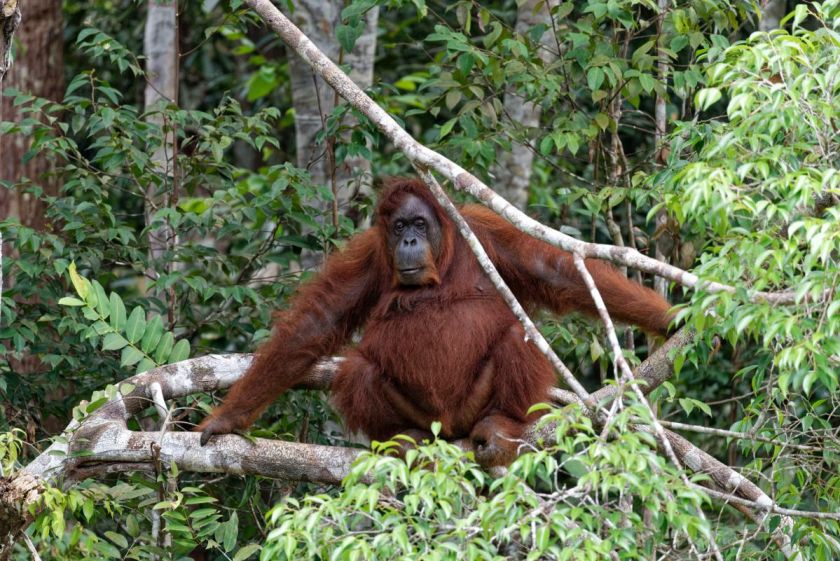
The matriarch was in a tree near the parking lot and ironically closer and easier to observe than if she’d come to the feeding platform. It was Seduku. She’s nicknamed the ‘Grand Old Lady’, born in 1971.
The Grand Old Lady
Seduku could be aggressive towards tourists, our guide said. But the morning we ‘met’ her she was mellow (and almost seemed to be showing off). All I can say is that she had a conscious dignity. Kudos to the great work being done on behalf of orangutans at the Semenggoh Rehab Centre!
My books are Broken In: A Novel in Stories, Tsunami Cowboys, Grounded and The Trail Back Out.
Tsunami Cowboys was longlisted for the 2019 ScreenCraft Cinematic Book Award. Broken In: A Novel in Stories was semifinalist for the international 2020 Hawk Mountain Short Story Collection Award from Hidden River Arts and Finalist for Greece’s 2021 Eyelands Book of the Year Award (Short Stories). The Trail Back Out was the 2023 San Francisco Book Festival Winner for General Fiction, American Book Fest 2020 Best Book Award Finalist: Fiction Anthologies, Runner-Up for the 2021 Top Shelf Award, 2021 IAN Book of the Year Award Short Story Collection Finalist, and awarded a 2021 Wishing Shelf Red Ribbon. The title story The Trail Back Out was longlisted for the 2021 ScreenCraft Cinematic Short Story Award.
Click here for my author page to learn more about me and purchase my books.
I first published this post almost a decade ago. I reprint it as a prayer for our world. —Jadi
The anniversary of 9/11 is here.
I was back in the States when the attack occurred. When I returned to Germany a few weeks later, I was in turmoil. I felt all the contradictions of my life. I’m a resident alien on another continent. I’ve been the target of instant hate when someone found out I’m American. This only has to happen once to convince you that prejudice is awful. What the hell was I doing so far away from my own country? What was going on in the world, and could anywhere feel safe? It seemed like everything was getting sucked into a swirling vortex. My identity as a US citizen, as a foreigner, as a human being, came crashing down.
A few months later my epidemiologist friend Elena came to Europe for a conference. I took an unplanned trip to Amsterdam with her. Maybe 2 days away would give me a break from how heavy life felt. Below is the account from those 2 days and how they affected me:
Friday planetary post, Schwedagon Pagoda, Yangon Burma
“I people-watch as we travel to Holland. On a German train near the border, the train car is full of local residents heading home. An African couple talk over their baby. Another young couple sit by me with their own child. The wife’s exquisite black scarf frames her face. Her husband reads from a small leather bound Koran. Both of them keep an eye on the baby carriage. The rest of the car is full with the usual students, professionals, commuters.
An old man goes into the WC. Later the door slides open without his realizing it. He stands helpless, then fumbles at the door. We all see the prosthetic leg strapped to his upper thigh. Everyone looks away. The door slides open again and he looks up, stricken. I rise and go to the door and close it. When the door inevitably opens again a few minutes later, the man with the Koran closes it for him.
A cell phone rings. The African man pulls out his phone and answers, then switches to English. I realize they’ve understood every word of the conversations Elena and I have been having about global health issues, world politics, and travel.
The woman in the headscarf looks at me steadily. When she finally catches my eye she holds me in a gaze of tenderness and our connectedness as human beings. We see one another for a few minutes, and then the train stops and they detrain.
The train reaches Amsterdam. I’ve been here before and always feel as if I’m coming home to an old friend. We walk along the canal streets, and brick building facades reflect in the Amstel as it flows under the bridges. The Egyptian bellhop at the hotel asks where we’re from. “I love this city! You meet people from all over the world,” he declares.
In 2 days Elena flies back to the US. Later that morning I stand waiting to catch the tram from our hotel. A dark-haired woman at the street bus stop carries a backpack. I offer her my tram pass; I won’t need it beyond the central train station. She thanks me, but says she’s heading home. She’s an Israeli airline stewardess, in Amsterdam for a few days’ holiday.
“I live in Tel Aviv, and I’m afraid to go out of my house,” she tells me. “Everyone is scared of more terrorist attacks there. The situation is out of control.” I listen to her and say, “The rest of the world says, ‘just make peace!’ If only it were so easy.”
Once I’m on board my train I read a Newsweek, then dive back into a novel. The quiet man next to me asks in English if this train stops at the Frankfurt airport. I offer him the magazine. We begin to talk: he is Iranian, in Germany for an international banking and finance conference. He lectures at the University of Cardiff. His wife is a dentist, he tells me. They live in Britain and go back to Iran, to their home in the northeast by the mountains at the Afghani border, each summer for vacation.
He lifts the suitcase at his feet and sets it on his lap. Opening it, he pulls out framed photographs of 2 smiling boys. “These are my children.” We discuss their names, their ages, their personalities. At the airport station he leaves for his flight, and I wish him a safe trip home.
The woman sitting across from us changes trains with me in Mannheim. We stand shivering in the evening air on the platform. She is a Dutch physical therapist, doing an apprenticeship in Munich. She asks what I think of Holland. We talk about the coffee shops. I mention the small scale that guides decision-making in her country. I give her my leftover Dutch coins and she buys the tram pass from me.
Late that night I finally arrive home. In the space of 48 hours I touched on what seemed to be the entire planet. And I didn’t learn the names of any of the people who talked to me.
Travel isn’t just seeing and exploring other countries and cultures or the threads that weave those peoples’ histories with the present. Travel is the journey we make every day into other people, other lives, other ways of being and thinking and feeling.
Travel is about the interconnectedness of us all. Each person with whom we interact leaves behind traces that can change the world. Travel is about holding onto hope.
A part of me remains in every place I’ve ever stood. My image was impressed in a snow angel I made up in the Arctic Circle, which vanished years ago. But who can say if some part of my spirit still wavers there like the Northern Lights? Or in my interactions with all those people on the trains between Stuttgart and Amsterdam? I don’t know…. but we should live as if every act matters, as if choosing to love and be open to the rest of the world and each other can transform us.”
My books are Broken In: A Novel in Stories, Tsunami Cowboys, The Trail Back Out and Grounded.
Tsunami Cowboys was longlisted for the 2019 ScreenCraft Cinematic Book Award. Broken In: A Novel in Stories was semifinalist for the international 2020 Hawk Mountain Short Story Collection Award from Hidden River Arts and Finalist for Greece’s 2021 Eyelands Book of the Year Award (Short Stories). The Trail Back Out was the 2023 San Francisco Book Festival Winner for General Fiction, American Book Fest 2020 Best Book Award Finalist: Fiction Anthologies, Runner-Up for the 2021 Top Shelf Award, 2021 IAN Book of the Year Award Short Story Collection Finalist, and awarded a 2021 Wishing Shelf Red Ribbon. The title story The Trail Back Out was longlisted for the 2021 ScreenCraft Cinematic Short Story Award.
Click here for my author page to learn more about me and purchase my books.

 They carry yellow stickers. Return to Sender. Not Deliverable as Addressed. Unable to Forward.


 My own, less clever Christmas cards are a way to remain connected to my mom’s tradition. And the cards are my way to remain connected, if I can, even if just one day out of the year, with the people who were in my life in various places at various times. Each of them helped me with their friendships more than they’ll ever know. Each year a few cards come back, and another friend has dropped from my life.



 There are issues to deal with – the loss of domestic animals to predators. The way elephants eat or trample crops. The complicated cross-country agreements. But, as their website states, “Local communities participate with enthusiasm in management of the TFCA through the Transboundary Natural Resources Managment Forum. The aim of this forum is to maximize skills and resources to promote sustainable land use, conservation of wildlife and landscapes, and rural development.”

 Johnny Hartman was born July 3, 1923 in Houma, Louisiana. As a jazz singer Johnny Hartman is most famous for his 1963 collaboration with saxophonist John Coltrane on the sublime album
  For twenty-five years (minus a day) I had a memory of rose-colored glass. Uwe and I got married over a quarter of a century ago. Aside from thinking Yikes, how did that happen?!, I have sighed Awwww. Not many things last this long, especially when we’re talking about human beans….
 We wanted to return to the little town in Alsace where it all began. We booked the same hotel and both of us think we may even have been given the same room. We drove over a day before our anniversary and checked in as it began to rain. The sight of the rain on the windows was get outta here romantic.
 I took some pictures. But later, checking to make sure my photos turned out, I was puzzled. The views of the village outside the windows had stayed pretty. But, wait a second: where were the colored panes of glass both of us are sure we remember?
 The mystery was solved by a friend who reminded me that hotels – especially old ones – spend money on renovations. So, along with the elevator that was not there when we checked in 25 years ago, the windows were probably recent too. The glass in the windows is now textured, maybe ‘pebbled’ is the word I want. The view is still ever so slightly wavy and distorted…
 The feeling came to me as a revelation. When I climbed shakily out of what I considered a toy tin helicopter after our ride over the Okavango Delta, I was startled to realize I was feeling something unfamiliar:
 We were at Semenggoh Nature Reserve, just south of Kuching in the Sarawak state on Borneo. Semenggoh is also a Wildlife Centre, established in 1975 as a rehabilitation sanctuary. They take in injured, orphaned, or rescued orangutans. The sole goal of the centre is the rehabilitation and gradual return of animals to fend for themselves in the wild.
 NOTES: [1]

