We had a great guide on our trip to Tanzania. Khalilu Munisi with Wilkinson Tours was with us for ten days, telling us all about the Big Five, the Ugly Five, and every critter in between.
While we were stopped in Tarangire Park to watch birds, a huge black snake suddenly slithered across the road. (Along with being attacked by lions, another good reason to never leave the jeep!) Khalilu identified it as a black mamba, one of the deadliest snakes in the world. How deadly? Around 100% of black mamba bites are fatal. I’d say that’s pretty deadly.
Black mamba. Over 2 meters long
It’s faster than a king cobra and its venom takes effect more quickly. A black mamba bite can kill a lion. One of the mamba’s only serious foes is the secretary bird. Khalilu told us he’s seen them fighting, and the bird won.
Secretary birdlooks too silly to be a serious threat to a mamba, doesn’t itTanzania January 2026yeah mamba, I’m coming for you
Much as I’d love to watch that particular fight someday, that snake moved fast. I want to be far out of striking range!
I am a Best American Essays-nominated writer. My books are Broken In: A Novel in Stories, Tsunami Cowboys, Grounded, The Trail Back Out, and The Taste of Your Name. Recent awards include Finalist for the 2025 Compass Press Book Award for The Taste of Your Name and Finalist for Greece’s Eyelands 11th International Short Story Contest.
Ah, the Maribou Stork. This bird is one of the infamous Ugly 5.
Dining out is the best! Nothing beats a well-aged steak. Chobe National Park, Botswana
This bird is a real stinker. Literally. A Maribou stork eats whatever’s lying around and was killed or died a reaaaallly long time ago. The first time we met this stork was in Botswana. We drove past the remains of a very, very dead water buffalo that we smelled long before we reached it. As we drove by, a head suddenly popped up. We’d interrupted a stork enjoying its supper.
In January in Arusha Park, Tanzania, we had the unnerving experience of seeing a flock of these storks flying overhead. The Maribou is huge, and it’s strange.
Maribou Stork Tanzania 2026Looks prehistoric, doesn’t it? TanzaniaSeveral flying at the same time really fill the sky. Tanzania
Maribou aren’t picky eaters. They’ll dine on termites and small birds, garbage, and the carcasses of animals, including elephants. Other storks are elegant, but not this one. A Maribou can weigh as much as 7kg, grow to 1.52m, almost 5′ tall, and an 8’8″ wingspan – 2.7 meters! When one flies by, you definitely notice.
I am a Best American Essays-nominated writer. My books are Broken In: A Novel in Stories, Tsunami Cowboys, Grounded, The Trail Back Out, and The Taste of Your Name. Recent awards include Finalist for the 2025 Compass Press Book Award for The Taste of Your Name and Finalist for Greece’s Eyelands 11th International Short Story Contest.
The goal of everyone who goes on safari is to spot The Big 5: lion, elephant, leopard, rhinoceros, and Cape buffalo. It took us 3 tries to see them all, but in January this year we finally did it!
You talkin’ to me? Etosha National Park, Namibia
Less famous (or looked-for) are The Ugly 5. The 5 are known for weird body builds and dull coloration, on a continent where each animal is more striking than the next. I give you #2:
Keeping their distance from everybody else. Etosha National Park, Namibia
The Wildebeest. It’s not only one of Africa’s Ugly 5: the wildebeest, along with the zebra, takes part in the largest migration in the world. In January we watched from a jeep as 1.5 million animals made the winter trek in Serengeti National Park.
the Great Migration at Serengeti Park, Tanzaniawildebeest and zebras migrate togethermaking a dash for itwildebeest as far as the eye can see
Like the hyena (who we met as Ugly #1), the blue wildebeest has short hind legs and longer front legs (for endurance) and wide forequarters (greater lung capacity). The wildebeest has a strangely flat face, both sexes grow horns, and their coloring is a dark grey, blueish sheen. I’ve heard them called the ‘spare parts critter’: the horns of a juvenile buffalo, the tail of a horse, the beard of a goat, and a sloped, hyena-like back. Definitely a strange looking dude!
I am a Best American Essays-nominated writer. My books are Broken In: A Novel in Stories, Tsunami Cowboys, Grounded, The Trail Back Out, and The Taste of Your Name. Recent awards include Finalist for the 2025 Compass Press Book Award for The Taste of Your Name and Finalist for Greece’s Eyelands 11th International Short Story Contest.
One of the most spectacular sights I’ve ever witnessed is what’s known as the Great Migration. One and a half million wildbeests and zebras are all traveling at the same time. The animals make a huge loop from Kenya down to Tanzania and back again, following the weather patterns for water and grasses. The best times to see the Great Migration is in the summer when it’s raining and massive herds have to ford raging rivers.
Serengeti Plain. I love this picture. I think this is one of the best photos Uwe’s ever taken.
The other best time to go is in the winter during the dry season and see the herds with their babies. Uwe and I went in January for ten days of safaris on the Serengeti Plain and the surrounding national parks.
Tanzania 2026
Look at this photo! Those are animals as far back as you can see.
Tanzania 2026This little zebra’s stripes will darken as it agesone hell of a lot of gnus
The Serengeti National Park is beautiful, a stunning and stunningly impressive nature reserve. I would have been blown away by the opportunity to see it without all the animals. Getting to watch from the middle of the largest migration on the planet was unbelievable.
I am a Best American Essays-nominated writer. My books are Broken In: A Novel in Stories, Tsunami Cowboys, Grounded, The Trail Back Out, and The Taste of Your Name. Recent awards include Finalist for the 2025 Compass Press Book Award for The Taste of Your Name and Finalist for Greece’s Eyelands 11th International Short Story Contest.
Rosalind: I will laugh like a hyen, and that when thou art inclined to sleep.” As You Like It, IV. i. 147-9. – William Shakespeare
The goal of everyone who goes on safari is to spot The Big 5: lion, elephant, leopard, rhinoceros, and Cape buffalo. It took us 3 tries to see them all, but in January this year we finally did it!
Less famous (or looked-for) are The Ugly 5. Uwe and I have spotted every single one over time. And yes, they are UGLY. It is my great pleasure to introduce you to them, one at a time….
First up is the spotted hyena. They like grasslands and open terrain. From our tent in the Serengeti, in the middle of the night I heard them laughing hysterically. The spotted hyena is chatty!
Tanzania 2026a mud bath. Because he’s not filthy enough yetfollowing the Great Migration and hoping something gets killed soon
yup. ugly
Unlike most hyenas, the spotted hyena is a social animal and hunts in packs, probably because they follow migrating animals.
they hang out in packs
When they do their own hunting, spotted hyenas kill with their teeth and not their claws. They take care of other animals’ leftovers with those sharp teeth (and lack of compunction about eating something that’s clearly been dead for ages). As Wikipedia describes them, “Spotted hyenas evolved sharp carnassials behind their crushing premolars, therefore they did not need to wait for their prey to die, and thus became pack hunters as well as scavengers.” [1]
Along with bats, the spotted hyena is one of the very few creatures that can survive a rabies infection. Their diet of rotting meat gives them powerful concentrations of antibodies in their saliva.
Our safari guide told us that lions only eat meat. The hyenas then move in. They’re able to completely digest the organic matter found in bones, and their skulls and teeth are specialized to crack large bones and cut through animal hides.
Along with the hyenas come the carrion birds – two more of the Ugly Five. You’ll meet them soon.
I am a Best American Essays-nominated writer. My books are Broken In: A Novel in Stories, Tsunami Cowboys, Grounded, The Trail Back Out, and The Taste of Your Name. Recent awards include Finalist for the 2025 Compass Press Book Award for The Taste of Your Name and Finalist for Greece’s Eyelands 11th International Short Story Contest.
For me, one of the most exciting events during our two weeks in Tanzania was completely unexpected. We’d spent days on the Serengeti Plain to see the Great Migration. Now we were driving to the Ngorogoro Conservation Area. We halted very close to the Olduvai Gorge at a rest area with public toilets. [1] A sign advertising our next destination stood on one side of the parking lot.
Tanzania 2026
On the other side UNESCO had erected a huge plaque. Curious, I went over to read it.
I was standing less than 30 miles from where Mary Leakey discovered the Zinjanthropus skull, which pushed back the known timeline of human evolution to 1.75 million years ago and confirmed Africa as the cradle of humankind. AND! She found the Proconsul skull that connected us to a prehistoric ape ancestor. AND! She found the Laetoli footprints, fossil footprints proving early humans had walked erect far longer than scientists had believed. AND! The UNESCO World Heritage sign firmly gave all the credit to Mary, where it belongs.
I was out of my mind with excitement as I read. For some reason I’d always thought that those paleoanthropological discoveries occurred in Kenya (where the Leakeys had also conducted digs). To be so close to where the incredible artifacts were found, and to see her groundbreaking discoveries properly credited at last, thrilled me beyond words.
I am in awe. Tanzania 2026
Mary Leakey has been called ‘the woman who found our ancestors’. But, for as long as I can remember, her husband Louis got (stole!) all the credit. Louis Leakey was charismatic, showy, and a bit of a charlatan. He was skilled at fundraising and loved being in the limelight of fame. When Mary’s discoveries became famous, he traveled around the US to lecture about ‘his’ finds and speculate about their significance.
Mary quietly went on with her field work. She couldn’t care less about fame and wasn’t a bit intimidated by male colleagues.
For almost a century people have been trying to explain away the lack of credit she received. Sometimes her husband’s theft is described as a collaborative effort. As I was putting together this blog post, I was annoyed when I read an article in an article in The Roanoke Times, that “marriage to Mary Nicol paired Leakey with a first-rate scientist freeing him to work the public relations side of science. … Primarily using Mary’s work, Louis regained his scientific reputation.” [2] In other words, she did the work and he got all the credit.
The Smithsonian Magazine’s profile of Mary is even worse. The author said, “It’s worth remembering that Mary Leakey wasn’t university-educated and got her start as an illustrator on archaeological digs like the one where she first met Louis. And that Louis Leakey was already “a Cambridge University professor with an established reputation for fieldwork in East Africa,” according to Barnes, when he left his pregnant first wife to marry Mary, who was in her early twenties. Mary was talented, but she probably wasn’t sure how to play the game of academia, particularly in a field as fraught with intense differences of interpretation as paleoanthropology, which requires practitioners to form extended arguments off a few remaining physical clues about our ancient ancestors.” [3]
The article is another attempt to explain away her husband’s claim to her incredible discoveries as if really, he was just doing her a big favor. This is utter bullshit.
My questions are: WHY is it worth remembering that Mary Leakey wasn’t university educated? Mary probably wasn’t sure how to play the game?? A more plausable explanation is the well known fact that she didn’t indulge in speculation! Mary believed in using science and research to reach the conclusions.
I didn’t know that Uwe took my photo as I paid my respects before that sign. On that afternoon I felt an intense connection to our common ancestors, going back millions and millions of years. Standing where she had, where my first humanoid ancestors stood, made me dizzy.
It took my breath away and brought me close to tears. Still does, actually.
In honor of Mary Douglas Nicol Leakey, 6 February 1913 – 9 December 1996
NOTES: As if all this wasn’t enough, Mary also created a system to classify the stone tools they found at Olduvai. At the Laetoli site where she discovered the footprints, she also found hominin fossils more than 3.75 million years old. She discovered fifteen new animal species. She was responsible for creating a new genus. And she was the first to write about the Kondoa Irangi Rock Paintings in central Tanzania.
[1] Usually we made bush toilets, where you climb out of the jeep and duck down behind the back of it in the road. [2] The Roanoke Times . [3] And the title! “Mary Leakey’s Husband (Sort of) Took Credit For Her Groundbreaking Work on Humanity’s Origins.” Come on, Smithsonian! You’ve got to be kidding. https://www.smithsonianmag.
I am a Best American Essays-nominated writer. My books are Broken In: A Novel in Stories, Tsunami Cowboys, Grounded, The Trail Back Out, and The Taste of Your Name. Recent awards include Finalist for the 2025 Compass Press Book Award for The Taste of Your Name and Finalist for Greece’s Eyelands 11th International Short Story Contest.
Uwe and I spent two weeks in Tanzania and Zanzibar in January. One of the highlights for me wasn’t what we saw (although there were highlights aplenty). A highlight was what I got to do. It all started with a boat ride to spot birds. Uwe sat in the middle of the canoe and took photographs.
Tanzania 2026Squacco HeronCormorantsSquacco Heronanother gorgeous cormorantgetting dried offStriated HeronMalachite KingfisherAfrican Fish Eagle, high upa GULP of cormorants! What a great name for a group of birds, especially these onesHammerhead bird
We had a fantastic guide/driver for a ten day safari. He knew everything, except how to swim. When the day’s activities involved going out in a canoe on Lake Duluti, he firmly declined to join us, even with a life jacket.
Did either Uwe or I know how to paddle a canoe? asked our guide for the lake. I do! I do! I was sooo excited. I grew up around water and canoes and man I miss them.
I spent the next two hours paddling the circumferance of the lake. Uwe took endless photos of the water birds. We were both in Paradise.
paddling my way to Heaventhat dazzling Malachite Kingfisher again
I am a Best American Essays-nominated writer. My books are Broken In: A Novel in Stories, Tsunami Cowboys, Grounded, The Trail Back Out, and The Taste of Your Name. My recent awards are Finalist for the 2025 Compass Press Book Award and Finalist for Greece’s Eyelands 11th International Short Story Contest.
Click here for my author page to learn more about me and purchase my books.
Dr. Jane Goodall was born on April 3, 1934 in Hamstead, London, England. She is a anthropologist and primatologist, acknowledged as the world’s expert on chimpanzees. In 1960 she went to the Gombe Stream National Park of Tanzania to study the Kasakela chimpanzee community. That study is still going, making it the the longest continuous study of animals in their natural habitat [1]. In her honor I give you the post I wrote after we visited the orangutan rehabilitation center on Borneo. – Jadi
In 2019 we saw our first free roaming orangutan.
We were at Semenggoh Nature Reserve, just south of Kuching in the Sarawak state on Borneo. Semenggoh is also a Wildlife Centre, established in 1975 as a rehabilitation sanctuary. They take in injured, orphaned, or rescued orangutans. The sole goal of the centre is the rehabilitation and gradual return of animals to fend for themselves in the wild.
Orangutans are endangered, rare, marvelous. They’re native to only two places on the entire planet: Borneo or Sumatra. Our chances of running across them in the wild were pretty much zero, but at Semenggoh maybe we could watch them feeding.
Our individually booked, guided visit conjoined with the larger international tourist groups. The centre gives educational lectures. We learned the rarity and habits of these giant primates. Orangutans spend at least 60% of their waking time looking for food. “Their diet consists of 300 different kinds of fruit such as barks, honey, young shoots, insects and occasional bird egg and small vertebrae. Fruits make up 60% of the orangutan’s diet.” Also (this fact surprised me), “a 1-mile square radius of rainforest can only support a low population density of about 2.5 orangutans.” [2]
The centre maintains a feeding platform. Orangutans are called back for lunch if they want it. But the jungle vegetation fruited a second time last winter, and we were informed that if the orangutans didn’t show, this was a sign that they were fending successfully for themselves in the thick woods. And indeed, none of the creatures responded to the rangers’ calls. [3]
We waited patiently for the tardy luncheon guests. Then suddenly walkie talkies crackled. The seemingly relaxed park guides sprang into action, urging everyone back towards the entrance. A ranger had spotted an orangutan!
Seduku
The matriarch was in a tree near the parking lot and ironically closer and easier to observe than if she’d come to the feeding platform. It was Seduku. She’s nicknamed the ‘Grand Old Lady’, born in 1971.
The Grand Old Lady
Seduku could be aggressive towards tourists, our guide said. But the morning we ‘met’ her she was mellow (and almost seemed to be showing off). All I can say is that she had a conscious dignity. Kudos to the great work being done on behalf of orangutans at the Semenggoh Rehab Centre!
My books are Broken In: A Novel in Stories, Tsunami Cowboys, Grounded and The Trail Back Out.
Tsunami Cowboys was longlisted for the 2019 ScreenCraft Cinematic Book Award. Broken In: A Novel in Stories was semifinalist for the international 2020 Hawk Mountain Short Story Collection Award from Hidden River Arts and Finalist for Greece’s 2021 Eyelands Book of the Year Award (Short Stories). The Trail Back Out was the 2023 San Francisco Book Festival Winner for General Fiction, American Book Fest 2020 Best Book Award Finalist: Fiction Anthologies, Runner-Up for the 2021 Top Shelf Award, 2021 IAN Book of the Year Award Short Story Collection Finalist, and awarded a 2021 Wishing Shelf Red Ribbon. The title story The Trail Back Out was longlisted for the 2021 ScreenCraft Cinematic Short Story Award.
Click here for my author page to learn more about me and purchase my books.


 We were at Semenggoh Nature Reserve, just south of Kuching in the Sarawak state on Borneo. Semenggoh is also a Wildlife Centre, established in 1975 as a rehabilitation sanctuary. They take in injured, orphaned, or rescued orangutans. The sole goal of the centre is the rehabilitation and gradual return of animals to fend for themselves in the wild.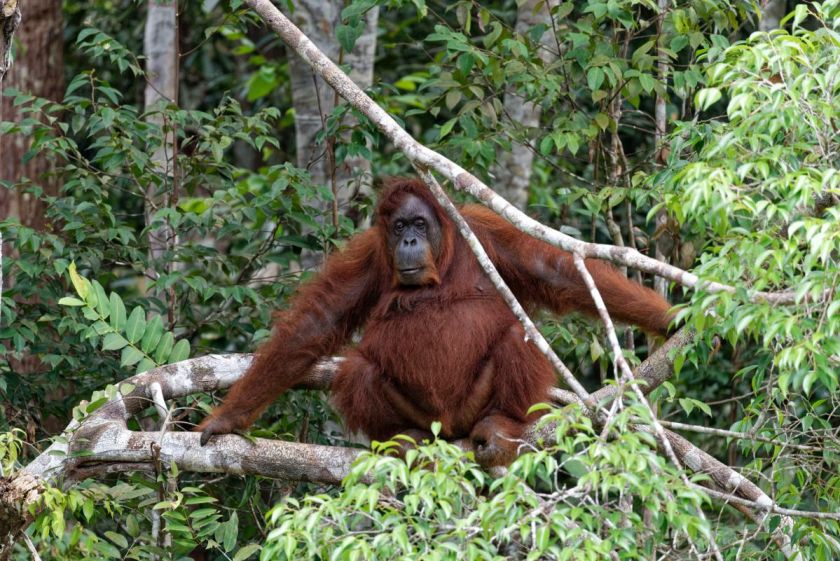

 NOTES: [1]