Illustrator/author Maurice Sendak was born on 10 June, 1928 in England. In his honor I give you the post I wrote upon hearing that he had died. – Jadi
My Sister & Maurice Sendak
Our first experiences learning to speak seem to involve rhymes. [Twinkle twinkle and Dr. Suess, anyone?] We recite as children, loving language’s sing-song chants.
One of the very first pieces I memorized as a child (to this day I can recite it) was ‘The Cow’ from A Child’s Garden of Verses and Underwoods by Robert Louis Stevenson, printed in 1913.
| The Cow |
| The friendly cow all red and white | |
| I love with all my heart: | |
| She gives me cream with all her might, | |
| To eat with apple-tart. | |
| She wanders lowing here and there, |
5 |
| And yet she cannot stray, | |
| All in the pleasant open air, | |
| The pleasant light of day; | |
| And blown by all the winds that pass | |
| And wet with all the showers, |
10 |
| She walks among the meadow grass | |
| And eats the meadow flowers. |
Can’t you see her?? In my child’s brain she was white and a funny shade of red. (Who ever heard of a red cow? I mean, really.) She was named Flossie, or Maisie, or Bessie. Placid Maisie meanders in a huge field, chewing her cud and surrounded by fairy rings of little flowers.
I have to be in the right mood for poetry, but I still have the used copy of The Norton Anthology of Modern Poetry from my college days of long ago. (How long ago? Decades. A couple of ’em.) My edition of Robert Frost’s complete works came to me when my mother died. When I read Frost, his poems of New England keep me linked to her, too.
Emily Dickinson still knocks me out, and every word Shakespeare penned is poetry in exalted form.
Poetry is emotion and experience expressed in crystalline shapes, no matter whether it’s metered or free verse. Prose works by poets betray themselves through the beauty of the writing. Think of The English Patient. I read that book slower and slower, and found myself rereading pages over and over, savoring Ondaatje’s mastery with language. Or anything by Ray Bradbury: each of his strange magical visions contains a goodly dose of poetry.
Hmm. I just went back and read what I’ve got here so far… Scratch the comment about needing to be in a certain mood to read poetry.
***
The Muses pay a very special visit on those they gift with the ability to speak through poems. For me it’s the hardest of all forms of writing. Sadly, the poetic Muses Erato (love poetry), Calliope (epic poetry), Euterpe (songs and elegiac poetry), and their sister Polyhymnia (hymns and sacred poetry) just don’t knock on my door more than once a decade or so. An impulse to even attempt a poem is the sighting and citing of a rare bird. The last time, and it came over me in a total rush of surprise and inspiration, was the death of Maurice Sendak.
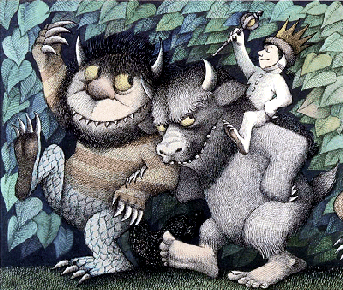
(Photo from Wikipedia)
Mr. Sendak accompanied my childhood and probably yours, too, and he was particularly part of my sister Pam’s early years. I remember his Nutshell Library books, extra small to fit the hands of children. There were 4 of them: Alligators All Around, Chicken Soup With Rice, One Was Johnny, and Pierre (A Cautionary Tale). Pammy read them repeatedly, relating especially to the contrary Pierre. A few years ago I spotted an interview with Sendak in The New York Times (click here for the interview).
The article brought back those little books and how much my sister loved Maurice Sendak. I promptly sent the link to Pam and we spent several weeks emailing back and forth about his wonderful art and our childhood memories.
In May 2012, Maurice passed away. My sister was teaching in Japan; had she heard yet? For some reason I wanted to be the person to break the news to her. I debated how to contact Pam and gently let her know.
The next morning I awoke preoccupied with way too much to do. I began my tasks with the radio on. NPR mentioned that Terry Gross was doing a special Fresh Air show in honor of Maurice Sendak’s passing (a much older interview with Sendak and a more recent one recorded not long before his death). Despite really having no time to spare, I sat down to give 5 minutes to Sendak.
An hour later I still sat. By now tears were streaming down my face. Sendak’s wise, sweet old voice came over the airways, speaking of the secret fears of children, of his inability to believe in God after the horrors of the Holocaust (he lost his entire extended family), his more than half a century with the man he loved, Dr. Eugene Glynn, a NYC psychoanalyst his parents never knew about… Sendak told his story as the tears continued to pour.
I forgot everything, the chores that had seemed so important that morning, the things I had wanted to cross off my to-do list that day. The interview ended, I got shakily out of my chair, found some tissues and blew my nose, wiped my eyes, and sat down to write my sister. “Pam,” I said, “I just heard an incredibly moving interview with Maurice Sendak. He’s died, and I wanted you to get the news from me…. but really you need to hear this interview and listen to his voice.”
And as I sat, a Muse spoke. I wrote the first version of the following poem in one take.
Maurice
Maurice Sendak
Your words and drawings,
depictions transcribe
the soul&depths
of my sister, Pammy.
You died yesterday,
83 years old and not a day
older than the children now grown
adults weeping, mourning
your passing theirs passing
something of childhood gone beyond
retrieving.
Maurice.
I listen to recordings of your voice
You speak, the New Yorker
in you so obvious
I love your sense of place
your first generation voice
of Polish immigrants
of your humanity
your humility
your atheism
your embrasure of
a definition of the world
in which God is
everywhere
in the Wild Things
where they are
My Wild Things salute you.
My Wild Things weep.
Gnash our teeth.
Our King has left us.
Our island, and not just New York
is so much smaller with your passing.
We will cook a meal
Eat a supper and
wish
You were still with us.
In loving memory of Maurice Sendak, June 10, 1928 to May 8, 2012
NOTES: © 2013 Jadi Campbell. Previously published as My Sister and Maurice Sendak.
My books are Broken In: A Novel in Stories, Tsunami Cowboys, The Trail Back Out and Grounded.
Click here for my author page to learn more about me and purchase my books.


 It’s an easy bus ride from the capitol Riga to the museum. Go to my post

 Existence was harsh and hard, like the overcast skies much of the day we visited. [2] Along with simple huts, the site includes windmills.
 A store building is filled with dowry chests and traces of Latvia’s long history serving in the Hanseatic League.


 The town to see whales is Hermanus. We walked from our hotel to the jetty where we’d catch a whale watching boat. The scenery included local art.


 The garter snake is Massachusetts’ official state snake, and is endemic to most of North America. It’s the most common snake species, and closely related to water snakes, the genus Nerodia.
 I find snakes fascinating. [2] Sacred snakes were used by the Oracle at Delphi and in ancient Minos. Recall the cobra, who spread its hood to shelter the Buddha. St. Patrick supposedly drove the snakes out of Ireland. [3] On a practical level, the garter snakes in Barb and Javier’s yard will eliminate any pest threat from rodents. (They also eat snails and slugs, common garden problems in the wet Northwest.)
 As I admire the yard and go look from time to time for the two snakes I’ve seen in different parts of the garden, I think mostly about the fact that the presence of snakes means the small biosphere of my sister’s home is a healthy one. It’s not a coincidence that garter snakes are often referred to as ‘garden snakes’.


 March 2019 Journal entry: Just returned from an exhilarating 2 and ½ hours night tour with nature guide and tour guide at Kubah National Park. We saw frogs on trees, leaves, vines, boles, the sides of the road…. Two rare horned frogs! Mahogany frogs! A teeny pitcher plant frog – just one – it jumped away before we could look more closely but I did see the tiny thing leap (the narrow-mouth frog first described in 2010). Three different lizards. White-lipped frogs. Cinnamon frogs. Firebelly toads. Harlequin tree frogs. We had to head up to 1,000 feet up a road in the dark, the ranger with a head light. Unreal how he could spot the frogs. Glorious sounds of running water and night sounds of the jungle all around, my glasses fogging over with the heat and humidity, a large frog pond formed by wild pigs’ rutting. The frogs surprisingly calm, not jumping at our presence, just hanging out in their domain. I was in the moment, totally blissed out, just there, present with each frog we spotted. The guide and ranger and I backlighting each critter with our flashlights so Uwe could photograph it. The deep jungle trees and vegetation and clicks and buzzes and calls of frogs all around us. Nature’s Symphony. Glorious. An Australian recorded just this place and won an international competition for the most beautiful sounds in the world. Borneo’s really promoting sustainable growth, they recognize what they have here. The Malaysian part of Borneo, that is. I feel hopeful about a corner of the planet for the first time in a very, very, very long and sad time. Man, I like Borneo.


 But I’d rather tell you about hearing him play.


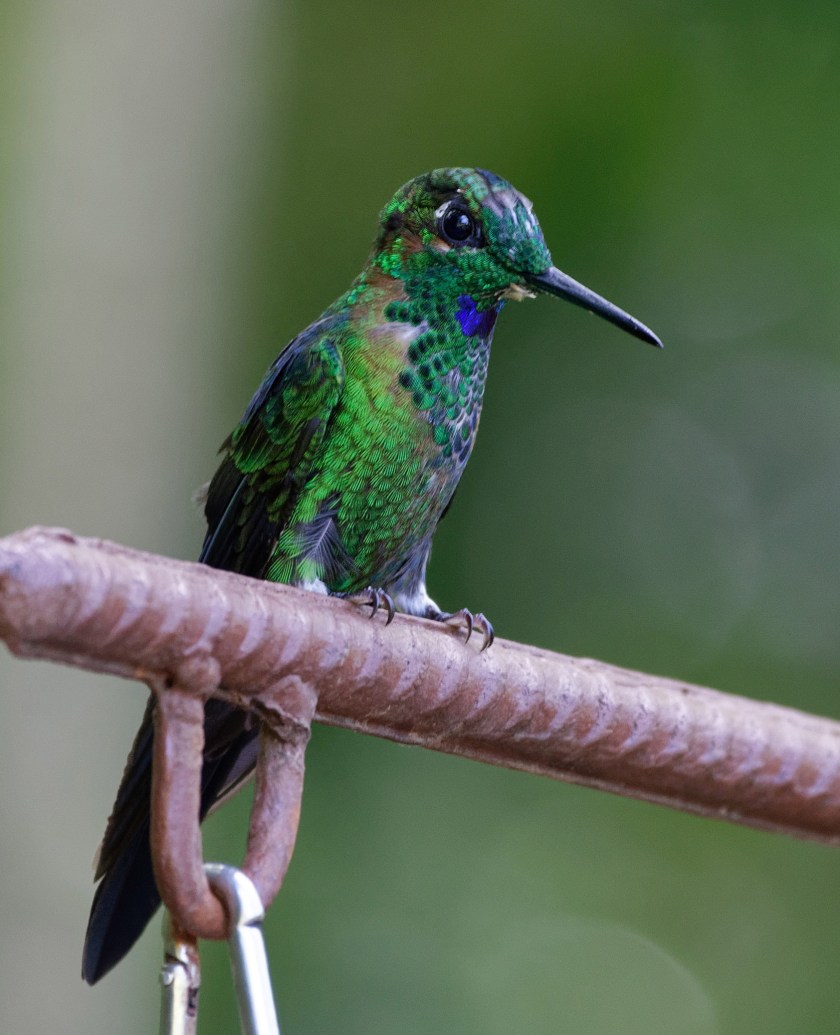
 Thirty minutes later we’re back at the park entrance’s buildings. The downpour vanishes. Uwe gets out his telefoto lens to capture the 7 varieties of blue, emerald, crimson, orange, purple hummingbirds darting in and out to the feeders on the porch. A white nosed coatimundi scurries under the hummingbird feeders, licking up the sugar water that’s dripped down onto the floorboards.
 “A walking stick!” I murmur.