This post is a blast from the past. My family spent many of the happiest weeks of our lives, individually and as a family unit, on the back trails of the Adirondacks. I’m posting this to remind myself I’m still on that trail, always.
I am a Best American Essays-nominated writer. My books are Broken In: A Novel in Stories, Tsunami Cowboys, Grounded, The Trail Back Out, and The Taste of Your Name. My recent awards are Finalist for the 2025 Compass Press Book Award and Finalist for Greece’s Eyelands 11th International Short Story Contest.
Margaret Hamilton was born on December 9, 1902 in Cleveland, Ohio. She appeared on-screen with W.C. Fields, Abbott and Costello, and Buster Keaton. She’s gone down in film history for her distinct voice and terrifying depiction of the Wicked Witch of the West/Almira Gulch in film The Wizard of Oz. The book The Wonderful Wizard of Oz first appeared in print on May 17, 1900; the film premiered on August 12, 1939.
Ms. Hamilton was devoted to public education (she was a former schoolteacher) and to the welfare of children and animals. In her honor I am reprinting one of my very first posts, about L. Frank Baum, bats, and monkeys. — Jadi
Both sides of my family hail from the Northeast. We lived for a while in Cazenovia, one of the most beautiful small towns in upstate NY. Caz is just a few miles from Chittenango Falls, and that town was the birthplace of L. Frank Baum, author of The Wizard of Oz.
My sisters and I first saw The Wizard of Oz film on an old black and white television set we called Lucille. Lucille was temperamental (“Dad! Lucille’s on the fritz again!”), but her screen was big.
It was years before I finally saw The Wizard of Oz on a color television. How I gasped when Dorothy opened that door and stepped out into Munchkin Land! But in color or black and white, to this day I don’t much like monkeys.
Balinese Barong
Some years ago my husband and I traveled to Bali. The Balinese fill their temples with statues of the strange half-bird, half-god creature known as Garuda, a lion-like Barong, lots of sinuous snakes, and Hanuman the monkey god. The cultural heart of Bali is Ubud, home to the Monkey Forest which contains the Monkey Temple. I wrapped a sarong around my waist before we entered to show respect, and I know I was curious as to what we’d find.
The temple grounds were filled – no, overrun – with crab-eating macaque (Macaca fascicularis) monkeys. Dozens of them rested on the platforms to the Pura Dalem Agung Padangtegal temple. Many more watched us from up in the canopy of thick jungle trees and vines. Worst of all, a horde of monkeys scampered our way as we drew near. They were used to people and accustomed to visitors who bring them food. We walked slowly, not making any sudden movements, keeping our arms stretched out with our hands opened. I hoped my empty palms signaled: no food here!
Monkey Temple Gang
I breathed a huge sigh of relief when we left the grounds. But I wonder about the sanity (to say nothing of the later health) of tourists who bring bananas and fruit to hand to the macaques. Those critters are feral!
Bali has another indigenous species: bats.
Bali bats from hell
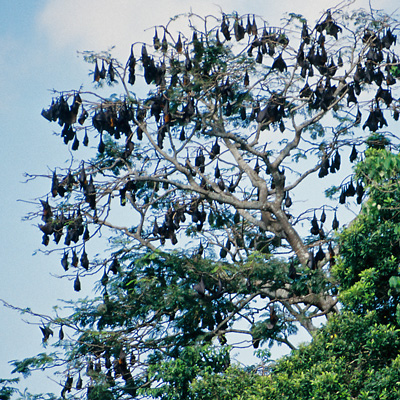
A huge colony of the largest fruit eating bats I have ever seen, all with wingspans of an easy three feet, hung upside down in a very tall tree. I was horrified by their size.
Then they began flying. In the middle of the day. Bright tropical sun highlighted the reddish membranes of their webbed skins. They flew in loops, more and more gigantic bats, circling lower. I began to feel dizzy as a scratchy voice in my head murmured, “I’ll get you, my little pretty …”
Macaques and bats had morphed together into L. Frank Baum’s flying monkeys. Never underestimate the power of imagination in children…or adults. That movie scene still haunts me. Like I said, to this day I don’t much like monkeys.
PS: But, do go to Bali!
In honor of Margaret Hamilton, 9 December, 1902 – 16 May, 1985
I am a Best American Essays-nominated writer. My books are Broken In: A Novel in Stories, Tsunami Cowboys, Grounded, The Trail Back Out, and The Taste of Your Name. Recent awards include Finalist for the 2025 Compass Press Book Award for The Taste of Your Name and Finalist for Greece’s Eyelands 11th International Short Story Contest.
Here is installment #8 from my blog thread describing what to call groups of animals … most of them now endangered or vulnerable. See how many you can guess. Answers listed at the bottom of the page.
The roll rolled up tight.
The flight took flight.
You don’t want this wake at a wake.
We spotted three stands standing on the beach.
The parliament looked parliamentary and regal indeed.
The risk risks being turned into dinner.
Parliament, Madeira
Answers:
Roll of armadillos [1]
Flight of butterflies [2]
Wake of buzzards
Stand of plovers (on land) [3]
Parliament of owls [4]
Risk of lobster [5]
Flight, back trails Cranberry Lake, Adirondacks USA
I’m beyond dismayed – I am furious. The Trump administration is gutting environmental protections. Take action. Volunteer. Speak up! Write letters, make phone calls, donate to organizations like the Environmental Defense Fund and Greenpeace.
I am a Best American Essays-nominated writer. My books are Broken In: A Novel in Stories, Tsunami Cowboys, Grounded, The Trail Back Out, and The Taste of Your Name. Recent awards include Finalist for the 2025 Compass Press Book Award for The Taste of Your Name and Finalist for Greece’s Eyelands 11th International Short Story Contest.
While we were in New Zealand in February we stopped at Punakaiki Pancake Rocks and Blowholes Walk, South Island. It was a gorgeously sunny day and a pod of Hector’s dolphins were cavorting off shore!
The Pancake Rocks are eroded limestone rock formations, flat and compressed. The Tasman Sea has eroded them into blowholes and caves. It’s a great spot. We visited it for the first time 20 years ago… when the weather was cold and wet and rainy. We did manage to get a photo between showers.
I wanted to use this photograph for our annual Christmas card that year. Sadly, for some reason, Uwe nixed the idea. Happy Thanksgiving, everyone! xo
I am a Best American Essays-nominated writer. My books are Broken In: A Novel in Stories, Tsunami Cowboys, Grounded, The Trail Back Out, and The Taste of Your Name. Recent awards include Finalist for the 2025 Compass Press Book Award for The Taste of Your Name and Finalist for Greece’s Eyelands 11th International Short Story Contest.
With all the angst and intensity in the news these days, I decided to post a photo of somewhere beautiful. This image makes me feel calmer every time I look at it.
This is Milford Sound in the UNESCO-listed Fjordland National Park on the South Island, New Zealand. Uwe and I visited New Zealand for six weeks in February/March. Check out the sailboat: it gives some perspective on how massive the fjord walls are!
I am a Best American Essays-nominated writer. My books are Broken In: A Novel in Stories, Tsunami Cowboys, Grounded, The Trail Back Out, and The Taste of Your Name. Recent awards include Finalist for the 2025 Compass Press Book Award for The Taste of Your Name and Finalist for Greece’s Eyelands 11th International Short Story Contest.
I present to you installment #7 from my blog thread describing what to call groups of animals … See how many you can guess. Answers listed at the bottom of the page. (I’m especially proud of No. 5 on this week’s list!)
Their knot knotted in the mud.
He heard the murmuration’s murmurs.
Unblinking, the stare stared back.
The dole didn’t look doleful.
The earth’s earth was in the earth. ***
Stuffy noses don’t suit a sute.
Stare, Raptor rescue center, AustraliaDole, Wong Tai Sin Medicine Temple, New Territories, China
Answers:
Knot of toads [1]
Murmuration of starlings
Stare of owls [2]
Dole of turtles [3]
Earth of foxes; place the vixen (female fox) searches out to raise her kits; ground she finds the earth in. ***3 uses of the word! [4]
Sute of bloodhounds
Knot member, back trails Cranberry Lake, Adirondacks USA
I’m beyond dismayed – I am furious. The Trump administration is gutting environmental protections. Take action. Speak up! Write letters, make phone calls, donate to organizations like the Environmental Defense Fund and Greenpeace. Volunteer.
I am a Best American Essays-nominated writer. My books are Broken In: A Novel in Stories, Tsunami Cowboys, Grounded, The Trail Back Out, and The Taste of Your Name. Recent awards include Finalist for the 2025 Compass Press Book Award for The Taste of Your Name and Finalist for Greece’s Eyelands 11th International Short Story Contest.
Yet another addition to my blog thread describing what to call groups of animals! … See how many you can guess. Answers listed at the bottom of the page.
A rookery will hardly rook you.
The cast cast out sand.
The quivering quiver swayed and waited….
Culture doesn’t care about culture.
This lounge member lunged!
The swarm swarmed my sandwich and I couldn’t eat it.
Answers:
Quiver, Snake Farm (Queen Saovabha Memorial Institute), Bangkok Thailand
Rookery of gooney birds [1]
Cast of crabs
Quiver of cobras
Culture of bacteria
Lounge of lizards [2]
Swarm of flies [3]
Lounge member, Khao Lak National Park, ThailandCast, Khao Lak, Thailand
I’m beyond dismayed – I am furious. The Trump administration is gutting environmental protections. Take action. Speak up! Volunteer. Write letters, make phone calls, donate to organizations like the Environmental Defense Fund and Greenpeace.
I am a Best American Essays-nominated writer. My books are Broken In: A Novel in Stories, Tsunami Cowboys, Grounded, The Trail Back Out, and The Taste of Your Name. Recent awards include Finalist for the 2025 Compass Press Book Award for The Taste of Your Name and Finalist for Greece’s Eyelands 11th International Short Story Contest.
Another installment from my blog thread describing what to call groups of animals … See how many you can guess. Answers listed at the bottom of the page.
The generation generated alarm in the audience.
I was not bowled over by the barrel barreling towards us….
A big congregation congregated on the beach.
The turn turned again towards the sun.
The horde should have hoarded their food.
The fleet fleet ran off.
Answers:
Generation, Snake Farm (Queen Saovabha Memorial Institute), Bangkok Thailand
Generation of vipers [1]
Barrel of monkeys
Congregation of plovers
Turn of turtles [2]
Horde of hamsters
Fleet of mud hens
Barrel, southern ThailandTurn, Wong Tai Sin Medicine Temple, New Territories, China
I’m beyond dismayed – I am furious. The Trump administration is gutting environmental protections. Take action. Speak up! Write letters, make phone calls, donate to organizations like the Environmental Defense Fund and Greenpeace. Volunteer.
I am a Best American Essays-nominated writer. My books are Broken In: A Novel in Stories, Tsunami Cowboys, Grounded, The Trail Back Out, and The Taste of Your Name. Recent awards include Finalist for the 2025 Compass Press Book Award for The Taste of Your Name and Finalist for Greece’s Eyelands 11th International Short Story Contest.
Uwe and I spent 6 weeks exploring New Zealand. The two islands are so far away and take so long to reach that we wanted to see as much as possible. The landscape is spectacular, from fjords to mountain ranges to rolling hills and wide-open plains. Plenty of room for people and hobbits, if you’re a Lord of the Rings fan. (Full disclosure: I sure am!) We did lots of short hikes and knew we’d see some great nature.
What I’d forgotten is that the population of sheep in New Zealand far outstrips that of humans. Look who what we saw on a hike in Takapūneke Reserve near Akaroa on the south island.
According to a Radio New Zealand article from 3 May 2024,
“Sheep numbers continue to fall due to land conversion to forestry. New StatsNZ figures show the national flock dropped by 3 percent in the year to June 2023 to 24.4 million sheep. The decline in sheep numbers followed a two percent drop the year before. With a population of about 5.3 million people – it now meant there was just 4.6 sheep per person.” [1] The title of the article was this: New Zealand’s iconic sheep-to-person ratio keeps falling.
“And just what do you humans think you’re doing in our park?”
Just 4.6 sheep per person. I don’t know if this is a good stat or something to worry about – but I remember well that on that hike when we came around a hillside on a steep path, we scared the s**t out of a ewe. She backed up in panic and took off crashing through the brush!
I am a Best American Essays-nominated writer. My books are Broken In: A Novel in Stories, Tsunami Cowboys, Grounded, The Trail Back Out, and The Taste of Your Name. Recent awards include Finalist for the 2025 Compass Press Book Award for The Taste of Your Name and Finalist for Greece’s Eyelands 11th International Short Story Contest.
…Here’s the next installment from my blog thread describing what to call groups of animals! … See how many you can guess. Answers listed at the bottom of the page.
Grain needs a grist!
The sound of the sounder almost gave her a heart attack.
The flock flocked on his poor kids.
Wow, the muster mustered such gaudy colors.
When my bike ran over the bike, I knew I was in big trouble.
The drove drove towards us in the dirt road.
Muster member
Answers:
Grist of bees [1]
Sounder of wild boar
Flock of lice
Muster of peacocks
Bike of hornets [2]
Drove of horses
Drove, Northern ThailandGrist, Khao Yai National Park, Thailand
NOTES: [1] Status: Endangered “….[P]ollinators are under threat around the world…about 40 percent of invertebrate pollinator species (such as bees and butterflies) are facing extinction.” This could have major implications for world food supply, because “about 75 percent of the world’s food crops … depend at least partly on pollination.” NPR Report 35 UK bees species are under threat of extinction, and all species face serious threats. UK Bees [2] European hornets are a protected species in Germany. European_hornet
I’m beyond dismayed – I am furious. The Trump administration is gutting environmental protections. Take action. Speak up! Write letters, make phone calls, donate to organizations like the Environmental Defense Fund and Greenpeace.
I am a Best American Essays-nominated writer. My books are Broken In: A Novel in Stories, Tsunami Cowboys, Grounded, The Trail Back Out, and The Taste of Your Name. My recent awards are Finalist for the 2025 Compass Press Book Award and Finalist for Greece’s Eyelands 11th International Short Story Contest.




 The Pancake Rocks are eroded limestone rock formations, flat and compressed. The Tasman Sea has eroded them into blowholes and caves. It’s a great spot. We visited it for the first time 20 years ago… when the weather was cold and wet and rainy. We did manage to get a photo between showers.


 Yet another addition to my blog thread describing what to call groups of animals! … See how many you can guess. Answers listed at the bottom of the page.


