Author Virginia Woolf was born on January 25, 1882 in South Kensington, London, England. Her novels were some of the first to use stream of consciousness, and Woolf and the Bloomsbury Group, her circle of family, friends and fellow artists, founded one of the most important movements in modern art and culture.
I’ve read my way through most of her work. Virginia Woolf has a delicious sense of humor (and irony!) and a keen sense of what it is to be a woman and an artist. I’ve reread her slim treatise A Room of One’s Own over and over, throughout my life.
“A woman must have money and a room of her own if she is to write fiction,” Woolf tells us.
Indeed. In her honor, here is the post I wrote about hard lives after visiting an open-air museum in Latvia. – Jadi
Open-air museums are inappropriately named. For many people, Museum + History = Death by Excessive Yawning. Not me! A good open-air museum can transport me into other cultures and the past. I think a better name for such a site is ‘living museum’.

A favorite open-air museum is Neuhausen ob Eck (amusingly named ‘New Home on the Eck’), located not far from Tuttlingen and Konstanz in southern Germany. In the bee keeper’s house, I learned all about the world of bees. The German language holds bees in special regard. In German, the term for animals is die Bestie or Tiere, beasts. But Germans speak of the Bienenvolk, a hive or literally ‘the bee people’. In the Middle Ages, if the bee keeper died in the night someone was sent to the hives to whisper the news to the bees.
The bee keeper enjoyed a special status. Thanks to his bee family he produced wax candles for light, honey for food, and pollen products for medicine. [1]

Outdoor museums can teach with their simplicity. On our trip to Estonia and Latvia, we spent a day at Latvia’s Ethnographic Open-Air Museum on the shore of Lake Jugla. The spot is incredibly atmospheric.


 It’s an easy bus ride from the capitol Riga to the museum. Go to my post The Art of Food and salivate over the delicious meals you can order in Baltic restaurants.
What I learned is that as recently as 100 years ago life here was a different story.


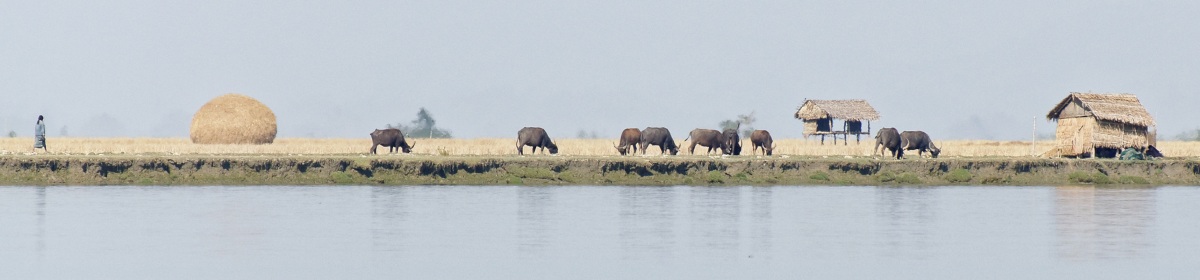
 Existence was harsh and hard, like the overcast skies much of the day we visited. [2] Along with simple huts, the site includes windmills.

 A store building is filled with dowry chests and traces of Latvia’s long history serving in the Hanseatic League.


My takeaway: How truly thin the veneer of prosperity is. Our sense of progress and the advance of civilization is so recent, and so young. I left grateful for the things I take for granted in my everyday life. In too many places in the world people still live without electricity, running water, or centralized heat.

In memory of Virginia Woolf, 25 January 1882 – 28 March 1941
NOTES: [1] Honey-based products never rot. I purchased a propolis salve at Neuhausen over a decade ago; it’s still good. The bee keeper told me the salve can be used on everything from wounds and burns to arthritis and herpes. [2] For Game of Thrones fans, I kept thinking of the Iron Islands and how craggy-rocks bitter life is there. These Latvian houses would fit the scenes perfectly, except for the fact that Game of Thrones is a fantasy world. Real people lived in the huts as recently as the start of the 20th Century. © Jadi Campbell 2017. Previously published as Death By Yawning. Photos © Uwe Hartmann. To see more of Uwe’s photos and pics from our trips go to viewpics.de.
Click here for my author page to learn more about me and purchase my books.


 The town to see whales is Hermanus. We walked from our hotel to the jetty where we’d catch a whale watching boat. The scenery included local art.










 Aw, come on. King’s Landing! Cercei’s Walk of Shame! Tyrion sightings!


 I remind myself Dubrovnik is all romantic corners and silly tourists taking selfies.
 and the European Cup soccer matches!


 March 2019 Journal entry: Just returned from an exhilarating 2 and ½ hours night tour with nature guide and tour guide at Kubah National Park. We saw frogs on trees, leaves, vines, boles, the sides of the road…. Two rare horned frogs! Mahogany frogs! A teeny pitcher plant frog – just one – it jumped away before we could look more closely but I did see the tiny thing leap (the narrow-mouth frog first described in 2010). Three different lizards. White-lipped frogs. Cinnamon frogs. Firebelly toads. Harlequin tree frogs. We had to head up to 1,000 feet up a road in the dark, the ranger with a head light. Unreal how he could spot the frogs. Glorious sounds of running water and night sounds of the jungle all around, my glasses fogging over with the heat and humidity, a large frog pond formed by wild pigs’ rutting. The frogs surprisingly calm, not jumping at our presence, just hanging out in their domain. I was in the moment, totally blissed out, just there, present with each frog we spotted. The guide and ranger and I backlighting each critter with our flashlights so Uwe could photograph it. The deep jungle trees and vegetation and clicks and buzzes and calls of frogs all around us. Nature’s Symphony. Glorious. An Australian recorded just this place and won an international competition for the most beautiful sounds in the world. Borneo’s really promoting sustainable growth, they recognize what they have here. The Malaysian part of Borneo, that is. I feel hopeful about a corner of the planet for the first time in a very, very, very long and sad time. Man, I like Borneo.


 But I’d rather tell you about hearing him play.


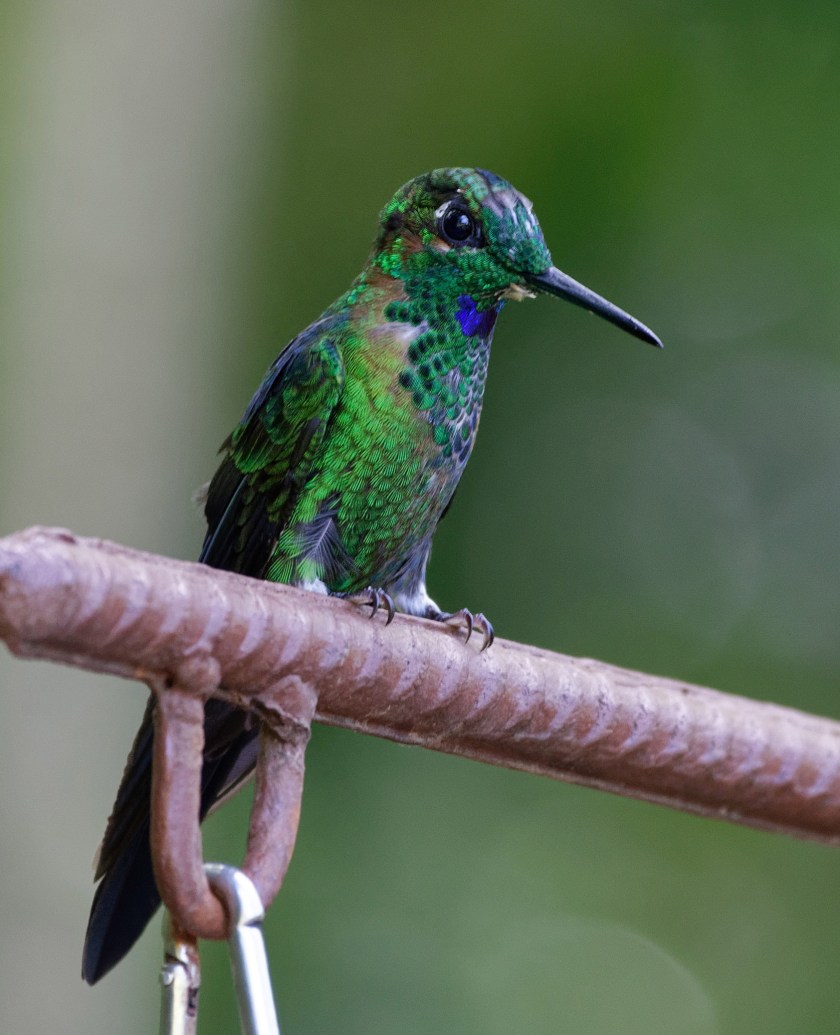
 Thirty minutes later we’re back at the park entrance’s buildings. The downpour vanishes. Uwe gets out his telefoto lens to capture the 7 varieties of blue, emerald, crimson, orange, purple hummingbirds darting in and out to the feeders on the porch. A white nosed coatimundi scurries under the hummingbird feeders, licking up the sugar water that’s dripped down onto the floorboards.
 “A walking stick!” I murmur.