…Here’s the next installment from my blog thread describing what to call groups of animals! … See how many you can guess. Answers listed at the bottom of the page.
Grain needs a grist!
The sound of the sounder almost gave her a heart attack.
The flock flocked on his poor kids.
Wow, the muster mustered such gaudy colors.
When my bike ran over the bike, I knew I was in big trouble.
The drove drove towards us in the dirt road.
Muster member
Answers:
Grist of bees [1]
Sounder of wild boar
Flock of lice
Muster of peacocks
Bike of hornets [2]
Drove of horses
Drove, Northern ThailandGrist, Khao Yai National Park, Thailand
NOTES: [1] Status: Endangered “….[P]ollinators are under threat around the world…about 40 percent of invertebrate pollinator species (such as bees and butterflies) are facing extinction.” This could have major implications for world food supply, because “about 75 percent of the world’s food crops … depend at least partly on pollination.” NPR Report 35 UK bees species are under threat of extinction, and all species face serious threats. UK Bees [2] European hornets are a protected species in Germany. European_hornet
I’m beyond dismayed – I am furious. The Trump administration is gutting environmental protections. Take action. Speak up! Write letters, make phone calls, donate to organizations like the Environmental Defense Fund and Greenpeace.
I am a Best American Essays-nominated writer. My books are Broken In: A Novel in Stories, Tsunami Cowboys, Grounded, The Trail Back Out, and The Taste of Your Name. My recent awards are Finalist for the 2025 Compass Press Book Award and Finalist for Greece’s Eyelands 11th International Short Story Contest.
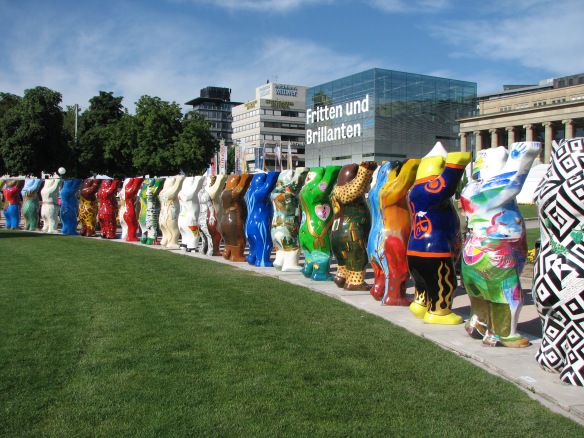
Eva Herlitz was born on July 28, 1952 in Solingen, Germany. She was a teacher and interior decorator, and a visionary. Eva Herlitz and her husband Klaus created the wonderful United Buddy Bears. The couple invited artists from every country in the world to decorate oversized bear statues. The Buddy Bears are placed in circles side by side, in exhibits that tour around the globe and are always free to the public. Donations are raised for UNICEF and other charities for children. According to the Buddy Bears website: “Since 20th June 2001, when the Buddy Bears appeared in Berlin’s streets and squares for the first time, Buddy Bear activities and help for children in need have formed an inseparable unit.” In Eva Herlitz’s honor here I give you the post I wrote after The Buddy Bears came to downtown Stuttgart. – Jadi
Many people feel Berlin is now the cultural heart of Europe. Creative impulses come from Germany’s capital and spread from there. One of the quirkiest is the Buddy Bears.
Circle of United Buddy Bears, Stuttgart
The Buddy Bears creators were inspired by the cow parades in New York and Zurich. Eva and Klaus Herlitz of Berlin wanted to initiate a similar street art project. The bear is the icon of Berlin, and thus in 2001, the Herlitzes created the first bear with a sculptor named Roman Strobl.
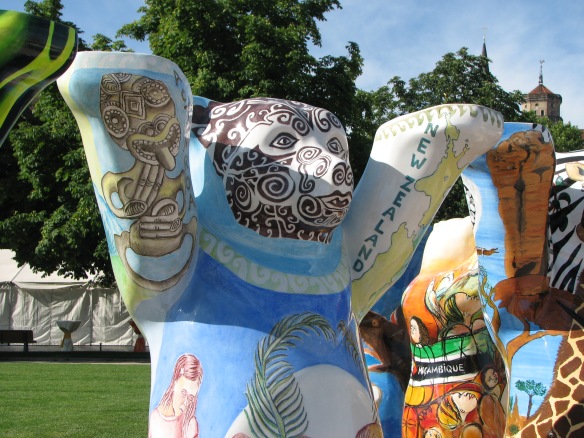
New Zealand
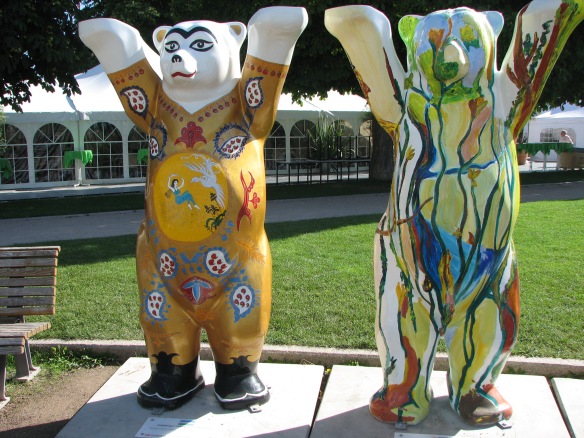
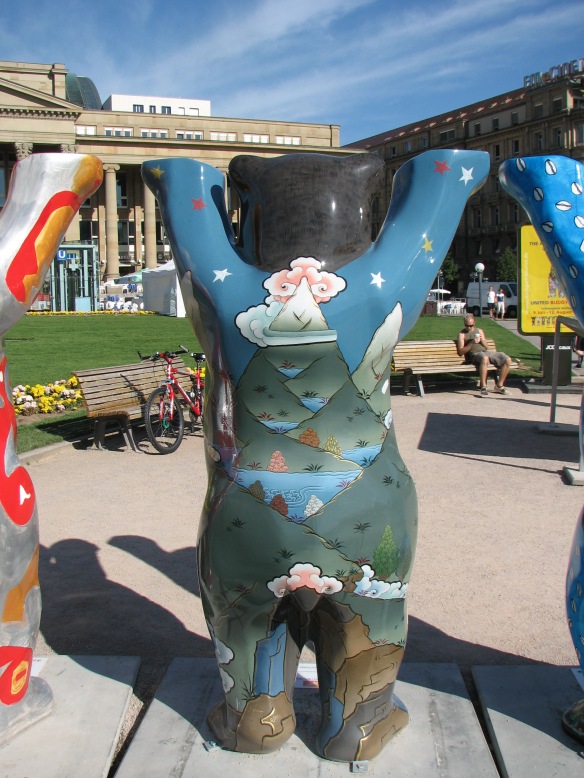
Their projected expanded, and in 2002 it went international. They had a bear created for every country the UN acknowledges, designed by artists native to each country. The bears have their arms raised as if they’re holding hands. (This can also be described as the laughing Buddha pose.) Each bear is painted with images of the culture, history, landscape, economy, art and music of its country.
The first display took place in a circle around Berlin’s Brandenburg Gate. The circle symbolizes the Art of Tolerance. One and a half million people saw the exhibit, and since then, they’ve toured 5 continents and stood in an alphabetical circle in the centers of host cities.
Uzbekistan and UruguayPanama
I saw the Buddy Bears in 2008 when they came to the Schlossplatz in downtown Stuttgart. They send a message about peace, understanding, love and tolerance among the world’s nations, cultures and religions.
When new bears are commissioned, the older ones are auctioned off. All monies go to UNICEF and other childrens’ charities. As of September 2018, 2,300,000 Euros have been raised for charities such as Eva Herlitz’s Buddy Bear Help!
Over 240 artists have been involved in the project, and more than 30 million visitors have seen the United Buddy Bears. A smaller circle of United Buddy Bears-The Minis (1 meter high) also tours.
South and North Korea, side by side
Brazil and Bulgaria
The United Buddy Bears exhibitions are always opened by national and foreign dignitaries. After he saw the bears in Berlin, actor Jackie Chan made sure they came to Hong Kong. When UNICEF Goodwill Ambassador Sir Peter Ustinov saw them, he insisted that Iraq be represented.
There is one very special grey and white polar bear. He has the image of Albert Einstein and the following quote: ‘Peace cannot be kept by force. It can only be achieved by understanding’.
Kirgyzstan, Columbia, Congo and Congo-Brazzaville
It’s fascinating to consider that United Buddy Bears change their order as they travel. The circle is always organized in the language of the host country. Buddy Bears may suddenly hold hands with distant or hostile neighbors…
In memory of Eva Herlitz, 28 July 1952 – 26 February 2021
Selected Bibliography:
Herlitz, Eva & Klaus, United Buddy Bears — Die Kunst der Toleranz. Bostelmann & Siebenhaar Publishers, 2003. ISBN 3-936962-00-6.
Herlitz, Eva & Klaus, United Buddy Bears — World Tour. NeptunArt Publisher, 2006. ISBN 3-85820-189-8.
Herlitz, Eva & Klaus, United Buddy Bears — The Art of Tolerance. 384 pages, English/German, December 2009, ISBN 978-3-00-029417-4.
Here is the third installment from my blog thread describing what to call groups of animals … See how many you can guess. Answers listed at the bottom of the page.
The charm charmed me again with their singing.
A huge cloud clouded the sky, and ruined any chance of a good photo.
The band banded together, hoping no one would notice.
A blue fluther fluthered in the tide. [1]
A mob mobbed Uluru.
The squadron flew off in a squadron. [2]
Answers:
Charm or chirm of finches
Cloud of gnats
Band of gorillas [3]
Fluther of jellyfish [4]
Mob of kangaroos [5]
Squadron of pelicans
Fluther, Loro Parque, TenerifaSquadron
NOTES: [1] There are 3 wonderful names for jellyfish groups. Fluther is the second [2] A military flight formation [3] Status: Endangered to Critically Endangered WWF [4] Using fluther in a sentence even allowed me to make up a verb! [5] According to the IUCN Red List, tree kangaroos range from near threatened to critically endangered across the various species. Intl Fund for Animal Welfare
Band, Loro Parque, Tenerifa
I’m beyond dismayed – I am furious. The Trump administration is gutting environmental protections. Take action. Speak up! Write letters, make phone calls, donate to organizations like the Environmental Defense Fund and Greenpeace.
I am a Best American Essays-nominated writer. My books are Broken In: A Novel in Stories, Tsunami Cowboys, Grounded, The Trail Back Out, and The Taste of Your Name. My most recent book The Taste of Your Name was a finalist for the 2025 Compass Press Book Award.
E.B. White was born on July 11, 1899 in Mount Vernon, New York. He was a staff writer for The New Yorker Magazine, and edited the classic handbook The Elements of Style. White wrote essays, letters, meditations on the natural world, and books for children. My sisters and I talk often of our sweet childhood memories: our father read us Charlotte’s Web numerous times before bedtime. In his honor (with apologies to Charlotte), I give you a post I wrote about spiders after we visited Cambodia. – Jadi
One of the exotic foods I have (NOT!) eaten is a Cambodian treat of crispy fried big black hairy spiders. Sold at a roadside stop when the bus from Phnom Penh thoughtfully stopped for a bathroom break.
Crispy Fried Big Black Hairy Spiders .. who doesn’t love ’em?
Actually, this post belongs to my blog thread describing what to call groups of animals. Here I give you: a cluster of spiders. Realize that these are (were) each about the size of my closed fist, and you will understand why I lost my appetite.
The spider in the next photo was as large as the span of my whole hand….
Really, you don’t even wanna imagine a cluster of these guys in Northern LaosHow about a cluster of these spiders – also gigantic – from Japan?
I can’t imagine eating these spiders. Or the scorpions, or larvae, or bugs fried up at various markets we’ve visited…. But they are a source of protein. “Over 1,000 species of insects are known to be eaten in 80% of the world’s nations. The total number of ethnic groups recorded to practice entomophagy is around 3,000. …Today insect eating is rare in the developed world, but insects remain a popular food in many regions of Latin America, Africa, Asia, and Oceania. …FAO has registered some 1900 edible insect species and estimates there were in 2005 some 2 billion insect consumers worldwide.” [1]
In memory of E.B. White, July 11, 1899 – October 1, 1985
I am a Best American Essays-nominated writer. My award-listed books are Broken In: A Novel in Stories, Tsunami Cowboys, Grounded, The Trail Back Out, and The Taste of Your Name. My most recent book, The Taste of Your Name, was a finalist for the 2025 Compass Press Book Award.
This post is the fourth in my series on southern Africa’s traditional baskets. This one is from Botswana, and the pattern is titled Running Ostrich. If you’ve ever watched these gangley birds do a thirty yard dash, you know this basket couldn’t be called anything else. Perfectly named!
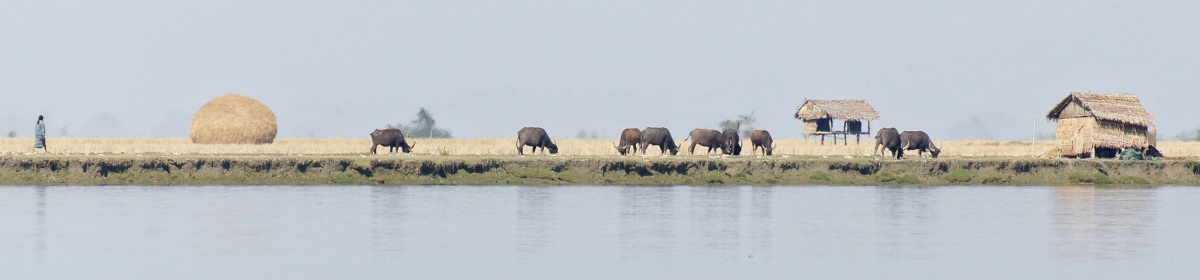
This is the second installment from my blog thread describing what to call groups of animals … See how many you can guess. Answers listed at the bottom of the page.
“Double double, toil and trouble, fire burn and caldron bubble,” she cackled. Then the witch threw another cauldron into the caldron. [1]
The prickle prickled no one that day.
And the clutch clutched at the edges of the baskets.
Exaltation exalted the evening with the complex songs of the family Alaudidae.
A smack smacks into goo on the rocks.
The romping romp are some of my favorite critters.
Prickle, Laos
Answers:
Cauldron of bats [2]
Prickle of porcupines
Clutch of birds
Exaltation of larks
Smack of jellyfish [3]
Romp of otters [4]
Smack, Loro Parque, TenerifaCauldron, Khao Yai National Park, Thailand
I’m beyond dismayed – I am furious. The Trump administration is gutting environmental protections. Take action. Speak up! Write letters, make phone calls, donate to organizations like the Environmental Defense Fund and Greenpeace.
I am a Best American Essays-nominated writer. My books are Broken In: A Novel in Stories, Tsunami Cowboys, Grounded, The Trail Back Out, and The Taste of Your Name. My most recent book The Taste of Your Name was a finalist for the 2025 Compass Press Book Award.
Author Colleen McCullough was born on June 1, 1937 in Wellington, Australia. She wrote a highly regarded series on Rome; she taught and did research at Yale’s Medical School Dept. of Neurology. And while she was working at Yale – because neurology and a position at an Ivy League university somehow didn’t take up all her time – she wrote The Thorn Birds. In her honor I give you the post I wrote after visiting the Outback. —Jadi
In The Thorn Birds, Colleen McCullough vividly depicts a turn of the century sheep ranch in the Australian Outback. The hardships of working an unforgiving landscape, conditions that seem too extreme to be real, and the isolation are all accurately portrayed.
You’re already yawning, right?
All right then, how about this? In The Thorn Birds, young heroine Meggie and the priest Father Ralph de Bricassart, many years her senior, fall in love. Their life long passion is both forefront and backdrop to the fates of a family in the Outback.
That caught your attention!
I’m not usually one for the guilty pleasure of romance novels, but this one works on so many levels that it’s irresistible. Whether as romance, family saga, or historical portrayal, The Thorn Birds is a great read. It’s also accurate to a fault. As you read this book, you experience Australia’s hard climate along with McCullough’s characters.
Uwe and I drove through a small portion of the Western Australia Outback. Our goal was the gold mining town of Kalgoorlie-Boulder and we had a long, stop-every-3-hours to stretch our legs drive to do. The Coolgardie-Esperance Highway goes on with no bends or turns (and very few trees).
We halted briefly in Norseman
Norseman, Western Australia
and purchased sandwiches and drinks for a planned picnic stop. But there was a problem: no picnic tables anywhere. We drove and drove. Why, on such an endless highway, were there were no facilities?
We finally gave up and pulled over to the side of the road.
At least there was a tree and some shadeNote the deep red soil
I got out of the car and spread lunch on the hood. I was too hungry to wait for Uwe, so I unwrapped my sandwich and yummy cake, and gazed out into the endless empty brush.
The Indian Ocean is somewhere on the other side of those mountains
Every fly in the endless empty brush left wherever they’d been snoozing. Within seconds my eyes and mouth, my hands and arms, and my lunch were engulfed with fat hungry insects. My sandwich was rendered way beyond salvaging; it had vanished under layers of crawling flies. I wrapped everything back into a bag to throw away later and contented myself with a piece of fruit (eaten in the car, with the windows all closed).
In case you’re eating your own lunch as you read this I won’t tell you what it is in The Thorn Birds that’s covered in flies. But man, that McCullough sure can write!
In memory of Colleen McCullough, June 1, 1937 toJanuary 29, 2015
I am a Best American Essays-nominated writer. My award-listed books are Broken In: A Novel in Stories, Tsunami Cowboys, Grounded, The Trail Back Out, and The Taste of Your Name. My most recent book, The Taste of Your Name, was a finalist for the 2025 Compass Press Book Award.
Maybe it’s weird, but I know more about people in my imagined universe than I do about the real people in my life. I figure real folks are entitled to their privacy. But if I thought you up and wrote you down, I DO know and WILL share salacious and embarassing details.
I create back stories for all my characters. People in my books reappear in later works. I take characters who showed up in an earlier novel or short story and fill in their profiles – sometimes against their wills.
Which brings us to Brian Klevenger. He made a brief appearance in Tsunami Cowboys, remember? Brian is Scott McCreedy’s best friend. He’s an only child, the son of alcoholics, and spends as much time as possible at Scott’s house.
Brian takes center stage in my most recent novel The Taste of Your Name. He’s fled to Germany where he does reminiscence therapy with dementia patients. He’s sleeping with two sisters. And (because I wrote his story) I tell the readers his most secret inner thoughts and emotions (because getting to do so is one of the great rewards of being a writer).
Brian is one of the most complex, complete human beings I know. You can meet him here: Amazon.com. Available around the world as eBook, hardcover, and paperback.
I am a Best American Essays-nominated writer. My books are Broken In: A Novel in Stories, Tsunami Cowboys, Grounded, The Trail Back Out, and The Taste of Your Name. My most recent book with Brian, The Taste of Your Name, was a finalist for the 2025 Compass Press Book Award.
Consider this a public service announcement. I repeat: Save your receipts!
I just took a long holiday which started in January. It’s a long flight to New York City. I arrived jet-lagged and my bag hadn’t made it onto the plane. It was about 0° Celsius and all my other sweaters were in Frankfurt. I was tired, annoyed, and cold.
Avoid gypsy cabs! Don’t get ripped off!signs warned. I booked a taxi to the city at JFK’s official airport kiosk in the International Arrivals terminal. My cab ride would cost about $77. Fair enough…
When the driver dropped me at my hotel I paid with a credit card and rounded up the bill to $95 to give him an $18 tip, stuffed the receipt in my wallet, and wearily climbed out of the cab. Let the holidays begin!
A week later in Mexico (I did say this was an extended trip) I logged into my bank’s website to see which charges had come in. There was my cab ride in NYC… $178.44.
WTF???
I remembered that receipt I’d stuffed in my wallet. Later I’d placed it with all the other receipts I’d accrued while traveling. I like to check them against the bank charges to be sure my account balances are still sufficient to cover costs. I dug through my bag (which had finally arrived almost 48 hours after I did) and found the receipt for the taxi ride. Check it out:
Did you spot it? He’d given himself a VERY generous $95 tip. I was so jet-lagged that without checking I’d just signed the credit card machine he’d held out. “Round it up to $95,” I’d told him. $95?” he’d repeated.
Maybe it had been an honest mistake. Or maybe as a driver picking up tourists traveling from overseas he’d figured that I would head on my merry way and never know that he’d knowingly given himself a tip that would cost me more than the ride itself. He figured I’d see the charge on my bank statement and not have any way to get my money back.
Check out that receipt again.
It gives his driver number. 5841026. It lists his cab number. 1P88. It names the date, time, distance, tunnel charges, starting point and destination, AND IT PROVIDES A WEBSITE!
I wrote a pissed-off email to the company and they reimbursed me for the tip charge ($95!!!) the next day. I don’t know what happened to Driver #5841026, but I enjoyed some fantasies… So. In conclusion, save your receipts.
And don’t leave the damned cab before you review what you’re being charged.
I am a Best American Essays-nominated writer. My books are Broken In: A Novel in Stories, Tsunami Cowboys, Grounded, The Trail Back Out, and The Taste of Your Name. My most recent book The Taste of Your Name was a finalist for the 2025 Compass Press Book Award.
Anaïs Nin was born on February 21, 1903 in Neuilly-sur-Seine, France. She wrote essays, diaries, short stories, novels, and erotica. She befriended and promoted fellow author Henry Miller. Her work is strong, feminine, and unapologetically sexual. In her honor I am reprinting the post I wrote after we visited an amazing temple complex in India: Khajuraho. – Jadi
When we visited, Khajuraho could only be reached via a long trek on bad roads. Since we’re talking about India, this means the roads are bad indeed.
Where’d the road go?Down here maybe?
The driver we’d hired was there to meet us at our hotel in Agra, and off we went. Five bone-jolting hours later we reached our destination.
Along with its inaccessibility, Khajuraho is notorious for 1,000 year old, perfectly preserved, UNESCO World Heritage erotic carvings.
Somehow this site survived a millennia (millennia, people!), in a spot that had no fortresses or fortifications to speak of. The temple complex existed simply for the purpose of worship.
And what worship. Every single inch of the temple buildings are carved in high relief, depicting gods, tender lovers, voluptuous attendants, monkeys, elephants, assistants for the sexual act….
Hundreds of skilled stonemasons were hired to build the site. The Khajuraho region has excellent sandstone, and the sandstone temples were built with granite foundations. All were constructed without mortar! Instead, gravity holds the stones together with mortise and tenon joints.
Some of these stones are megaliths weighing up to 20 tons.
The glory of sandstone is that it loans itself to delicate carving. Even viewing the temple walls from the ground we could see the wrinkles in Ganesh’s trunk; the fingernails of the apsaras and the beads in their strands of jewelry; the sheer layers of veils over their thighs and buttocks.
Uwe vanished almost immediately with his camera, leaving me alone with the young male guide. I could feel my face go red, and it wasn’t a hot flash or sunburn. I was terribly afraid of how embarrassed I was going to be. But the guide pointed out the various depictions of the act of love and spoke in a clear calm voice, explaining the significance (pull your minds of out the gutter, dear readers) in terms of energy, religion, and esoteric philosophy.
It was mid-January, past the usual Christmas tourist season. It was also a two-week period when northern and central India get swathed in fogs – something smarter tourists than we knew. As a result we had the pleasure of being two of the few Westerners at the site.
Most of the others were Indians on holiday, and I was touched to see that at Khajuraho, this meant young married couples. They walked around the compound, standing in front of particularly erotic carved panels, heads together in discussion.
How about the next panel?Is that a new yoga position?
While only 10% of the carvings depict sexual acts, you can guess which panels elicited the most commentary. These were the love-making couples known as maithunas. Other carvings depict everyday activities: playing musicians, potters, farmers, soldiers on horseback, etc.
Musicians
The temples were probably built in the one hundred year period between 950 and 1050 AD, during the Rajput Chandella dynasty. According to historical records, by 1100 Khajuraho contained 85 temples covering 20 square kilometers. Roughly 20 temples still stand. They were located 60 kilometers from Mahoba, the medieval capital of the Chandela kingdom.
Khajuraho was mentioned by the Arabic historian Abu Rihan-al-Biruni, in 1022 AD, and by Ibn Battuta, the Moroccan traveler, in 1335 AD.
When Muslim rulers took control, heathen places of worship were systematically destroyed. Ironically, even centuries ago the remoteness of these temples helped secure their survival. Nature did the rest as vegetation and forest reclaimed the site. For years the temples were covered by dense date palm trees which gave the city its name: in Hindi, Khajur = date. (The more ancient name was Vatsa.)
The scenes explain Hinduism’s four goals for life: dharma (right way of living), kama (aesthetic enjoyment), artha (prosperity) and moksha (liberation). The complexity of the geometric layout and the grid pattern of the temples with their circles, squares and triangles, the importance of geographic orientation and bodies of water and the carvings’ iconography is beyond my very weak grasp. Instead, here is an excerpt from the UNESCO website:
Greatly influenced by the Tantric school of thought, the Chandela kings promoted various Tantric doctrines through royal monuments, including temples. Sculptors of Khajuraho depicted all aspects of life. The society of the time believed in dealing frankly and openly with all aspects of life, including sex. Sex is important because Tantric cosmos is divided into the male and female principle. Male principle has the form and potential, female has the energy. According to Hindu and Tantric philosophy, one cannot achieve anything without the other, as they manifest themselves in all aspects of the universe. Nothing can exist without their cooperation and coexistence. In accordance with ancient treaties on architecture, erotic depictions were reserved for specific parts of the temples only. The rest of the temple was profusely covered with other aspects of life, secular and spiritual. Source: UNESCO/CLT/WHC
Khajuraho remained forgotten by the outside world until 1838 when a British army engineer, Captain T.S. Burt, was carried in via palanquin. I laughed so hard when I read that the Victorian officer was shocked by what he found….
Khajuraho!
In memory of Anaïs Nin, February 21, 1903 – January 14, 1977
I am a Best American Essays-nominated writer. My books are Broken In: A Novel in Stories, Tsunami Cowboys, Grounded, The Trail Back Out, and The Taste of Your Name. My most recent book The Taste of Your Name was a finalist for the 2025 Compass Press Book Award.