NOTE: The Wonderful Wizard of Oz first appeared in print on 17 May, 1900; the film premiered on 12 August, 1939. Here is one of my very first posts, about author L. Frank Baum, bats, and monkeys…. — Jadi
Both sides of my family hail from the Northeast. We lived for a while in Cazenovia, one of the most beautiful small towns in upstate NY. Caz is just a few miles from Chittenango Falls, and that town was the birthplace of L. Frank Baum, author of The Wizard of Oz.
My sisters and I first saw The Wizard of Oz film on an old black and white television set we called Lucille. Lucille was temperamental (“Dad! Lucille’s on the fritz again!”), but her screen was big.
It was years before I finally saw The Wizard of Oz on a color television. How I gasped when Dorothy opened that door and stepped out into Munchkin Land! But in color or black and white, to this day I don’t much like monkeys.

Some years ago my husband and I traveled to Bali. The Balinese fill their temples with statues of the strange half-bird, half-god creature known as Garuda, a lion-like Barong, lots of sinuous snakes, and Hanuman the monkey god. The cultural heart of Bali is Ubud, home to the Monkey Forest which contains the Monkey Temple. I wrapped a sarong around my waist before we entered to show respect, and I know I was curious as to what we’d find.
The temple grounds were filled – no, overrun – with crab-eating macaque (Macaca fascicularis) monkeys. Dozens of them rested on the platforms to the Pura Dalem Agung Padangtegal temple. Many more watched us from up in the canopy of thick jungle trees and vines. But worst of all, a horde of monkeys scampered our way as we drew near. They were used to people and accustomed to visitors who bring them food. We walked slowly, not making any sudden movements, keeping our arms stretched out with our hands opened. I hoped my empty palms signaled: no food here!

I breathed a huge sigh of relief when we left the grounds. But I wonder about the sanity (to say nothing of the later health) of tourists who bring bananas and fruit to hand to the macaques. Those critters are feral!
Bali has another disturbing indigenous species: bats.
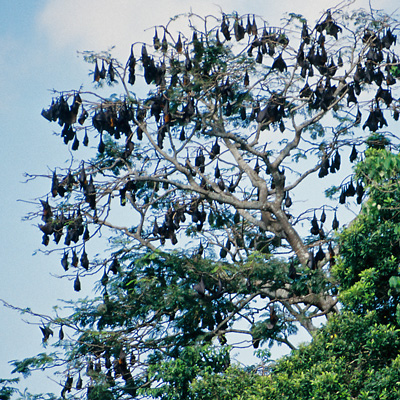
A huge colony of the largest fruit eating bats I have ever seen, all with wingspans of an easy three feet, hung upside down in a very tall tree. I was horrified by their size.
Then they began flying. In the middle of the day. Bright tropical sun highlighted the reddish membranes of their webbed skins. They flew in loops, more and more gigantic bats, circling lower. I began to feel dizzy as a scratchy voice in my head murmured, “I’ll get you, my little pretty …”
Macaques and bats had morphed together into L. Frank Baum’s flying monkeys. Never underestimate the power of imagination in children…or adults. That movie scene still haunts me. Like I said, to this day I don’t much like monkeys.
PS: But, do go to Bali!
NOTES: © Jadi Campbell. All photos © Uwe Hartmann. Uwe’s photos of our trips and his photography may be viewed at viewpics.de.
Click here for my author page to learn more about my books and me.


 For twenty-five years (minus a day) I had a memory of rose-colored glass. Uwe and I got married a quarter of a century ago. Aside from thinking Yikes, how did that happen?!, I have sighed Awwww. Not many things last this long, especially when we’re talking about human beans….
 Our wedding anniversary recently took place, and we wanted to return to the little town in Alsace where it all began. We booked the same hotel and both think we may even have been given the same room. We drove over a day before our anniversary and checked in as it began to rain. The sight of the rain on the windows was get outta here romantic.
 I took some pictures. But later, checking to make sure my photos turned out, I was puzzled. The views of the village outside the windows had stayed pretty. But, wait a second: where were the colored panes of glass both of us are sure we remember?
 The mystery was solved by a friend who reminded me that hotels – especially old ones – spend money on renovations. So, along with the elevator that was not there when we checked in 25 years ago, the windows were probably recent too. The glass in the windows is now textured, ‘pebbled’ maybe is the word I want. The view is still ever so slightly wavy and distorted…
 This 3-day festival celebrates the start of the rainy season by shooting rockets off into the heavens. [1] Teams compete for awards with home made rockets. HOME MADE.


 But what a terrific way to mark the change of seasons: throw a village party, give out some prizes (and these were significant: our guide told us a new house and a water buffalo were among the prizes to be awarded), and shoot off some fireworks. Just make sure that they’re home made, by a team of you and your friends.


 We were in Laos and Vientiane for the first time, and only had a couple of days there. So we booked a car and driver and a guide, and left the city for a day. On the way back, we drove down a road filled with stands selling food and drinks. “It’s a rocket festival,” our guide exclaimed. “Would you like to stop and see it?”

 What really drew our interest were the large numbers of men in dresses and skirts, wearing make-up. It was still the afternoon, and most of them were already hammered.

 Laos’s most important religious festival opens with a parade led by monks and government officials, accompanied by musicians in ethnic costumes.


 The festival brings everyone together, regardless of ethnic group or social standing. The procession shows solidarity among communities as people from all walks of life take part in the festival. Everyone dresses in their best clothes, and people from all over the country attend. Groups across Laos try to bring at least one wax castle to the stupa. The stupa itself is the country’s most important religious edifice, believed to contain a sacred relic of the Buddha.
 We spent a long time on the grounds, quietly watching the comings and goings. People laugh and talk and play music as they make their offerings, but the solemnity of the procession made me sorry I didn’t have on a skirt or dress, or pay to rent a sarong for the event. Tourists are welcomed but there is nothing touristy about this sacred ritual. It was an overwhelmingly, intensely Laotian celebration. As always: I feel honored and lucky that Uwe and I were there for that full moon, and that we continue to get to witness the wonders of this precious world.
 NOTES: “November 28, 2012 Wax Castle Procession” Vientiane Times, The First National English Language Newspaper
 The That Luang Festival – Part 1


 The festival is a holiday honoring Buddha at the That Luang stupa, Laos’s most sacred religious site. [1] Traditionally, the festival occurs during the full moon of the twelfth lunar month (November).


 Part 2 will post next week.
 This is a brand new feature for this blog: I’m transcribing selected entries from my old travel journals. Currently I’m working on a batch of new posts set in Laos. I hauled out the journal I kept on our first visit to make sure that my memories match up with the facts. My descriptions from that trip are raw. I use a travel diary to record first impressions and get down the details to go over later (like now, years later). I’ve decided to post some of them here for your amusement. — Jadi
 A 1,000-year-old site we visited with our guide on yesterday’s tour:
 Buddhas in the Angkor Wat style carved out of boulders in the jungle. And, not twenty feet away, a spirit altar by a tall tree. [1]
 No one’s allowed to build anything on or near the site. But the locals come there for ceremonies and celebrations. It had a rather hushed and holy air as we stood on the jungle (forest) floor in the welter of the afternoon heat at Vang Sang. An elephant graveyard was once found nearby!


 The buildings all high on stilts for the rainy times. We had my favorite meal so far in this trip: a soup with fresh Chinese vegetables and tofu and vermicelli noodles – it may be the freshest ingredients in a soup of this kind I can remember. And a lake fish grilled whole with garlic and ginger and lemon grass and cilantro; and it was all just too delicious for words.