Yes. It’s time for the next post on animals that may go extinct thanks to the Trump administration’s removal of environmental protections. Installment #9 from my blog thread describing what to call groups of animals … See how many you can guess. Answers listed at the bottom of the page.
The gulp gulped down fish.
A puddle needs more water than just a puddle.
Late season is packed with packs.
A blessing blesses all my dreams.
The kennel was so happy to be out of the kennel!
The hover hovered just under the surface.
Kennel, Montréal Canada
Answers:
Gulp of cormorants [1]
Puddle of platypussi [2]
Late season of grouse (in late season) [3]
Blessing of unicorns
Kennel of dogs
Hover of trout [4]
Gulp
I’m beyond dismayed – I am furious. The Trump administration is gutting environmental protections. Take action. Speak up! Write letters, make phone calls, donate to organizations like the Environmental Defense Fund and Greenpeace. Volunteer.
I am a Best American Essays-nominated writer. My books are Broken In: A Novel in Stories, Tsunami Cowboys, Grounded, The Trail Back Out, and The Taste of Your Name. Recent awards include Finalist for the 2025 Compass Press Book Award for The Taste of Your Name and Finalist for Greece’s Eyelands 11th International Short Story Contest.
This post is a blast from the past. My family spent many of the happiest weeks of our lives, individually and as a family unit, on the back trails of the Adirondacks. I’m posting this to remind myself I’m still on that trail, always.
I am a Best American Essays-nominated writer. My books are Broken In: A Novel in Stories, Tsunami Cowboys, Grounded, The Trail Back Out, and The Taste of Your Name. My recent awards are Finalist for the 2025 Compass Press Book Award and Finalist for Greece’s Eyelands 11th International Short Story Contest.
Margaret Mead was born on December 16, 1901 in Philadelphia, Pennsylvania. Mead was a cultural anthropologist and one of my secret heroes when I was a little girl. The idea of an adult woman who traveled the world to meet people from other cultures probably influenced me more than I realize. In her honor I am reprinting one of the posts I wrote after Uwe and I trekked to meet the Chin women in NW Burma. This area is closed off to the outside world now. – Jadi
***
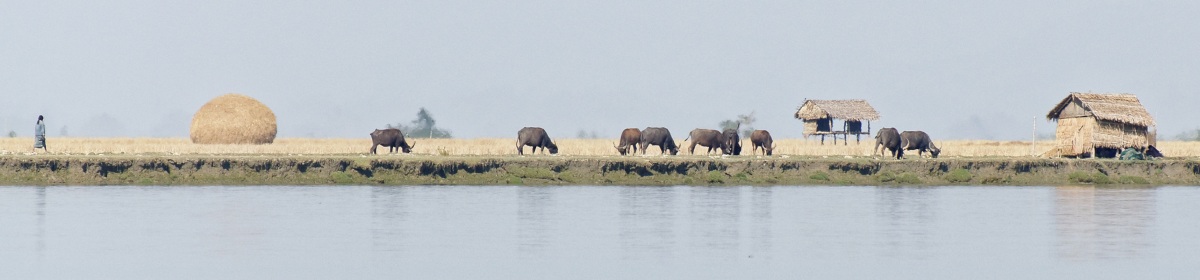
We made a long trek to reach the Chin State. We had a day pass (tourists are not allowed to remain overnight in the Chin territory) and a guide to translate for us. Our hope was to reach the villages where the local tribes still have elders with tattoos, by tradition only the women. The government represses the tradition, and it was feared that it had died out.
We had no guarantees that the women would come out to meet us once we reached the villages. At some point in the journey I stopped caring, because every minute in Burma was filled with wonders. The long slow passage upriver had become a journey to a some where, a some thing else. We chugged slowly upriver in NW Burma on the Lemro, from the Rakhine to the Chin state.
Arriving
After walking around for some time in the first village, the elders stood before us! It was literally as if we looked up, and there they suddenly were.
We asked through our guide if Uwe might take photos. The elder women calmly answered in the affirmative. They were, after all, the reason we’d come so far to visit. The tribes are self-sufficient and produce nothing for the tourist market. To meet the female elders is the reason why foreigners come to the villages.
We were meeting Laytu Chin women (also called Lemro or Laito). The Chin are of Tibetan-Burman ethnicity, and tattooing is practiced only among the southern Chin.
To a woman they were calm, poised, and radiated confidence. When did the Chin begin tattooing? One claim is that the tattooing was done to make the women ugly so the Burmese kings would stop stealing them to use as slaves, but this claim has been discounted as myth. It’s our modern world that sees tattooing as unattractive and labels it ‘ugly’. It’s far more likely that the Chin women were tattooed in a rite of passage, and that the facial tattoos are a mark of social status and coming of age. The tattoos make the women beautiful.
No one in the outside world knows just what these patterns signify. The tattoos may be stippling, dots, circles. The Laytu women we met have the most elaborate Chin tattoo, a spider web or rising sun pattern. Our guide told us the men had gathered the materials used in the tattooing process. Jens Uwe Parkitny reports being told that the actual tatooing is done by female tatoo artists.
The women walked us through the village, up to the school. It was originally funded by a foreigner and we were invited to make a donation. It was all very formal: the guide wrote out a receipt along with the amount, our names, and our nationalities.
One of the women was in charge of taking the money and handling the donation, but the task is rotated. He translated our questions, explaining that on each day a different woman takes on this task. The responsibility of supporting the village is shared communally.
On that day we were invited up into a home on stilts. In another Chin village we watched one of the old women work at a handloom. We visited a burial ground on the river banks, where the dead are cremated and offerings are set out for the deceased. When we finally set back down the Lemro River on that December 31st, the last day of the year 2009, Uwe and I knew we had journeyed a very far way indeed.
In memory of Margaret Mead, December 16, 1901 – November 15, 1978
I am a Best American Essays-nominated writer. My books are Broken In: A Novel in Stories, Tsunami Cowboys, Grounded, The Trail Back Out, and The Taste of Your Name. Recent awards include Finalist for the 2025 Compass Press Book Award for The Taste of Your Name and Finalist for Greece’s Eyelands 11th International Short Story Contest.
Margaret Hamilton was born on December 9, 1902 in Cleveland, Ohio. She appeared on-screen with W.C. Fields, Abbott and Costello, and Buster Keaton. She’s gone down in film history for her distinct voice and terrifying depiction of the Wicked Witch of the West/Almira Gulch in film The Wizard of Oz. The book The Wonderful Wizard of Oz first appeared in print on May 17, 1900; the film premiered on August 12, 1939.
Ms. Hamilton was devoted to public education (she was a former schoolteacher) and to the welfare of children and animals. In her honor I am reprinting one of my very first posts, about L. Frank Baum, bats, and monkeys. — Jadi
Both sides of my family hail from the Northeast. We lived for a while in Cazenovia, one of the most beautiful small towns in upstate NY. Caz is just a few miles from Chittenango Falls, and that town was the birthplace of L. Frank Baum, author of The Wizard of Oz.
My sisters and I first saw The Wizard of Oz film on an old black and white television set we called Lucille. Lucille was temperamental (“Dad! Lucille’s on the fritz again!”), but her screen was big.
It was years before I finally saw The Wizard of Oz on a color television. How I gasped when Dorothy opened that door and stepped out into Munchkin Land! But in color or black and white, to this day I don’t much like monkeys.
Balinese Barong
Some years ago my husband and I traveled to Bali. The Balinese fill their temples with statues of the strange half-bird, half-god creature known as Garuda, a lion-like Barong, lots of sinuous snakes, and Hanuman the monkey god. The cultural heart of Bali is Ubud, home to the Monkey Forest which contains the Monkey Temple. I wrapped a sarong around my waist before we entered to show respect, and I know I was curious as to what we’d find.
The temple grounds were filled – no, overrun – with crab-eating macaque (Macaca fascicularis) monkeys. Dozens of them rested on the platforms to the Pura Dalem Agung Padangtegal temple. Many more watched us from up in the canopy of thick jungle trees and vines. Worst of all, a horde of monkeys scampered our way as we drew near. They were used to people and accustomed to visitors who bring them food. We walked slowly, not making any sudden movements, keeping our arms stretched out with our hands opened. I hoped my empty palms signaled: no food here!
Monkey Temple Gang
I breathed a huge sigh of relief when we left the grounds. But I wonder about the sanity (to say nothing of the later health) of tourists who bring bananas and fruit to hand to the macaques. Those critters are feral!
Bali has another indigenous species: bats.
Bali bats from hell
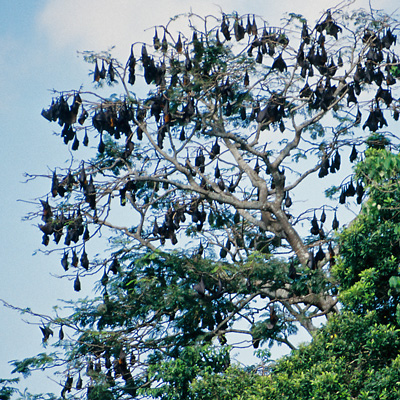
A huge colony of the largest fruit eating bats I have ever seen, all with wingspans of an easy three feet, hung upside down in a very tall tree. I was horrified by their size.
Then they began flying. In the middle of the day. Bright tropical sun highlighted the reddish membranes of their webbed skins. They flew in loops, more and more gigantic bats, circling lower. I began to feel dizzy as a scratchy voice in my head murmured, “I’ll get you, my little pretty …”
Macaques and bats had morphed together into L. Frank Baum’s flying monkeys. Never underestimate the power of imagination in children…or adults. That movie scene still haunts me. Like I said, to this day I don’t much like monkeys.
PS: But, do go to Bali!
In honor of Margaret Hamilton, 9 December, 1902 – 16 May, 1985
I am a Best American Essays-nominated writer. My books are Broken In: A Novel in Stories, Tsunami Cowboys, Grounded, The Trail Back Out, and The Taste of Your Name. Recent awards include Finalist for the 2025 Compass Press Book Award for The Taste of Your Name and Finalist for Greece’s Eyelands 11th International Short Story Contest.
Here is installment #8 from my blog thread describing what to call groups of animals … most of them now endangered or vulnerable. See how many you can guess. Answers listed at the bottom of the page.
The roll rolled up tight.
The flight took flight.
You don’t want this wake at a wake.
We spotted three stands standing on the beach.
The parliament looked parliamentary and regal indeed.
The risk risks being turned into dinner.
Parliament, Madeira
Answers:
Roll of armadillos [1]
Flight of butterflies [2]
Wake of buzzards
Stand of plovers (on land) [3]
Parliament of owls [4]
Risk of lobster [5]
Flight, back trails Cranberry Lake, Adirondacks USA
I’m beyond dismayed – I am furious. The Trump administration is gutting environmental protections. Take action. Volunteer. Speak up! Write letters, make phone calls, donate to organizations like the Environmental Defense Fund and Greenpeace.
I am a Best American Essays-nominated writer. My books are Broken In: A Novel in Stories, Tsunami Cowboys, Grounded, The Trail Back Out, and The Taste of Your Name. Recent awards include Finalist for the 2025 Compass Press Book Award for The Taste of Your Name and Finalist for Greece’s Eyelands 11th International Short Story Contest.
While we were in New Zealand in February we stopped at Punakaiki Pancake Rocks and Blowholes Walk, South Island. It was a gorgeously sunny day and a pod of Hector’s dolphins were cavorting off shore!
The Pancake Rocks are eroded limestone rock formations, flat and compressed. The Tasman Sea has eroded them into blowholes and caves. It’s a great spot. We visited it for the first time 20 years ago… when the weather was cold and wet and rainy. We did manage to get a photo between showers.
I wanted to use this photograph for our annual Christmas card that year. Sadly, for some reason, Uwe nixed the idea. Happy Thanksgiving, everyone! xo
I am a Best American Essays-nominated writer. My books are Broken In: A Novel in Stories, Tsunami Cowboys, Grounded, The Trail Back Out, and The Taste of Your Name. Recent awards include Finalist for the 2025 Compass Press Book Award for The Taste of Your Name and Finalist for Greece’s Eyelands 11th International Short Story Contest.
With all the angst and intensity in the news these days, I decided to post a photo of somewhere beautiful. This image makes me feel calmer every time I look at it.
This is Milford Sound in the UNESCO-listed Fjordland National Park on the South Island, New Zealand. Uwe and I visited New Zealand for six weeks in February/March. Check out the sailboat: it gives some perspective on how massive the fjord walls are!
I am a Best American Essays-nominated writer. My books are Broken In: A Novel in Stories, Tsunami Cowboys, Grounded, The Trail Back Out, and The Taste of Your Name. Recent awards include Finalist for the 2025 Compass Press Book Award for The Taste of Your Name and Finalist for Greece’s Eyelands 11th International Short Story Contest.
I present to you installment #7 from my blog thread describing what to call groups of animals … See how many you can guess. Answers listed at the bottom of the page. (I’m especially proud of No. 5 on this week’s list!)
Their knot knotted in the mud.
He heard the murmuration’s murmurs.
Unblinking, the stare stared back.
The dole didn’t look doleful.
The earth’s earth was in the earth. ***
Stuffy noses don’t suit a sute.
Stare, Raptor rescue center, AustraliaDole, Wong Tai Sin Medicine Temple, New Territories, China
Answers:
Knot of toads [1]
Murmuration of starlings
Stare of owls [2]
Dole of turtles [3]
Earth of foxes; place the vixen (female fox) searches out to raise her kits; ground she finds the earth in. ***3 uses of the word! [4]
Sute of bloodhounds
Knot member, back trails Cranberry Lake, Adirondacks USA
I’m beyond dismayed – I am furious. The Trump administration is gutting environmental protections. Take action. Speak up! Write letters, make phone calls, donate to organizations like the Environmental Defense Fund and Greenpeace. Volunteer.
I am a Best American Essays-nominated writer. My books are Broken In: A Novel in Stories, Tsunami Cowboys, Grounded, The Trail Back Out, and The Taste of Your Name. Recent awards include Finalist for the 2025 Compass Press Book Award for The Taste of Your Name and Finalist for Greece’s Eyelands 11th International Short Story Contest.
MAYDAY is an online cultural magazine produced by New American Press and I am very proud that they accepted my piece for their Culture column!
The Ghastly Ghost Writer is my takedown of Philip Roth, who tried his hardest to erase Anne Frank…. When I happened to stumble over his book I was appalled and disgusted. A year later I was still disgusted, enough so that I wrote about it.
MAYDAY agreed with me. I hope you will, too. Follow this link to read my essay in MAYDAY Magazine: MAYDAY Magazine: Culture
Today’s moment of serenity depicts a Maori fishing basket. This is just one installation of public art on the waterfront at Whangarei, North Island, New Zealand.
And this is only one example of the vibrant presence of Maori culture. All signs are in both Maori and English. Maori were the original settlers of the country, and are rightfully prominent in the history, language, and arts in New Zealand. More images to follow!
I am a Best American Essays-nominated writer. My books are Broken In: A Novel in Stories, Tsunami Cowboys, Grounded, The Trail Back Out, and The Taste of Your Name. Recent awards include Finalist for the 2025 Compass Press Book Award for The Taste of Your Name and Finalist for Greece’s Eyelands 11th International Short Story Contest.




 The Pancake Rocks are eroded limestone rock formations, flat and compressed. The Tasman Sea has eroded them into blowholes and caves. It’s a great spot. We visited it for the first time 20 years ago… when the weather was cold and wet and rainy. We did manage to get a photo between showers.


