I’ve posted steadily about our trip to southern Africa. It’s fun to write about! The region is a bottomless wellspring of inspiration.
That trip gave me something I don’t feel very often: hope.
We’ve spent months in Asia in natural habitats that are now being dammed, or mined, or paved in the name of progress. It’s all happening so quickly. We know we won’t recognize those places when we go back.
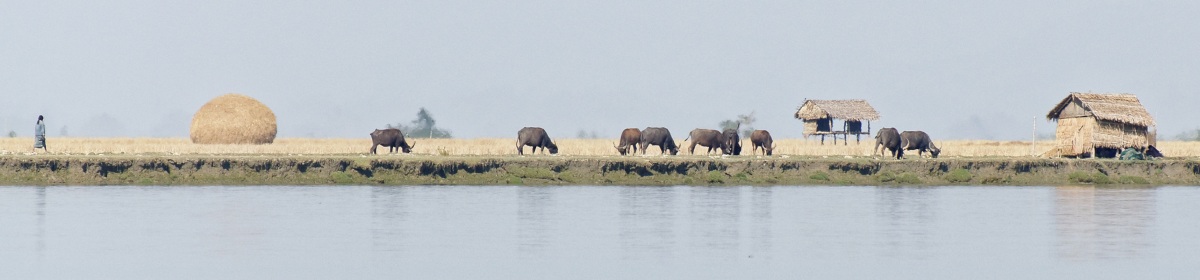
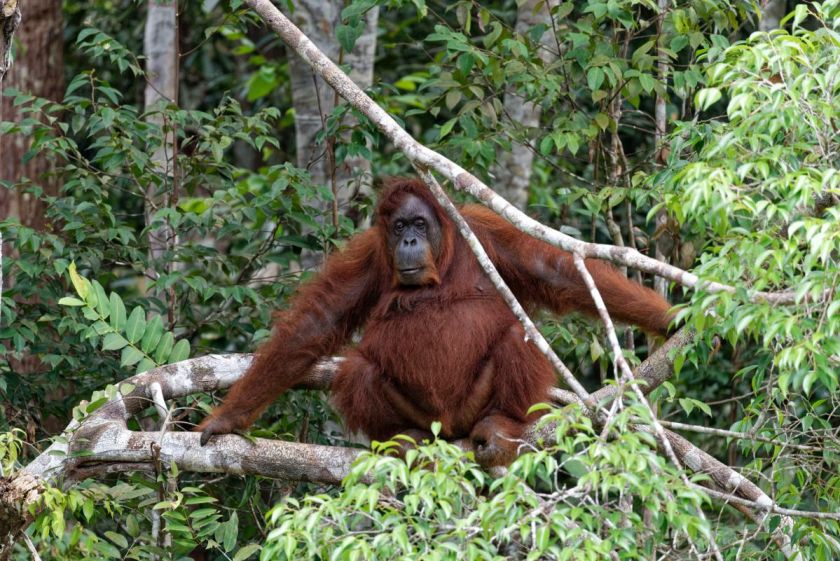
Laos. China is damming the Mekong River and neighbors to the south will be impacted (ie, all of them)Borneo. Indonesia has moved the capitol city Jakarta from Java to Borneo, reducing the orangutan’s habitat even furtherSittwe, Burma. The junta is crushing all resistance; Uwe and I won’t be allowed to visit this region if we go backnorthern Cambodia/Laos border. The rare Irrawaddy dolphin will go extinct if the water in the Mekong River is further reduced
But in southern Africa, in Botswana and Namibia, we were thrilled by the wildlife and the inhabitants. These countries spoke in growls and whistles and birdsong and hippo songs and human voices.
The Kavango-Zambezi Transfrontier Conservation Area (KAZA TFCA) is the largest transnational conservation area in the world at 444.000 km2. It is enormous, larger than Germany and Austria combined and nearly twice as large as the United Kingdom. The KAZA TFCA lies in the Kavango and Zambezi river basins where Angola, Botswana, Namibia, Zambia and Zimbabwe converge. [1]
There are issues to deal with – the loss of domestic animals to predators. The way elephants eat or trample crops. The complicated cross-country agreements. But, as their website states, “Local communities participate with enthusiasm in management of the TFCA through the Transboundary Natural Resources Managment Forum. The aim of this forum is to maximize skills and resources to promote sustainable land use, conservation of wildlife and landscapes, and rural development.”
I urge everyone to learn about this multinational effort to preserve the environment for the benefit of ALL inhabitants, whether winged, hooved, legged, or finned. FINALLY! A region of the world that’s getting it right!
My books are Broken In: A Novel in Stories, Tsunami Cowboys, Grounded and The Trail Back Out.
Tsunami Cowboys was longlisted for the 2019 ScreenCraft Cinematic Book Award. Broken In: A Novel in Stories was semifinalist for the international 2020 Hawk Mountain Short Story Collection Award from Hidden River Arts and Finalist for Greece’s 2021 Eyelands Book of the Year Award (Short Stories).
The Trail Back Out was the 2023 San Francisco Book Festival Winner for General Fiction, American Book Fest 2020 Best Book Award Finalist: Fiction Anthologies, Runner-Up for the 2021 Top Shelf Award, 2021 IAN Book of the Year Award Short Story Collection Finalist, and awarded a 2021 Wishing Shelf Red Ribbon. The title story The Trail Back Out was longlisted for the 2021 ScreenCraft Cinematic Short Story Award.
Click here for my author page to learn more about me and purchase my books.
This summer I took a train to Hamburg for the first time. Hamburg has more bridges than Venice, Amsterdam and London combined. The St. Pauli Reeperbahn is where the Beatles got their start playing in small clubs. (It’s pretty seedy in the daytime, but I did spot the life-sized silhouettes of the Fab Four.)
The one thing my friend Diana was insistent on seeing was the Miniatur Wunderland. This is the world’s largest model train museum.
Layout size: 1,490 square meters or 16,038 square feet.
It cost 45 Million Euros and (thus far) has taken 760,000 hours to build. The museum contains 42 planes in the air, 9,250 cars, and 1,040 trains. The sets include 1,380 signals, 385,000 LEDs on 15,4000 meters of tracks that light up 4,110 buildings, 260,000 figures, and 130,000 miniature trees.
The model of the Elbesimfonie building opens up to reveal the inside rooms
The rooms go dark for part of each hour and the exhibits light up!
All the vehicles are moving
Now take a look at the SCALE….
The people who built these models must have great senses of humor. You have to squint anyway to take in all the details (260,000 figures! 130,000 tiny trees!). But when you begin to look you see the funniest things.
Mama mia! Check out that giant pizza
I’ll end this with my personal favorite: A boat on Venice’s Gran Canale filled with wild animals.
My books are Broken In: A Novel in Stories, Tsunami Cowboys, Grounded and The Trail Back Out.
Tsunami Cowboys was longlisted for the 2019 ScreenCraft Cinematic Book Award. Broken In: A Novel in Stories was semifinalist for the international 2020 Hawk Mountain Short Story Collection Award from Hidden River Arts and Finalist for Greece’s 2021 Eyelands Book of the Year Award (Short Stories).
The Trail Back Out was the 2023 San Francisco Book Festival Winner for General Fiction, American Book Fest 2020 Best Book Award Finalist: Fiction Anthologies, Runner-Up for the 2021 Top Shelf Award, 2021 IAN Book of the Year Award Short Story Collection Finalist, and awarded a 2021 Wishing Shelf Red Ribbon. The title story The Trail Back Out was longlisted for the 2021 ScreenCraft Cinematic Short Story Award.
Click here for my author page to learn more about me and purchase my books.
Jorge Luis Borges was born on August 24, 1899 in Buenos Aires, Argentina. He was a colassal figure in Spanish language arts and letters. His work is classified as fantasy and philosophical literature; he was a poet and translator, too. My second book Tsunami Cowboys includes a quote of his.
Borges said, “Time is the substance I am made of. Time is a river which sweeps me along, but I am the river; it is a tiger which destroys me, but I am the tiger; it is a fire which consumes me, but I am the fire.” [1]
In his honor I am reprinting the post I wrote after visiting a tiger park in India. – Jadi
“A brave heart and a courteous tongue,” said he. “They shall carry thee far through the jungle, manling.” —The Jungle Book, Rudyard Kipling [2]
We’re in India for a few weeks and currently we’re riding in the back of an open jeep. We spent the better part of five hours each day on really bad roads to get here.
Now we’re layered in the few long-sleeved clothes we brought along. How cold can it be if you’re not way up north trekking in the Himalyas?
How cold? Man, it’s effing freezing.
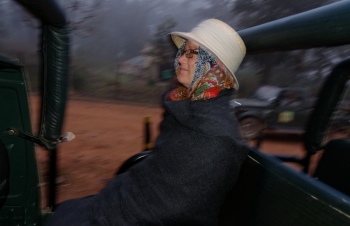
It’s shortly after 6 a.m. in the Bandhavgarh Tiger Reserve and we’ve been up since 5:00. “Remind me,” I beg. “What are we doing here?” I wrap the blanket the tiger lodge lent us tighter around my body. (What I really want is a sub zero temperatures sleeping bag.) “Remind me,” I ask again. “Why are we doing this?”
“You wanted to come back to India,” Uwe prompts.
“Oh, yeah. Now I remember.” And it’s true: I was really excited to return. I fell in love with the subcontinent when we visited a decade ago. In Goa we walked miles of pristine beaches. In Karnataka we attended an astonishing Nandi Purnima, the full moon festival, and Hampi was a bare landscape filled with gigantic boulders and ancient temples.
In a country this exotic and large, surely we’d experience something new when we came back. What I did not expect was that I’d be freezing my ass off.
***
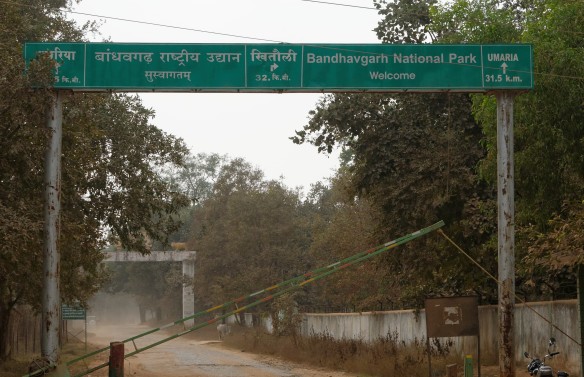
Entrance to Bandhavgahr National Park
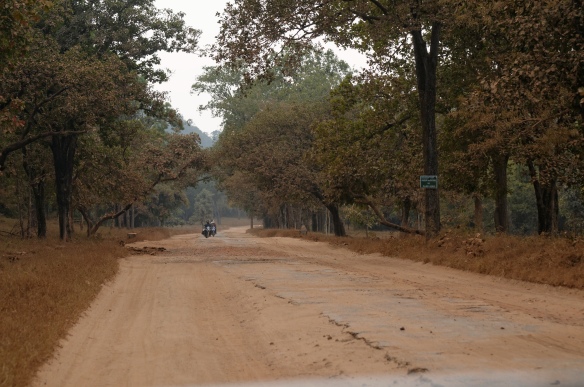
We’re doing a mix of culture and nature. India is one of the two most populated countries on the planet, and we thought it would be smart to schedule some time in quieter areas too. I’m glad we did. The north central region of Madya Pradesh is green and varied and home to some of the few remaining wild Bengal tiger populations.
So for two days at Bandhavgarh and a day at Kanha National Park*, we haul our sorry butts out of bed at the crack of dawn, pull on all our clothes and drape ourselves in borrowed blankets. 6 a.m.-1 p.m. for the early safari; 3-6 p.m. for the afternoon attempt. If we’re lucky, we’ll spot a big cat.
We’re not lucky. We’re cold.
***
Later we shed layers as the day warms up. The parks contain barking and spotted deer,
gaurs, nilgai,
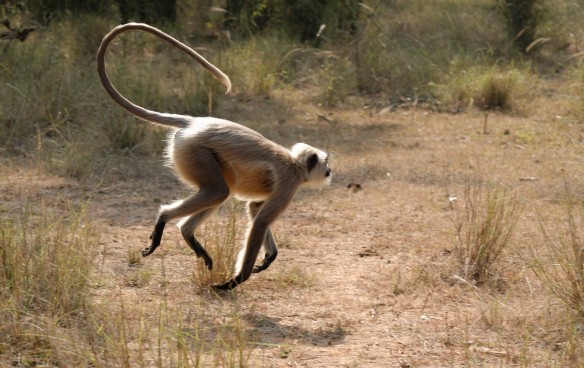
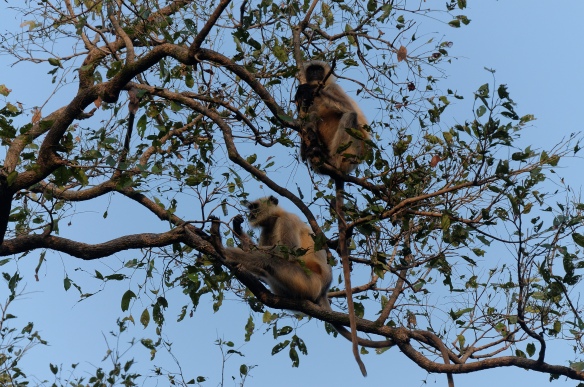
lemurs and langurs,
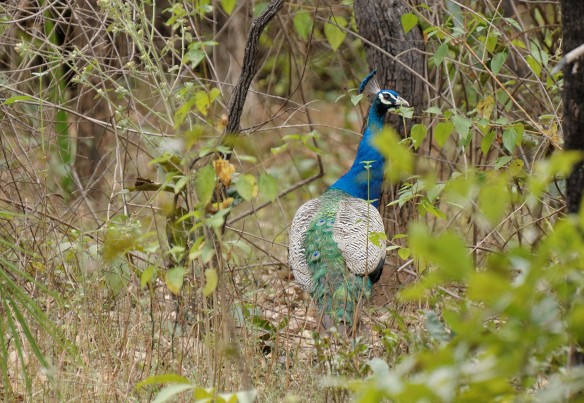
wild peacocks and other birdlife,
Green bee-eater
Crested hawk-eagle
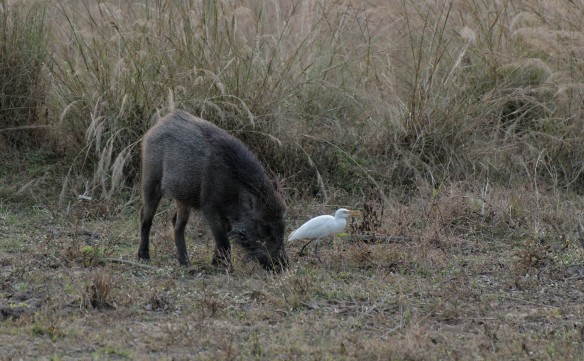
wild boar,
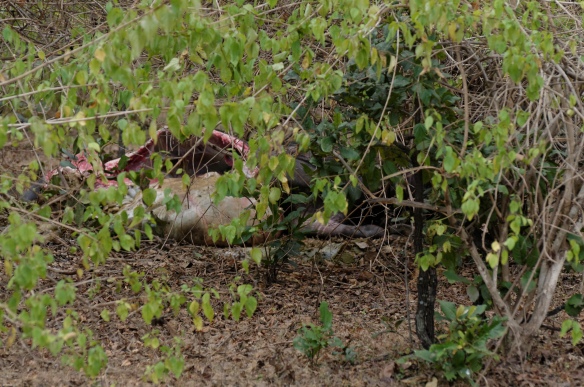
and a landscape filled with watering holes and high grasses, forest and farmers’ villages. On the second day at Bandhavgarh our jeep carries a park ranger to inspect a water buffalo kill from the night before. It occurred just outside the official boundary of the preserve and the farmer will be reimbursed for the animal the tiger took down.
One dead water buffalo
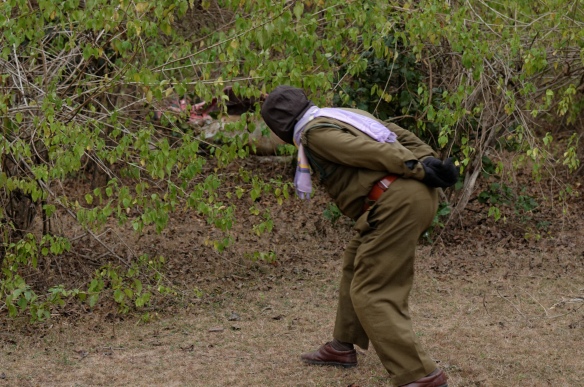
We aren’t allowed to leave the jeep – ever – and the ranger approaches the carcass very slowly.
Be sure you notice that the ranger’s got on lots of clothes too.
Where there’s a fresh kill, the big cat can’t be far.
I mean it: it’s really cold out.
By the third day I’ve perfected what I name the mummy wrap. I have myself wrapped so tight that I literally can’t move, but this way the blanket doesn’t unwind in the cold wind.
Brr.
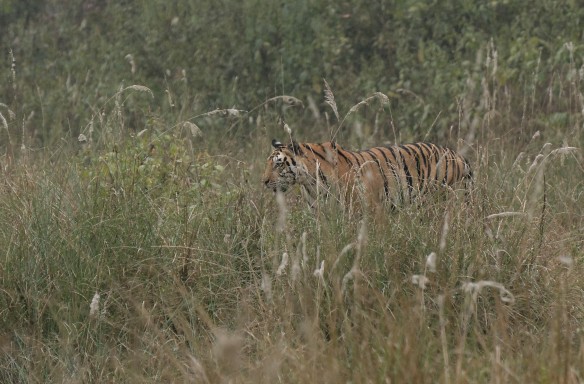
And, suddenly, a tiger leaps from the forest, followed by his mate. He moves into the reeds and returns dragging a dead spotted deer by the neck.
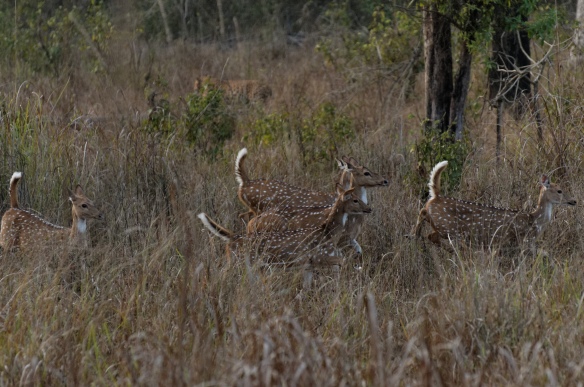
We see them for less than a minute and those seconds are absolutely worth the days of waiting. My God, they’re magnificent! During the afternoon safari we get lucky again: 10 seconds of spotting a shyer, rarer leopard.
The leopard moved unconcerned in the back through the high grass
Uwe captures the group of spotted deer nervously fleeing the leopard. He’s in Photographer Heaven.
Naturally we’re already dreaming – about an African safari.
In memory of Jorge Luis Borges, 24 August 1899 – 14 June 1986
My books are Broken In: A Novel in Stories, Tsunami Cowboys, Grounded, and The Trail Back Out.
Tsunami Cowboys was longlisted for the 2019 ScreenCraft Cinematic Book Award. Broken In: A Novel in Stories was semifinalist for the international 2020 Hawk Mountain Short Story Collection Award from Hidden River Arts and Finalist for Greece’s 2021 Eyelands Book of the Year Award (Short Stories). The Trail Back Out was the 2023 San Francisco Book Festival Winner for General Fiction, American Book Fest 2020 Best Book Award Finalist: Fiction Anthologies, Runner-Up for the 2021 Top Shelf Award, 2021 IAN Book of the Year Award Short Story Collection Finalist, and awarded a 2021 Wishing Shelf Red Ribbon. The title story The Trail Back Out was longlisted for the 2021 ScreenCraft Cinematic Short Story Award.
Click here for my author page to learn more about me and purchase my books.
“Wherever there are birds, there is hope.” ― Mehmet Murat Ildan
There is something incredibly surreal — and very, very funny — to be out in a jeep in the sand dunes on the Namibian coast and see the world’s largest bird stroll by.
Ostrich, Sandwich Harbor
Uwe posted photos from our recent trip to southern Africa on his photography website. He now has an entire section dedicated just to birds of Namibia. http://viewpics.de/pics/Namibia/Birds Here are some of his birds and their stories.
The ostriches were seemingly everywhere. They walk around in the Namib, the world’s oldest desert and one of the driest places on the planet. They hang out in flocks in Etosha National Park.
They hang out with other species, too. It’s safety in numbers, as well as combining forces against predators. The elephants provide their bulk and the impalas have keen hearing and sight.
someone’s got to keep an eye out for the lions
We saw hundreds of flamingos on the coast.
Flamingos, Walvis Bay, Namibia
When the rainy season arrives, the flamingos send birds north to see if the saltpan in Etosha Park has flooded yet. If the scouts don’t return, the rest of the flocks head north as well. Ann and Mike Scott in NamPower/Namibia Nature Foundation Strategic Partnership Newsletter No. 5: September 2010 had this to say: “Greater Flamingos are widely distributed in southern Africa with concentrations at flooded salt pans (during breeding) and coastal bays (during non-breeding). …at the central coast, they are concentrated at Walvis Bay and Sandwich Harbour. … Breeding occurs in large, typically mixed colonies on raised islands on flooded salt pan at Etosha …. Laying induced by extensive flooding and continued high levels increases chances of success.”
The birds migrate to this giant saltpan in Etosha once it floods. 1,100,000 flamingos were recorded in an especially rainy year!
Etosha Saltpan, seen in November 2023 before the rains. It is 4,760 km² in size, up to 129 km long and 72 km wide, and covers almost 25% of Etosha National Park
Uwe photographed this juvenile African openbill stork in Etosha.
I’ve saved my favorite photo he took of the Southern carmine bee-eaters for this post:
Almost everyone caught an insect
Here’s another bee-eater, this one in olive.
olive bee-eater
For the final image, I leave you with a species that birders and guides all get excited about: the lilac-breasted roller. Our guide was really pleased with himself that he got us close enough to this elusive bird for a photo.
the lilac-breasted roller IS stunning, isn’t it?
Much as I’d love to take credit for this post, it owes everything to my husband’s great eye and good camera equipment.
My books are Broken In: A Novel in Stories, Tsunami Cowboys, Grounded and The Trail Back Out.
Tsunami Cowboys was longlisted for the 2019 ScreenCraft Cinematic Book Award. Broken In: A Novel in Stories was semifinalist for the international 2020 Hawk Mountain Short Story Collection Award from Hidden River Arts and Finalist for Greece’s 2021 Eyelands Book of the Year Award (Short Stories).
The Trail Back Out was the 2023 San Francisco Book Festival Winner for General Fiction, American Book Fest 2020 Best Book Award Finalist: Fiction Anthologies, Runner-Up for the 2021 Top Shelf Award, 2021 IAN Book of the Year Award Short Story Collection Finalist, and awarded a 2021 Wishing Shelf Red Ribbon. The title story The Trail Back Out was longlisted for the 2021 ScreenCraft Cinematic Short Story Award.
Click here for my author page to learn more about me and purchase my books.
Yes, another post about the wildlife of southern Africa. I’ve written about lions and giraffes and ostriches and marabou storks and hippos. No lengthy explanations this time. Instead, here are Uwe’s photographs of some other animals we saw. Every day brought new creatures into our consciousnesses. They’ve taken up residence there….
We saw all these wild animals during the four days we spent exploring Etosha National Park in Namibia. Seeing them in their natural habitat is powerful magic.
My books are Broken In: A Novel in Stories, Tsunami Cowboys, Grounded and The Trail Back Out.
Tsunami Cowboys was longlisted for the 2019 ScreenCraft Cinematic Book Award. Broken In: A Novel in Stories was semifinalist for the international 2020 Hawk Mountain Short Story Collection Award from Hidden River Arts and Finalist for Greece’s 2021 Eyelands Book of the Year Award (Short Stories).
The Trail Back Out was the 2023 San Francisco Book Festival Winner for General Fiction, American Book Fest 2020 Best Book Award Finalist: Fiction Anthologies, Runner-Up for the 2021 Top Shelf Award, 2021 IAN Book of the Year Award Short Story Collection Finalist, and awarded a 2021 Wishing Shelf Red Ribbon. The title story The Trail Back Out was longlisted for the 2021 ScreenCraft Cinematic Short Story Award.
Click here for my author page to learn more about me and purchase my books.
We took the trip of a lifetime last year in Namibia and Botswana.
Once you are away from the few cities, the choices for overnight lodging become scarce. We picked lodges on rivers or watering holes. Each meal brought something new to identify and photograph and add to our growing list of fellow creatures.
I’ve already mentioned the giraffes that came to drink on precarious legs.
Here are some photos of the other visitors to the watering hole. I’ve just given names and photos. Their presence speaks for them without needing any more words from me.
Hungry warthogthe African skies!I was such a happy camperBlackbacked Jackal
My books are Broken In: A Novel in Stories, Tsunami Cowboys, Grounded and The Trail Back Out.
Tsunami Cowboys was longlisted for the 2019 ScreenCraft Cinematic Book Award. Broken In: A Novel in Stories was semifinalist for the international 2020 Hawk Mountain Short Story Collection Award from Hidden River Arts and Finalist for Greece’s 2021 Eyelands Book of the Year Award (Short Stories).
The Trail Back Out was the 2023 San Francisco Book Festival Winner for General Fiction, American Book Fest 2020 Best Book Award Finalist: Fiction Anthologies, Runner-Up for the 2021 Top Shelf Award, 2021 IAN Book of the Year Award Short Story Collection Finalist, and awarded a 2021 Wishing Shelf Red Ribbon. The title story The Trail Back Out was longlisted for the 2021 ScreenCraft Cinematic Short Story Award.
Click here for my author page to learn more about me and purchase my books.
Johnny Hartman was born July 3, 1923 in Houma, Louisiana. As a jazz singer Johnny Hartman is most famous for his 1963 collaboration with saxophonist John Coltrane on the sublime album John Coltrane and Johnny Hartman. Also playing on the album are McCoy Tyner, Jimmy Garrison, and Elvin Jones. (This was John Coltranes’s only album with a singer!)
Hartman was a crooner par excellence. Frank Sinatra’s name might be more famous, but from the first time I heard Hartman singing a song I knew who I’ll forever prefer. I discovered him late in life, the soundtrack to a film perhaps, or playing on a jazz radio station. In any case, I promptly bought three of his CDs. When I’m in a mood for love or my spirit needs soothing, I listen to his voice. In his honor here is a post I wrote about romance. How can I not honor him? Hartman’s kind of music will never go stale. – Jadi
For twenty-five years (minus a day) I had a memory of rose-colored glass. Uwe and I got married over a quarter of a century ago. Aside from thinking Yikes, how did that happen?!, I have sighed Awwww. Not many things last this long, especially when we’re talking about human beans….
You know how some couples seem to glide through life without ever having a disagreement?
We aren’t that couple.
walking around a town with even more history than we have
But I distinctly recall that the hotel room where we spent our first night as husband and wife had old-fashioned windows with glass panels in various colors. I can remember looking at those little panes and thinking, How wonderful to begin married life looking at the world through rose-colored glasses. That first image has comforted me countless times. It’s provided me with endless inspiration, and I love telling friends the story of those old windows that shimmered and glowed like gemstones.
We wanted to return to the little town in Alsace where it all began. We booked the same hotel and both of us think we may even have been given the same room. We drove over a day before our anniversary and checked in as it began to rain. The sight of the rain on the windows was get outta here romantic.
I took some pictures. But later, checking to make sure my photos turned out, I was puzzled. The views of the village outside the windows had stayed pretty. But, wait a second: where were the colored panes of glass both of us are sure we remember?
Had my mind and emotions played tricks all these years, keeping me roped in with a faulty metaphor? Or is my eye sight seriously that bad?
The mystery was solved by a friend who reminded me that hotels – especially old ones – spend money on renovations. So, along with the elevator that was not there when we checked in 25 years ago, the windows were probably recent too. The glass in the windows is now textured, maybe ‘pebbled’ is the word I want. The view is still ever so slightly wavy and distorted…
We had three gorgeous days in one of our favorite regions in Europe. Yes, it remained romantic. As you can see from the photos, with rain or without, the views from the windows are lovely.
And, in the right light, my world as a married woman still looks rose-colored.
no my vision wasn’t impaired by the wine we bought at this winery, founded in 1728…
In memory of Johnny Hartman, 3 July, 1923 – 15 September, 1983
My books are Broken In: A Novel in Stories, Tsunami Cowboys, Grounded, and The Trail Back Out.
Tsunami Cowboys was longlisted for the 2019 ScreenCraft Cinematic Book Award. Broken In: A Novel in Stories was semifinalist for the international 2020 Hawk Mountain Short Story Collection Award from Hidden River Arts and Finalist for Greece’s 2021 Eyelands Book of the Year Award (Short Stories). The Trail Back Out was the 2023 San Francisco Book Festival Winner for General Fiction, American Book Fest 2020 Best Book Award Finalist: Fiction Anthologies, Runner-Up for the 2021 Top Shelf Award, 2021 IAN Book of the Year Award Short Story Collection Finalist, and awarded a 2021 Wishing Shelf Red Ribbon. The title story The Trail Back Out was longlisted for the 2021 ScreenCraft Cinematic Short Story Award.
Click here for my author page to learn more about me and purchase my books.
I keep posting about the trip to southern Africa that Uwe and I made in November 2023. I’m doing it to share Uwe’s breathtaking photographs, and to share with you what we experienced.
The act of blogging reinforces my memories. Writing these posts helps me recall where we went and what we did.
But there’s something else going on here. In the months since we returned home I’ve created post after post after post after post after post, as if nothing can shut me up….
They aren’t just for the followers who stay with me as I tell tales. I write to keep reminding myself of how great I felt about the world during that entire trip.
The feeling came to me as a revelation. When I climbed shakily out of what I considered a toy tin helicopter after our ride over the Okavango Delta, I was startled to realize I was feeling something unfamiliar:
Optimistic.
I don’t know about you or everyone else, but it looks to me like ongoing world events are grim. Wars, climate change, mass extinctions, corrupt and greedy politicians destroying democratic governments to hang onto power…. It’s a long, depressing list. So to feel unequivocally GREAT about a spot was wonderful.
Thanks to all of you for reading, liking, and commenting on my endless flow of stories about southern Africa. I want to spread my sense of optimism. Let’s share some hope for a change!
My books are Broken In: A Novel in Stories, Tsunami Cowboys, Grounded and The Trail Back Out.
Tsunami Cowboys was longlisted for the 2019 ScreenCraft Cinematic Book Award. Broken In: A Novel in Stories was semifinalist for the international 2020 Hawk Mountain Short Story Collection Award from Hidden River Arts and Finalist for Greece’s 2021 Eyelands Book of the Year Award (Short Stories).
The Trail Back Out was the 2023 San Francisco Book Festival Winner for General Fiction, American Book Fest 2020 Best Book Award Finalist: Fiction Anthologies, Runner-Up for the 2021 Top Shelf Award, 2021 IAN Book of the Year Award Short Story Collection Finalist, and awarded a 2021 Wishing Shelf Red Ribbon. The title story The Trail Back Out was longlisted for the 2021 ScreenCraft Cinematic Short Story Award.
Click here for my author page to learn more about me and purchase my books.
Old Sturbridge Village opened to the public for the first time on June 8, 1946. The site was born from the collective collecting vision of one family. The three Wells brothers of the American Optical Company founded the massive collection that makes up Old Sturbridge. It is the world’s finest collection of rural New England artifacts.
Old Sturbridge Village began with a 1926 golf date cancelled due to Vermont rain. A.B. Wells went on an antiquing quest instead, and became obsessed with collecting New England antiques and artifacts. Click here for more on the history of Old Sturbridge Village and their website: www.osv.org/visit.
In honor of the Wells and their visionary collection I am reprinting Part One to my post describing our visit to Old Sturbridge. – Jadi
***
I love open air museums. Reading about history is nice, but when it’s three dimensional it comes to life for me. As a child, one of my family’s favorite destinations was Old Sturbridge Village in Massachusetts. The village depicts life in historic New England from 1790-1840. Visitors stroll across 200 acres that contain 40 mostly original buildings and over 50,000 artifacts. It’s the northeast’s largest open air museum.
One year Uwe and I went to New England. I insisted that our trip include a visit to Old Sturbridge Village. In retrospect, it wasn’t just because the spot is so much fun, and it would be interesting (I hoped) for my European husband to learn about early New England history. A big part of the draw was my desire to revisit a favorite piece of my own childhood.
Revisiting places can be a letdown, but the autumn weather couldn’t have been more beautiful. The seasons were about to change and the leaves were coming into their glory. It was perfect.
Old Sturbridge Village autumn
The entry price is steep, now $28 a person. But parking is free, and a second day’s visit is included. I was delighted that Uwe was willing to return the next day! [1]
Old Sturbridge has a large staff and lots of volunteer docents, folks who dress up in period costumes and chat with visitors. These volunteers go through a training period first and either demonstrate crafts (the blacksmith) or share knowledge (the bank clerk). All of them are enthusiastic and fun to talk with.
Asa Knight Store
Originally from Dummerston, Vermont, c. 1826 and 1838-39
Only 25% of those first store patrons could afford to pay cash. Most customers bartered for store goods. The store owner kept a careful ledger of customers’ names, purchases, and what they owed. The young woman behind the counter explained that while ‘her’ father would have run the store, it was likely that a daughter would drop her other duties to help out if she was needed.
Goods from around the world as well as local products were for sale even two hundred years ago.
Tin Shop Reconstruction
Originally from Sturbridge, Massachusetts, c. 1800-1850
Tinplated sheet iron was imported from Great Britain and formed in New England tin shops.The Old Sturbridge Village gift store has handmade items such as dippers, lanterns, etc. for sale.
Thompson Bank
Originally from Thompson, Connecticut, c. 1835
The bank’s single employee was the cashier, open for business in the morning. Afternoons were spent doing paperwork and bookkeeping. This terrific volunteer regaled us with his knowledge and said that yes indeed, the bank clerk would have sat at the window waiting for business and chatting with people passing by…
Cider Mill
Originally from Brookfield, New Hampshire, c. 1840
A farm family drank about 300 gallons of hard cider each year. Hic!
Carding Mill
Originally from South Waterford, Maine c. 1840
This is the only New England water-powered carding mill still in existence. It did a day’s work of hand-carding wool in a mere 20 minutes.
My books are Broken In: A Novel in Stories, Tsunami Cowboys, Grounded and The Trail Back Out.
Tsunami Cowboys was longlisted for the 2019 ScreenCraft Cinematic Book Award. Broken In: A Novel in Stories was semifinalist for the international 2020 Hawk Mountain Short Story Collection Award from Hidden River Arts and Finalist for Greece’s 2021 Eyelands Book of the Year Award (Short Stories). The Trail Back Out was the 2023 San Francisco Book Festival Winner for General Fiction, American Book Fest 2020 Best Book Award Finalist: Fiction Anthologies, Runner-Up for the 2021 Top Shelf Award, 2021 IAN Book of the Year Award Short Story Collection Finalist, and awarded a 2021 Wishing Shelf Red Ribbon. The title story The Trail Back Out was longlisted for the 2021 ScreenCraft Cinematic Short Story Award.
Click here for my author page to learn more about me and purchase my books.
Rachel Louise Carson was born on May 27, 1907 in Springdale, Pennsylvania. She was a nature writer, marine biologist, conservationist, and scientist whose 1962 book Silent Spring helped spark the international environmental movement. Silent Spring first brought the world’s attention on the devastation done by synthetic pesticides. The New Yorker and Audubon serialized the book. The big chemical corporations fought her book (of course), including DuPont, Velsicol Chemical Corporation, and American Cyanamid. They claimed she was a fanatic, a Communist (?? because only Communists care about the environment ??), and impugned and called into question her credentials as a scientist. Nonetheless, Carson’s work eventually spurred lawmakers to ban DDT and similar pesticides!
Rachel Carson is one of the scientists whose work led to the creation of the Environmental Protection Agency. [1, 2] Her book plays a big role in the phenomenally successful science fiction trilogy The Three-Body Problem by China’s author Liu Cixin. It’s been a best-selling book in translation and was made into a series both in China and on Netflex. [3]
In acknowledgment of her work I am honored to reprint part of the post I wrote after visiting the intact world of Borneo’s protected frog populations. – Jadi
Ah, Kubah National Park on Borneo…. froggie paradise. The park is also home to other species. We met these guys.
And these. They were the size of my out-stretched hand!
When we planned what to do and see on Borneo, I made only one request. Okay, I admit: it was a demand. I wanted, no, I needed to go on the night tour to see endemic frogs.
Our tour guide picked us up in front of the hotel and drove us out to Kubah National Park, where the park ranger met us. The four of us headed up into the park in the deepening darkness. And I do mean up: we climbed to 1,ooo feet to reach the part of the park where the most frogs hang out. The road was lit only by the beams of our torches and the flashes of fire flies.
Fire flies! I haven’t seen them since my childhood in New England, back when their on-and-off glow was an atmospheric element of every summer evening….
It was glorious.
You hear the one about the cinnamon frog and the fly?
It was also very, very funny, at times like being in a Monty Python sketch. Overcast, humid as hell and still hot as hell, even in the middle of the night. I dripped sweat and my glasses kept fogging up. Pitch black darkness, except for our flashlights…. which the two guides and I were shining on the frogs so that Uwe could capture them in photos. He didn’t want to use the camera flash, not wanting to startle the wild life and because light from a camera flash is too artificial. So I took his flashlight and held a torch in each hand, aiming them as directed. It was as though he were a mad director with a camera crew. It didn’t bother the critters one bit – they went on singing, and croaking, and hanging out on bole branch and vine…
Pitcher plant colony. Home of the narrow-mouth frog, first described in 2010. Microhyla borneensis was once the smallest known frog from the Old World (the current record holder is Paedophryne amauensis from New Guinea). The narrow-mouth frog is the size of your pinkie’s finger nail
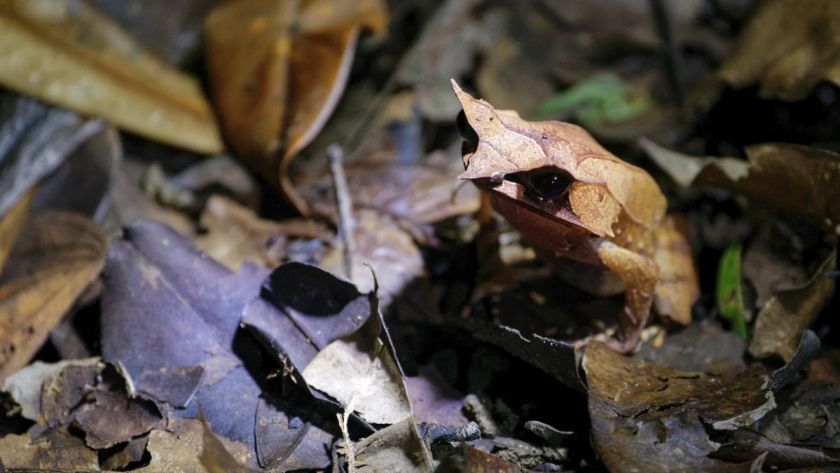
A highlight in a night of a parade of wonders was the long-nosed horned frog. O.M.G. If folks on safari speak of the ‘Big Five’, froggers go into raptures about this guy:
Bornean horned frog! (Megophrys nasuta)
He lives in the leaf litter on the jungle floor, and remained motionless even as the park ranger cleared away the leaf detritus around him so that we could see him better. The horned frog, mahogany frog, and narrow-mouthed frog found in the pitcher plant are the rarest of the rare, the ‘Big Three’ of Kubah Park’s frog world. I clearly saw the first two, and saw the third jump from a distance.
Natural world geek heaven.
In memory of Rachel Carson, 27 May 1907 – 14 April 1964
NOTES: [1, 2] President Jimmy Carter awarded Rachel Carson the Presidential Medal of Freedom after her death. Go to my post Today’s Birthday: The Enivornmental Protection Act to learn more about the importance of this legislation. Go to my post Jean-Jacques Rabin + The Trogonfor more about The Audubon Society. [3] I’ve read one of the books. Dense and absorbing. The Netflix series is superb!
My books are Broken In: A Novel in Stories, Tsunami Cowboys, Grounded, and The Trail Back Out.
Tsunami Cowboys was longlisted for the 2019 ScreenCraft Cinematic Book Award. Broken In: A Novel in Stories was semifinalist for the international 2020 Hawk Mountain Short Story Collection Award from Hidden River Arts and Finalist for Greece’s 2021 Eyelands Book of the Year Award (Short Stories). The Trail Back Out was the 2023 San Francisco Book Festival Winner for General Fiction, American Book Fest 2020 Best Book Award Finalist: Fiction Anthologies, Runner-Up for the 2021 Top Shelf Award, 2021 IAN Book of the Year Award Short Story Collection Finalist, and awarded a 2021 Wishing Shelf Red Ribbon. The title story The Trail Back Out was longlisted for the 2021 ScreenCraft Cinematic Short Story Award.
Click here for my author page to learn more about me and purchase my books.



 There are issues to deal with – the loss of domestic animals to predators. The way elephants eat or trample crops. The complicated cross-country agreements. But, as their website states, “Local communities participate with enthusiasm in management of the TFCA through the Transboundary Natural Resources Managment Forum. The aim of this forum is to maximize skills and resources to promote sustainable land use, conservation of wildlife and landscapes, and rural development.”











 I’ve saved my favorite photo he took of the Southern carmine bee-eaters for this post:


 Here are some photos of the other visitors to the watering hole. I’ve just given names and photos. Their presence speaks for them without needing any more words from me.


 Johnny Hartman was born July 3, 1923 in Houma, Louisiana. As a jazz singer Johnny Hartman is most famous for his 1963 collaboration with saxophonist John Coltrane on the sublime album
  For twenty-five years (minus a day) I had a memory of rose-colored glass. Uwe and I got married over a quarter of a century ago. Aside from thinking Yikes, how did that happen?!, I have sighed Awwww. Not many things last this long, especially when we’re talking about human beans….
 We wanted to return to the little town in Alsace where it all began. We booked the same hotel and both of us think we may even have been given the same room. We drove over a day before our anniversary and checked in as it began to rain. The sight of the rain on the windows was get outta here romantic.
 I took some pictures. But later, checking to make sure my photos turned out, I was puzzled. The views of the village outside the windows had stayed pretty. But, wait a second: where were the colored panes of glass both of us are sure we remember?
 The mystery was solved by a friend who reminded me that hotels – especially old ones – spend money on renovations. So, along with the elevator that was not there when we checked in 25 years ago, the windows were probably recent too. The glass in the windows is now textured, maybe ‘pebbled’ is the word I want. The view is still ever so slightly wavy and distorted…
 The feeling came to me as a revelation. When I climbed shakily out of what I considered a toy tin helicopter after our ride over the Okavango Delta, I was startled to realize I was feeling something unfamiliar:


 It was also very, very funny, at times like being in a Monty Python sketch. Overcast, humid as hell and still hot as hell, even in the middle of the night. I dripped sweat and my glasses kept fogging up. Pitch black darkness, except for our flashlights…. which the two guides and I were shining on the frogs so that Uwe could capture them in photos. He didn’t want to use the camera flash, not wanting to startle the wild life and because light from a camera flash is too artificial. So I took his flashlight and held a torch in each hand, aiming them as directed. It was as though he were a mad director with a camera crew. It didn’t bother the critters one bit – they went on singing, and croaking, and hanging out on bole branch and vine…