This the last in my series on southern Africa’s traditional baskets. This lidded basket is from KwaZulu-Natal in South Africa. I had done some reading, and wanted a ‘women’s’ basket.
The shape indicates an ukhamba basket and usually holds home-brewed sorghum beer. Its coil-weave is watertight. When the basket is filled, the ilala palm fibers swell and the outer surface of the basket sweats. These baskets are used for special ceremonies (like weddings).
The double diamond pattern signifies a married woman.
The colors start with the ilala palm (Hyphaene Coriacea), harvested from the North-Eastern Coast of KwaZulu-Natal. Its natural color is cream. Every other color is naturally obtained from roots, berries, bark and leaves. Black and brown are provided by the roots of the isizimane tree, which are crushed and boiled for many days. The orange comes from the roots of the xomisane plant. The ijuba plant is soaked in black mud for up to 1 week to produce the grey color.
Basket-making used to be exclusively a male occupation, but now the Zulu women create them. Today’s baskets can be used to store food or liquids, and master weavers make beautiful items of contemporary (and classic!) art.
The basket I purchased was woven by artist Zamama Khumahi.
I am a Best American Essays-nominated writer. My books are Broken In: A Novel in Stories, Tsunami Cowboys, Grounded, The Trail Back Out, and The Taste of Your Name. Recent awards include Finalist for the 2025 Compass Press Book Award for The Taste of Your Name and Finalist for Greece’s Eyelands 11th International Short Story Contest.
Margaret Mead was born on December 16, 1901 in Philadelphia, Pennsylvania. Mead was a cultural anthropologist and one of my secret heroes when I was a little girl. The idea of an adult woman who traveled the world to meet people from other cultures probably influenced me more than I realize. In her honor I am reprinting one of the posts I wrote after Uwe and I trekked to meet the Chin women in NW Burma. This area is closed off to the outside world now. – Jadi
***
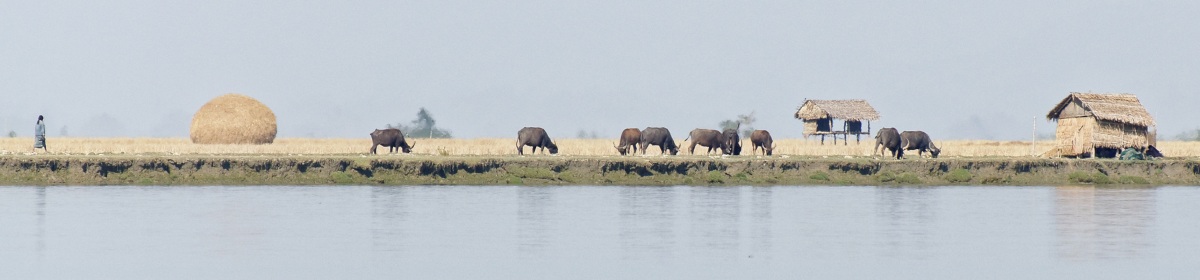
We made a long trek to reach the Chin State. We had a day pass (tourists are not allowed to remain overnight in the Chin territory) and a guide to translate for us. Our hope was to reach the villages where the local tribes still have elders with tattoos, by tradition only the women. The government represses the tradition, and it was feared that it had died out.
We had no guarantees that the women would come out to meet us once we reached the villages. At some point in the journey I stopped caring, because every minute in Burma was filled with wonders. The long slow passage upriver had become a journey to a some where, a some thing else. We chugged slowly upriver in NW Burma on the Lemro, from the Rakhine to the Chin state.
Arriving
After walking around for some time in the first village, the elders stood before us! It was literally as if we looked up, and there they suddenly were.
We asked through our guide if Uwe might take photos. The elder women calmly answered in the affirmative. They were, after all, the reason we’d come so far to visit. The tribes are self-sufficient and produce nothing for the tourist market. To meet the female elders is the reason why foreigners come to the villages.
We were meeting Laytu Chin women (also called Lemro or Laito). The Chin are of Tibetan-Burman ethnicity, and tattooing is practiced only among the southern Chin.
To a woman they were calm, poised, and radiated confidence. When did the Chin begin tattooing? One claim is that the tattooing was done to make the women ugly so the Burmese kings would stop stealing them to use as slaves, but this claim has been discounted as myth. It’s our modern world that sees tattooing as unattractive and labels it ‘ugly’. It’s far more likely that the Chin women were tattooed in a rite of passage, and that the facial tattoos are a mark of social status and coming of age. The tattoos make the women beautiful.
No one in the outside world knows just what these patterns signify. The tattoos may be stippling, dots, circles. The Laytu women we met have the most elaborate Chin tattoo, a spider web or rising sun pattern. Our guide told us the men had gathered the materials used in the tattooing process. Jens Uwe Parkitny reports being told that the actual tatooing is done by female tatoo artists.
The women walked us through the village, up to the school. It was originally funded by a foreigner and we were invited to make a donation. It was all very formal: the guide wrote out a receipt along with the amount, our names, and our nationalities.
One of the women was in charge of taking the money and handling the donation, but the task is rotated. He translated our questions, explaining that on each day a different woman takes on this task. The responsibility of supporting the village is shared communally.
On that day we were invited up into a home on stilts. In another Chin village we watched one of the old women work at a handloom. We visited a burial ground on the river banks, where the dead are cremated and offerings are set out for the deceased. When we finally set back down the Lemro River on that December 31st, the last day of the year 2009, Uwe and I knew we had journeyed a very far way indeed.
In memory of Margaret Mead, December 16, 1901 – November 15, 1978
I am a Best American Essays-nominated writer. My books are Broken In: A Novel in Stories, Tsunami Cowboys, Grounded, The Trail Back Out, and The Taste of Your Name. Recent awards include Finalist for the 2025 Compass Press Book Award for The Taste of Your Name and Finalist for Greece’s Eyelands 11th International Short Story Contest.
Margaret Hamilton was born on December 9, 1902 in Cleveland, Ohio. She appeared on-screen with W.C. Fields, Abbott and Costello, and Buster Keaton. She’s gone down in film history for her distinct voice and terrifying depiction of the Wicked Witch of the West/Almira Gulch in film The Wizard of Oz. The book The Wonderful Wizard of Oz first appeared in print on May 17, 1900; the film premiered on August 12, 1939.
Ms. Hamilton was devoted to public education (she was a former schoolteacher) and to the welfare of children and animals. In her honor I am reprinting one of my very first posts, about L. Frank Baum, bats, and monkeys. — Jadi
Both sides of my family hail from the Northeast. We lived for a while in Cazenovia, one of the most beautiful small towns in upstate NY. Caz is just a few miles from Chittenango Falls, and that town was the birthplace of L. Frank Baum, author of The Wizard of Oz.
My sisters and I first saw The Wizard of Oz film on an old black and white television set we called Lucille. Lucille was temperamental (“Dad! Lucille’s on the fritz again!”), but her screen was big.
It was years before I finally saw The Wizard of Oz on a color television. How I gasped when Dorothy opened that door and stepped out into Munchkin Land! But in color or black and white, to this day I don’t much like monkeys.
Balinese Barong
Some years ago my husband and I traveled to Bali. The Balinese fill their temples with statues of the strange half-bird, half-god creature known as Garuda, a lion-like Barong, lots of sinuous snakes, and Hanuman the monkey god. The cultural heart of Bali is Ubud, home to the Monkey Forest which contains the Monkey Temple. I wrapped a sarong around my waist before we entered to show respect, and I know I was curious as to what we’d find.
The temple grounds were filled – no, overrun – with crab-eating macaque (Macaca fascicularis) monkeys. Dozens of them rested on the platforms to the Pura Dalem Agung Padangtegal temple. Many more watched us from up in the canopy of thick jungle trees and vines. Worst of all, a horde of monkeys scampered our way as we drew near. They were used to people and accustomed to visitors who bring them food. We walked slowly, not making any sudden movements, keeping our arms stretched out with our hands opened. I hoped my empty palms signaled: no food here!
Monkey Temple Gang
I breathed a huge sigh of relief when we left the grounds. But I wonder about the sanity (to say nothing of the later health) of tourists who bring bananas and fruit to hand to the macaques. Those critters are feral!
Bali has another indigenous species: bats.
Bali bats from hell
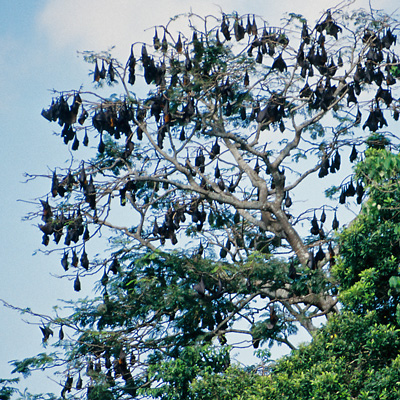
A huge colony of the largest fruit eating bats I have ever seen, all with wingspans of an easy three feet, hung upside down in a very tall tree. I was horrified by their size.
Then they began flying. In the middle of the day. Bright tropical sun highlighted the reddish membranes of their webbed skins. They flew in loops, more and more gigantic bats, circling lower. I began to feel dizzy as a scratchy voice in my head murmured, “I’ll get you, my little pretty …”
Macaques and bats had morphed together into L. Frank Baum’s flying monkeys. Never underestimate the power of imagination in children…or adults. That movie scene still haunts me. Like I said, to this day I don’t much like monkeys.
PS: But, do go to Bali!
In honor of Margaret Hamilton, 9 December, 1902 – 16 May, 1985
I am a Best American Essays-nominated writer. My books are Broken In: A Novel in Stories, Tsunami Cowboys, Grounded, The Trail Back Out, and The Taste of Your Name. Recent awards include Finalist for the 2025 Compass Press Book Award for The Taste of Your Name and Finalist for Greece’s Eyelands 11th International Short Story Contest.
Today’s moment of serenity depicts a Maori fishing basket. This is just one installation of public art on the waterfront at Whangarei, North Island, New Zealand.
And this is only one example of the vibrant presence of Maori culture. All signs are in both Maori and English. Maori were the original settlers of the country, and are rightfully prominent in the history, language, and arts in New Zealand. More images to follow!
I am a Best American Essays-nominated writer. My books are Broken In: A Novel in Stories, Tsunami Cowboys, Grounded, The Trail Back Out, and The Taste of Your Name. Recent awards include Finalist for the 2025 Compass Press Book Award for The Taste of Your Name and Finalist for Greece’s Eyelands 11th International Short Story Contest.
The Writer’s Notebook* The Writer’s Notebook* The Writer’s Notebook* The Writer’s Notebook* The Writer’s Notebook* The Writer’s Notebook* The Writer’s Notebook* The Writer’s Notebook*
Jadi Campbell is from Germany / Upstate New York. Jadi is one of IHRAM Press’s treasured writers. In this interview, she shares her musings, inspiration, and honest thoughts on her experience with us as an author and activist.
Jadi’s latest publication with IHRAM Press, “Red Red Roses,” is featured in the IHRAM Quarter 2 Literary Magazine: Reflections of Feminine Empowerment.
Thank you for all you do, Jadi.
Now, be honest, how has your experience been with IHRAM Press? How did you find us, and why did you choose to publish with us?
For several years, I took part in a variety show to benefit V-Day, begun by Eve Ensler, to end violence against all women, girls, and the earth. I began to look for a publication that might be interested in the essay I wrote for the show: “Red Red Roses.” When I found your call for submissions on the topic of Reflections of Feminine Empowerment, I knew my piece might find a perfect home.
Would you recommend IHRAM Press to other writers/artists?
I already have!
Share a quote from your ESSAY published in IHRAM Literary Magazine 2024!
“One day out of the blue my father astonished me by confessing that he and his male peers had watched with envy as my generation experienced the sexual revolution. I have no idea how much sex he imagined I’d had, but clearly he believed a generic ‘we’ were in and out of beds often.
Of course, he was speaking as a man. The cultural shift for women was complicated and it was messy. We inherited society’s clichés, including how we should look. My mother told me that when she was a girl she was instructed, it takes a lot of work to be attractive, and women just have to suffer in order to be beautiful. Mom passed this dubious wisdom on to me and my two sisters.
Another cliché I was taught is that nothing bad happens to girls who are good. We lived in a small town and I had no idea that terrible things could happen even there.”
Now for the fun questions! What compels you to pick up a pen or open your laptop to free-write? And what inspires/influences your writing, particularly when it comes to addressing human rights issues?
At the age of 6 I decided I was going to be a writer – and waited until I was 50 to get serious about it. A compulsion to write now rules my waking hours. I’ve belonged to a writers’ group since 2012. We talk about a writer’s need to bear witness. I write both fiction and nonfiction, and believe that compelling writing tells the truth no matter what genre a writer chooses. What influences me is a desire to make readers feel and empathize with the lives of others.
The human rights concerns addressed in the IHRAM literary magazine are often complex and challenging to navigate. How do you navigate the balance between highlighting these challenges and maintaining a sense of hope or optimism in your writing?
I couldn’t write about real-life attempted rape and societal blame without leavening the piece with humor. I also tried to give the story a historical perspective, and talked about the world my mother bequeathed to me and my sisters vs. what she had lived through. I marched on the streets 40 years ago and witnessed progress. I cannot believe that the majority of us want to turn back the clock.
How do you personally connect with our mission? Particularly on the power of art and literature to influence social change, and our values of beauty as a fundamental creative principle, sincerity, vulnerability, celebrating diversity, and opening doorways of engagement.
Your work is electrifying. The mix of international perspectives as well as the incredible artwork you feature produces a beautiful and stunning magazine. The word I keep coming back to is inspiring. I am incredibly proud to have been featured in such a global group of artists and writers. We are all interconnected, and using art to celebrate and explore what that signifies is healing and powerful.
The IHRAM magazine aims to celebrate authors contending with their identities within the context of their environments. How does your environment influence your view of the world (your home country, city, and surrounding culture)?
I’m an American who has spent half her life in Europe and another language. Experiencing a life between cultures informs everything… A dear friend once told me I’d become a citizen of the world. My German husband and I travel a great deal, and the globe is like a pointillist painting. The dots gather and connect, and create a larger and more detailed picture as I slowly fill it in.
In comparison, how does your intersectionality influence your view of the world (your personal beliefs, gender expression, religious affiliations, etc.)?
I seek out the sacred places of each place I visit. I will try to set my own ideas about what is ‘right’ or ‘true’ to one side and see if I can understand what a foreign culture has to tell me. With that said, a society that holds a group as more important or valuable than others is never justified.
Support Activist Writers* Support Activist Writers* Support Activist Writers* Support Activist Writers* Support Activist Writers* Support Activist Writers* Support Activist Writers *
I have no idea who crocheted these dolphin vests (or why!) but boy did they make me smile. My last visit to Hong Kong was in winter of 2019, just ahead of the COVID lock down. I returned to Hong Kong with Uwe in March of this year. Somehow we’d missed this part of Kowloon, logically called Dolphin Sunset….
The views are stunning and the whimsical clothes add a certain sweetness to an overwhelmingly urban landscape.
check out the reflection on my headnothing quite like a tailor-made shirt
The location is Dolphin Sunset at Harbor City, Tsim Sha Tsui, Hong Kong.
I am a Best American Essays-nominated writer. My books are Broken In: A Novel in Stories, Tsunami Cowboys, Grounded, The Trail Back Out, and The Taste of Your Name. Recent awards include Finalist for the 2025 Compass Press Book Award for The Taste of Your Name and Finalist for Greece’s Eyelands 11th International Short Story Contest.
Earlier I posted about the oversized Maori fishing basket on the waterfront in Whangarei, New Zealand.
Today’s fishing basket image is from the Auckland Art Gallery.
This piece is by artist Chris Charteris and titled Te Ma (Fish Trap). Here is the explanation provided by the museum and artist:
I’m the daughter of a fisherman. My sisters and I accompanied him on many, many fishing trips. We rowed the row boat for him, floated on our own inflatable raft, and got to fish with the crap fishing rod he always brought along just in case. Sometimes we caught fish, too!
In any case, I’m drawn to images of fishing and fishing techniques, and Maori art has created some of the most beautiful images in the world. These posts are for our dad, Bobbo Campbell.
I am a Best American Essays-nominated writer. My books are Broken In: A Novel in Stories, Tsunami Cowboys, Grounded, The Trail Back Out, and The Taste of Your Name. Recent awards include Finalist for the 2025 Compass Press Book Award for The Taste of Your Name and Finalist for Greece’s Eyelands 11th International Short Story Contest.
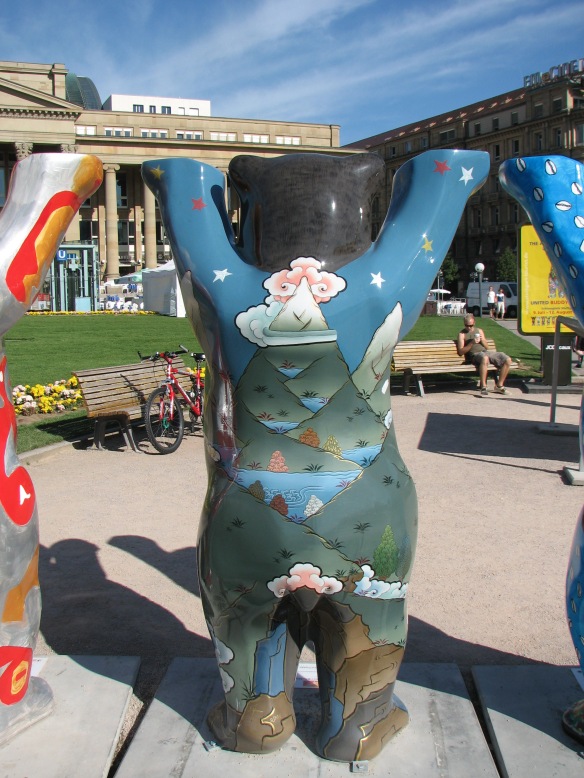
Eva Herlitz was born on July 28, 1952 in Solingen, Germany. She was a teacher and interior decorator, and a visionary. Eva Herlitz and her husband Klaus created the wonderful United Buddy Bears. The couple invited artists from every country in the world to decorate oversized bear statues. The Buddy Bears are placed in circles side by side, in exhibits that tour around the globe and are always free to the public. Donations are raised for UNICEF and other charities for children. According to the Buddy Bears website: “Since 20th June 2001, when the Buddy Bears appeared in Berlin’s streets and squares for the first time, Buddy Bear activities and help for children in need have formed an inseparable unit.” In Eva Herlitz’s honor here I give you the post I wrote after The Buddy Bears came to downtown Stuttgart. – Jadi
Many people feel Berlin is now the cultural heart of Europe. Creative impulses come from Germany’s capital and spread from there. One of the quirkiest is the Buddy Bears.
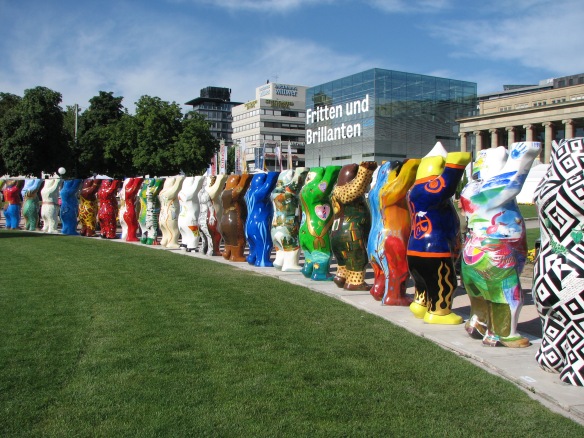
Circle of United Buddy Bears, Stuttgart
The Buddy Bears creators were inspired by the cow parades in New York and Zurich. Eva and Klaus Herlitz of Berlin wanted to initiate a similar street art project. The bear is the icon of Berlin, and thus in 2001, the Herlitzes created the first bear with a sculptor named Roman Strobl.
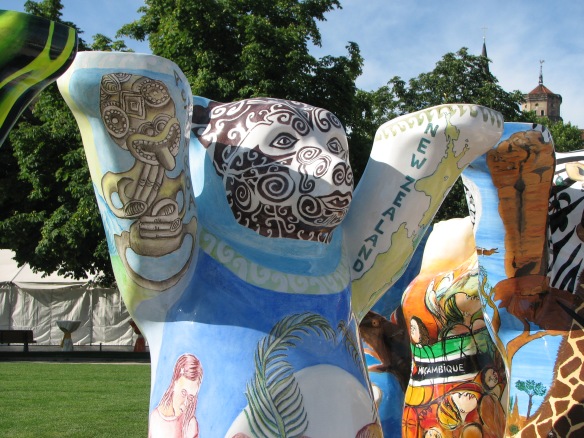
New Zealand
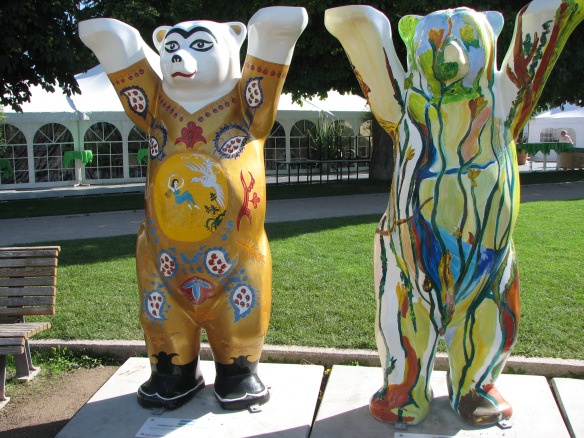
Their projected expanded, and in 2002 it went international. They had a bear created for every country the UN acknowledges, designed by artists native to each country. The bears have their arms raised as if they’re holding hands. (This can also be described as the laughing Buddha pose.) Each bear is painted with images of the culture, history, landscape, economy, art and music of its country.
The first display took place in a circle around Berlin’s Brandenburg Gate. The circle symbolizes the Art of Tolerance. One and a half million people saw the exhibit, and since then, they’ve toured 5 continents and stood in an alphabetical circle in the centers of host cities.
Uzbekistan and UruguayPanama
I saw the Buddy Bears in 2008 when they came to the Schlossplatz in downtown Stuttgart. They send a message about peace, understanding, love and tolerance among the world’s nations, cultures and religions.
When new bears are commissioned, the older ones are auctioned off. All monies go to UNICEF and other childrens’ charities. As of September 2018, 2,300,000 Euros have been raised for charities such as Eva Herlitz’s Buddy Bear Help!
Over 240 artists have been involved in the project, and more than 30 million visitors have seen the United Buddy Bears. A smaller circle of United Buddy Bears-The Minis (1 meter high) also tours.
South and North Korea, side by side
Brazil and Bulgaria
The United Buddy Bears exhibitions are always opened by national and foreign dignitaries. After he saw the bears in Berlin, actor Jackie Chan made sure they came to Hong Kong. When UNICEF Goodwill Ambassador Sir Peter Ustinov saw them, he insisted that Iraq be represented.
There is one very special grey and white polar bear. He has the image of Albert Einstein and the following quote: ‘Peace cannot be kept by force. It can only be achieved by understanding’.
Kirgyzstan, Columbia, Congo and Congo-Brazzaville
It’s fascinating to consider that United Buddy Bears change their order as they travel. The circle is always organized in the language of the host country. Buddy Bears may suddenly hold hands with distant or hostile neighbors…
In memory of Eva Herlitz, 28 July 1952 – 26 February 2021
Selected Bibliography:
Herlitz, Eva & Klaus, United Buddy Bears — Die Kunst der Toleranz. Bostelmann & Siebenhaar Publishers, 2003. ISBN 3-936962-00-6.
Herlitz, Eva & Klaus, United Buddy Bears — World Tour. NeptunArt Publisher, 2006. ISBN 3-85820-189-8.
Herlitz, Eva & Klaus, United Buddy Bears — The Art of Tolerance. 384 pages, English/German, December 2009, ISBN 978-3-00-029417-4.
This post is the fourth in my series on southern Africa’s traditional baskets. This one is from Botswana, and the pattern is titled Running Ostrich. If you’ve ever watched these gangley birds do a thirty yard dash, you know this basket couldn’t be called anything else. Perfectly named!
This basket was made in Botswana. I spotted it hanging on a wall among much brighter-colored baskets. I asked to see it, and was told that the colors are from traditional materials. The main material used to make Botswana baskets is raw fibres of the Mokola or ‘vegetable ivory’ palm tree. Brown dye tones are won from the bark and roots of Motlhakola and Motsentisila trees.
After I bought this basket I looked up the pattern, suspecting that it had to have an interesting name. This pattern is called the Knees of the Tortoise.
My books are Broken In: A Novel in Stories, Tsunami Cowboys, Grounded and The Trail Back Out.
Tsunami Cowboys was longlisted for the 2019 ScreenCraft Cinematic Book Award. Broken In: A Novel in Stories was semifinalist for the international 2020 Hawk Mountain Short Story Collection Award from Hidden River Arts and Finalist for Greece’s 2021 Eyelands Book of the Year Award (Short Stories).
The Trail Back Out was the 2023 San Francisco Book Festival Winner for General Fiction, American Book Fest 2020 Best Book Award Finalist: Fiction Anthologies, Runner-Up for the 2021 Top Shelf Award, 2021 IAN Book of the Year Award Short Story Collection Finalist, and awarded a 2021 Wishing Shelf Red Ribbon. The title story The Trail Back Out was longlisted for the 2021 ScreenCraft Cinematic Short Story Award.
Click here for my author page to learn more about me and purchase my books.




 Today’s fishing basket image is from the Auckland Art Gallery.






 After I bought this basket I looked up the pattern, suspecting that it had to have an interesting name. This pattern is called the Knees of the Tortoise.