Rachel Louise Carson was born on May 27, 1907 in Springdale, Pennsylvania. She was a nature writer, marine biologist, conservationist, and scientist whose 1962 book Silent Spring helped spark the international environmental movement. Silent Spring first brought the world’s attention on the devastation done by synthetic pesticides. The New Yorker and Audubon serialized the book. The big chemical corporations fought her book (of course), including DuPont, Velsicol Chemical Corporation, and American Cyanamid. They claimed she was a fanatic, a Communist (?? because only Communists care about the environment ??), and impugned and called into question her credentials as a scientist. Nonetheless, Carson’s work eventually spurred lawmakers to ban DDT and similar pesticides!
Rachel Carson is one of the scientists whose work led to the creation of the Environmental Protection Agency. [1, 2] Her book plays a big role in the phenomenally successful science fiction trilogy The Three-Body Problem by China’s author Liu Cixin. It’s been a best-selling book in translation and was made into a series both in China and on Netflex. [3]
In acknowledgment of her work I am honored to reprint part of the post I wrote after visiting the intact world of Borneo’s protected frog populations. – Jadi
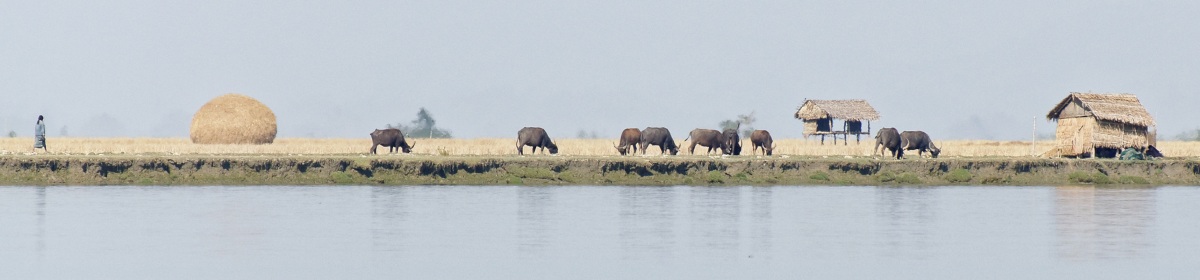
Ah, Kubah National Park on Borneo…. froggie paradise. The park is also home to other species. We met these guys.


And these. They were the size of my out-stretched hand!


When we planned what to do and see on Borneo, I made only one request. Okay, I admit: it was a demand. I wanted, no, I needed to go on the night tour to see endemic frogs.


Our tour guide picked us up in front of the hotel and drove us out to Kubah National Park, where the park ranger met us. The four of us headed up into the park in the deepening darkness. And I do mean up: we climbed to 1,ooo feet to reach the part of the park where the most frogs hang out. The road was lit only by the beams of our torches and the flashes of fire flies.
Fire flies! I haven’t seen them since my childhood in New England, back when their on-and-off glow was an atmospheric element of every summer evening….
It was glorious.


 It was also very, very funny, at times like being in a Monty Python sketch. Overcast, humid as hell and still hot as hell, even in the middle of the night. I dripped sweat and my glasses kept fogging up. Pitch black darkness, except for our flashlights…. which the two guides and I were shining on the frogs so that Uwe could capture them in photos. He didn’t want to use the camera flash, not wanting to startle the wild life and because light from a camera flash is too artificial. So I took his flashlight and held a torch in each hand, aiming them as directed. It was as though he were a mad director with a camera crew. It didn’t bother the critters one bit – they went on singing, and croaking, and hanging out on bole branch and vine…


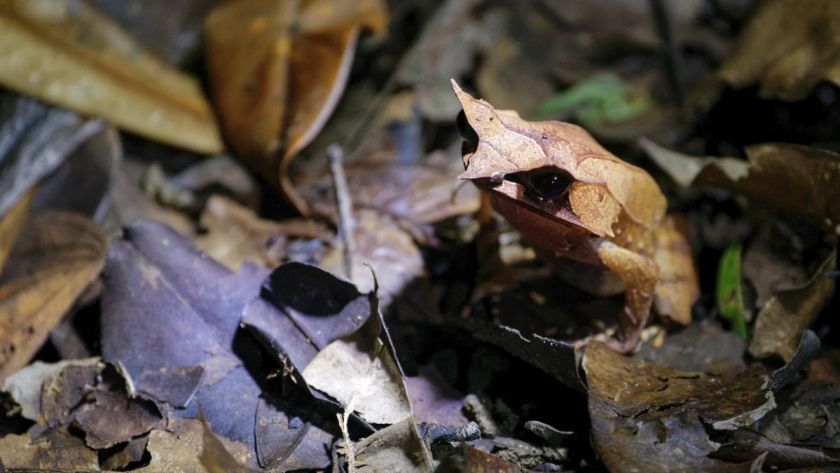
A highlight in a night of a parade of wonders was the long-nosed horned frog. O.M.G. If folks on safari speak of the ‘Big Five’, froggers go into raptures about this guy:


He lives in the leaf litter on the jungle floor, and remained motionless even as the park ranger cleared away the leaf detritus around him so that we could see him better. The horned frog, mahogany frog, and narrow-mouthed frog found in the pitcher plant are the rarest of the rare, the ‘Big Three’ of Kubah Park’s frog world. I clearly saw the first two, and saw the third jump from a distance.
Natural world geek heaven.

 In memory of Rachel Carson, 27 May 1907 – 14 April 1964
NOTES: [1, 2] President Jimmy Carter awarded Rachel Carson the Presidential Medal of Freedom after her death. Go to my post Today’s Birthday: The Enivornmental Protection Act to learn more about the importance of this legislation. Go to my post Jean-Jacques Rabin + The Trogon for more about The Audubon Society. [3] I’ve read one of the books. Dense and absorbing. The Netflix series is superb!
Many of these frog species can be found only on Borneo. Go to this link to hear what serenaded us in the jungle: Most beautiful sound. Microhyla borneensis. The jungle was not silent! © Jadi Campbell 2024. Previously published as Borneo is Frog Paradise: Part Two. All photos © Uwe Hartmann. To see more of Uwe’s pics from Borneo and our trips go to viewpics.de.
Click here for my author page to learn more about me and purchase my books.


 March 2019 Journal entry: Just returned from an exhilarating 2 and ½ hours night tour with nature guide and tour guide at Kubah National Park. We saw frogs on trees, leaves, vines, boles, the sides of the road…. Two rare horned frogs! Mahogany frogs! A teeny pitcher plant frog – just one – it jumped away before we could look more closely but I did see the tiny thing leap (the narrow-mouth frog first described in 2010). Three different lizards. White-lipped frogs. Cinnamon frogs. Firebelly toads. Harlequin tree frogs. We had to head up to 1,000 feet up a road in the dark, the ranger with a head light. Unreal how he could spot the frogs. Glorious sounds of running water and night sounds of the jungle all around, my glasses fogging over with the heat and humidity, a large frog pond formed by wild pigs’ rutting. The frogs surprisingly calm, not jumping at our presence, just hanging out in their domain. I was in the moment, totally blissed out, just there, present with each frog we spotted. The guide and ranger and I backlighting each critter with our flashlights so Uwe could photograph it. The deep jungle trees and vegetation and clicks and buzzes and calls of frogs all around us. Nature’s Symphony. Glorious. An Australian recorded just this place and won an international competition for the most beautiful sounds in the world. Borneo’s really promoting sustainable growth, they recognize what they have here. The Malaysian part of Borneo, that is. I feel hopeful about a corner of the planet for the first time in a very, very, very long and sad time. Man, I like Borneo.


 Ah, Kubah National Park on Borneo…. froggie paradise. The park is also home to other species. We met these guys.


 It was also very, very funny, at times like being in a Monty Python sketch. Overcast, humid as hell and still hot as hell, even in the middle of the night. I dripped sweat and my glasses kept fogging up. Pitch black darkness, except for our flashlights…. which the two guides and I were shining on the frogs so that Uwe could capture them in photos. He didn’t want to use the camera flash, not wanting to startle the wild life and because light from a camera flash is too artificial. So I took his flashlight and held a torch in each hand, aiming them as directed. It was as though he were a mad director with a camera crew. It didn’t bother the critters one bit – they went on singing, and croaking, and hanging out on bole branch and vine…

 NOTES: Many of these species can be found only on Borneo. If you missed it in Part One, go to this link to hear what serenaded us in the jungle:


